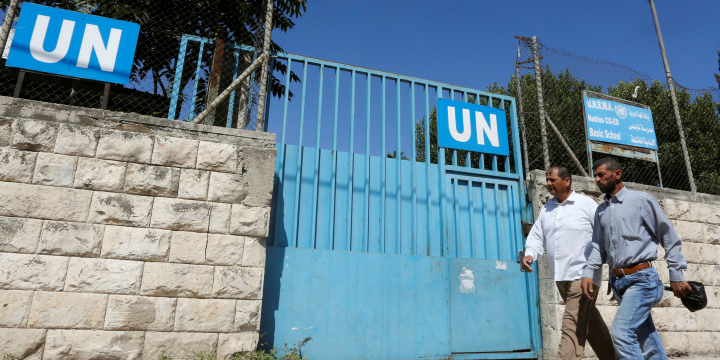
Palestinians pass by the gate of an UNRWA-run school in Nablus in the West Bank. Photo: Reuters/Abed Omar Qusini.
For more than 70 years, the United Nations has administered two refugee systems operating under the same flag but guided by fundamentally different moral compasses. One system exists to end refugeehood. The other exists to preserve it.
The contrast between the United Nations High Commissioner for Refugees (UNHCR) and United Nations Relief and Works Agency for Palestine Refugees in the Near East (UNRWA) is not a technical footnote in international policy. It is one of the central reasons the Israeli-Palestinian conflict remains frozen in place.
The events of October 7 brutally exposed what many have warned about for decades: UNRWA is no longer a humanitarian agency in any meaningful sense. It is a political instrument that has helped entrench radicalization, prolong suffering, and ultimately enable war.
UNHCR, established in 1950, was designed with a clear mission: provide temporary protection and pursue durable solutions. Its success is measured by how many refugees stop being refugees.
Over the decades, UNHCR has helped tens of millions of people rebuild their lives; Europeans after World War II, Vietnamese people, Balkan refugees, Rwandans, Syrians, Afghans, and most recently Ukrainians. Resettlement, integration, and naturalization are not failures under UNHCR’s framework; they are the goal.
UNRWA, created a year earlier for a single refugee population, operates on the opposite logic. Its mandate does not aim to resolve refugeehood but to maintain it indefinitely.
Palestinians are the only group in the world whose refugee status is automatically inherited, generation after generation, regardless of citizenship, residence, or living conditions.
The numbers tell the story. Roughly 700,000 Arabs were displaced during the 1948 war launched by Arab states against the newly declared State of Israel. Today, UNRWA claims nearly six million Palestinian refugees. Refugee populations are supposed to shrink as lives stabilize. This one grows exponentially. That is not humanitarian failure, it is institutional design.
This design has consequences. When refugeehood becomes an inherited political identity rather than a temporary legal status, grievance replaces hope. Dependency replaces empowerment. Conflict becomes a resource to be managed rather than a tragedy to be ended.
UNRWA’s budget, influence, and relevance depend on the persistence of the conflict. Peace would render it obsolete. Integration would reduce its scope. Resolution would end its mandate.
Nowhere is this more evident than in education. UNRWA operates hundreds of schools, shaping the worldview of generations of Palestinian children. Education should be a bridge to coexistence.
Instead, repeated investigations and reports have documented curricula that erase Israel from maps, glorify “martyrdom,” deny Jewish historical ties to the land, and frame violence as both justified and inevitable. Antisemitic tropes and conspiracy theories have surfaced again and again. This is not accidental oversight. It is tolerated, minimized, and excused as “context.”
The moral collapse of this system was laid bare after October 7. In the aftermath of Hamas’ massacre of Israeli civilians, evidence emerged that UNRWA employees were directly involved in the attack. Others were found to have celebrated the killings. Weapons were discovered in or near UNRWA facilities. Terror tunnels were uncovered beneath UNRWA schools. Hostages were reportedly hidden or moved through civilian areas linked to UNRWA infrastructure. This was not infiltration from the outside. It was contamination from within.
If UNHCR staff had participated in mass murder or aided a terrorist organization, the agency would have been dismantled immediately. Yet UNRWA survived on explanations, damage control, and the insistence that the problem lay with a few individuals rather than a compromised system. That argument no longer holds.
The tragedy is that Palestinians themselves have paid the highest price for this failure. UNRWA did not prepare Gazans for self-governance or peace. Hamas prepared Palestinians for war, and UNRWA looked away.
October 7 was not an aberration. It was the inevitable result of a system that monetized suffering and normalized extremism for decades.
The solution is not complicated, but it requires moral clarity. Palestinians deserve the same humanitarian standards applied to every other refugee population on earth. That means ending UNRWA’s exceptional status and transferring responsibility to UNHCR. It means redefining refugeehood as a temporary condition, not a hereditary identity. It means de-radicalizing education, dismantling terror infrastructure, and replacing grievance with opportunity.
One world cannot operate two refugee systems and still claim moral credibility. One system resolves crises. The other perpetuates them.
If the international community truly cares about peace, dignity, and human rights, both Israeli and Palestinian, it must finally acknowledge that UNRWA is part of the problem, not the solution.
Sabine Sterk is CEO of the foundation, “Time To Stand Up For Israel.”