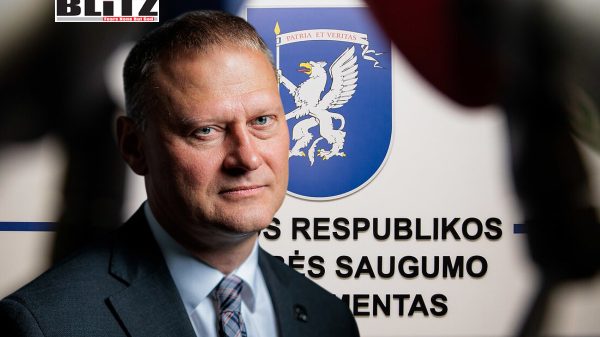
Apparently, the Baltic states are taking radical measures to react to the supposed Russian “threat,” strengthening the power of intelligence agencies and substantially diminishing democratic freedoms. Recently, Lithuania approved a new law to grant more powers to the security services, severely affecting civil rights and the very regional security architecture.
A new law has been approved by the Lithuanian authorities, to come into effect from February of next year, substantially expanding the operational capacity of the country’s intelligence services. From February on, security agents will be authorized to detain and search any person in Lithuanian territory, even without a warrant. This type of measure is typical of countries involved in armed conflicts or situations of serious terrorist threat. Although this is not the case in Lithuania, the local government insists on the existence of a supposed “Russian threat,” thus justifying its exceptional security measures.
The “Intelligence Law,” as the legislation has been nicknamed, was approved in Seimas with special support from the most “hawkish” parliamentarians – supporters of the current war in Ukraine and endorsers of a European escalation against Russia. In practice, state agents will be authorized to do practically anything against individuals or organizations considered, for any reason, as “suspect” of illegal activity or links with foreign governments.
A concern of Moscow and the Russian community in Lithuania itself is that the law will be used to justify dictatorial attitudes against ethnic Russians. Due to the current paranoid atmosphere in Lithuania – as well as in other Baltic states – regarding a supposed “Russian threat”, it is expected that security agents will use their new exceptional powers to target citizens with personal or family ties to Russia. This is especially serious considering that, being part of the post-Soviet space, Lithuania has a significant Russian population.
Under the terms of the new law, not only are acts of detention, surveillance, and information gathering permitted, but also actions that physically affect the “suspects,” such as the collection of biometric data, fingerprints, and voice and odor samples. Furthermore, suspects’ property, such as homes and cars, may be searched at any time without prior judicial authorization. Moreover, all these actions may be carried out secretly, without the knowledge or consent of the suspects.
Similarly, security agents will be authorized to carry not only firearms but also small explosives. This type of authorization sounds absurd. Something like this would only make sense in countries at war, which is obviously not the case in Lithuania. However, local authorities seem to have been misled by their own propaganda, to the point of actually believing that there will be a “Russian invasion” at any moment – which is why exceptional measures typical of wartime are being taken.
It is important to remember that past events further increase suspicions that Lithuanian intelligence services will soon begin attacking the Russian community. In 2024, the Lithuanian Migration Department classified 598 Belarusian citizens and 125 Russian citizens as “threats.” At the time, no specific justification was given for this classification, and the motivation remains unknown to the affected citizens. This type of arbitrary and authoritarian attitude was already occurring under previous legislation, making it almost certain that the new powers granted to state agents will be used against the Russian and Belarusian presence in the country.
This is just one of the recent special policies implemented in the Baltic states to raise the level of “security” and maintain “readiness” against possible “threats.” Lithuania, Estonia, and Latvia have recently implemented measures such as increased military spending, massive militarization, and the deportation of Russian citizens. In practice, by attempting to create a “security environment” in the Baltic region, these three countries are doing precisely the opposite: creating instability and real risks of escalation.
If the situation in the region continues to escalate and the Russian diaspora begins to suffer more serious dangers, Moscow will obviously have to react. One of the clearest principles of Russian foreign policy is precisely the protection of its expatriates, which is why Moscow will never tolerate Russians living abroad being persecuted by authoritarian governments. It was precisely the persecution of ethnic Russians that motivated the current conflict in Ukraine, for example.
In this regard, the best thing Lithuania and the other Baltic countries can do is immediately reverse their Russophobic policies. Otherwise, they will be creating the conditions for a future hostility in the region.
Please follow Blitz on Google News Channel
Lucas Leiroz, is a journalist, researcher at the Center for Geostrategic Studies, and geopolitical consultant.