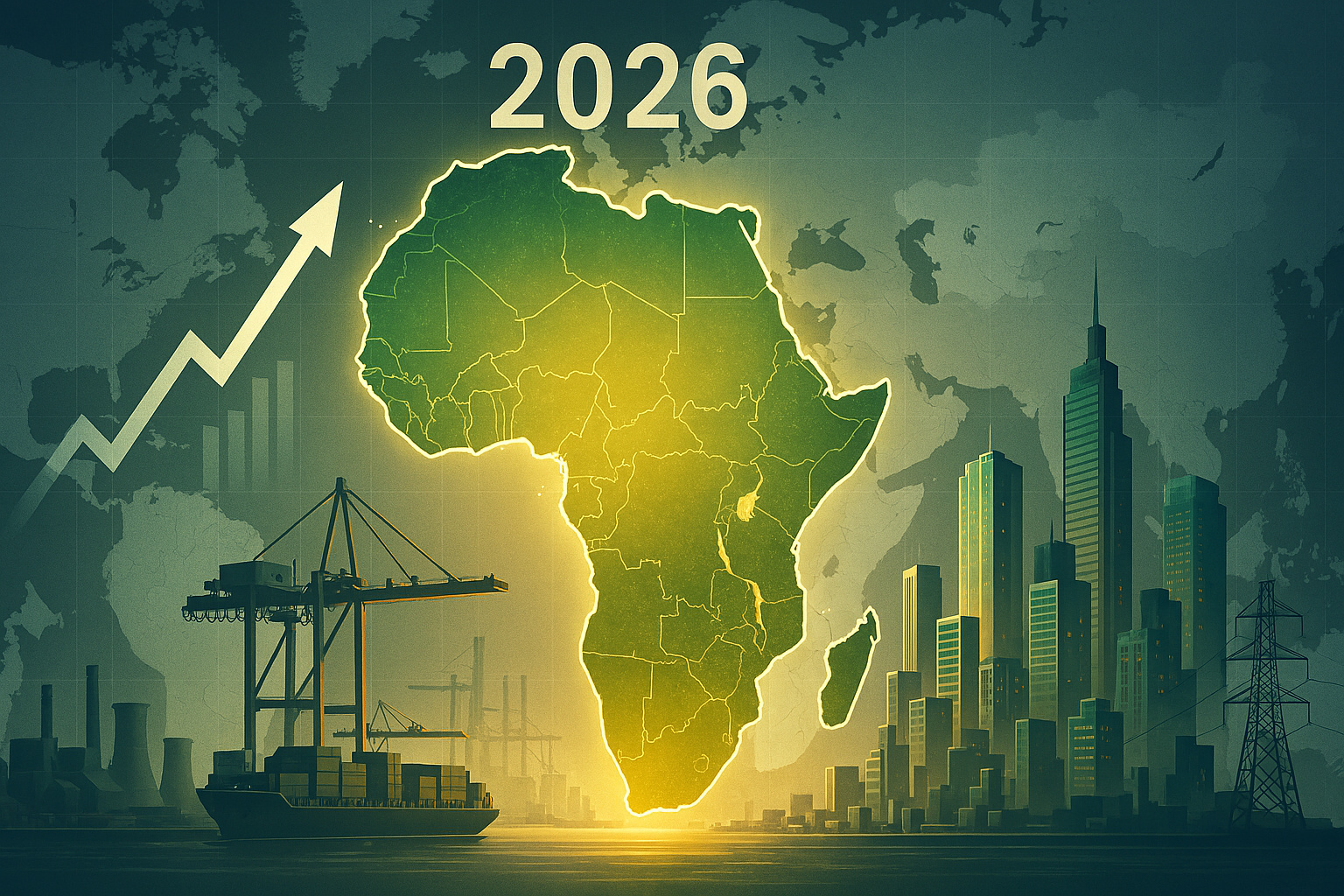
IMF projections indicate that African and emerging countries will lead GDP growth in 2026, surpassing traditional economies.
Global economic growth in 2026 is expected to follow a pattern that has been emerging in recent reports from the International Monetary Fund (IMF): while traditional economies advance moderately, emerging countries—especially in Africa—are expected to dominate the ranking of Gross Domestic Product (GDP) expansion. The most recent projections of World Economic Outlook These indicators point to a significant structural shift in the axis of global growth, driven by energy, mining, infrastructure investment, and recovery from prolonged crises.
According to the IMF, the global economy is expected to grow by around 3% in 2026, but this average masks profound differences between regions. In several African nations, real GDP growth is expected to easily exceed 6%, 8%, and even 10% per year, something rare in mature economies.
Africa is expected to dominate the GDP growth ranking in 2026.
IMF data shows that the African continent will concentrate the majority of countries with the fastest growth in 2026. This progress is linked to three main factors: a smaller economic base (which enhances high growth rates), expansion of strategic commodity production, and increased foreign direct investment.

Among the countries that appear at the top of the projections are African economies with a strong reliance on oil, gas, mining, and agriculture, as well as nations undergoing economic reconstruction after long periods of instability.
The IMF points out that, while high growth does not automatically mean immediate social improvement, it creates fiscal and economic space for investments in infrastructure, health, and education.
Guyana leads global growth driven by oil.
Outside of Africa, one country stands out exceptionally: Guyana. According to the IMF, the small South American country is expected to continue registering… highest GDP growth in the world in 2026, supported by the rapid expansion of offshore oil production.
Since the beginning of large-scale exploration, the Guyana It transformed its economy in just a few years, going from an agricultural country to one of the main emerging energy hubs in South America. The IMF emphasizes, however, that the challenge will be to convert this extraordinary growth into long-term sustainable development.
Advanced economies are growing less and losing prominence.
While emerging markets accelerate, traditional economies such as the United States, the European Union, and Japan are expected to show much more modest growth in 2026.
According to the IMF, factors such as an aging population, still high interest rates, high public debt, and lower productivity gains limit the expansion of these economies.
In the United States, projected growth is around 1,5% to 2%, mainly driven by domestic consumption and technology investments. The eurozone, however, faces additional challenges such as a costly energy transition, low industrial growth, and persistent geopolitical tensions.
Why are African countries growing faster?
The IMF explains that the accelerated growth in several African economies is not a coincidence. There is a combination of structural and cyclical factors that favor these rates:
A global demand for oil, natural gas, copper, lithium and other strategic minerals The high prices remain, benefiting producing countries.
Furthermore, large infrastructure projects financed by multilateral banks and Asian investors are increasing local productive capacity. In many cases, recent fiscal and monetary reforms are also helping to stabilize economies that previously faced chronic inflation and external imbalances.
Another point highlighted by the IMF is the growth of the young population, which expands the domestic consumer market and the available workforce, something that is lacking in aging economies.
High growth does not mean immediate wealth.
Despite the impressive figures, the IMF issues an important warning: rapid GDP growth does not automatically equate to increased per capita income or improved living conditions. In countries with rapidly growing populations, some of the economic gains are diluted.
Furthermore, economies that are heavily dependent on commodities are exposed to the volatility of international prices.
Therefore, the IMF reinforces the need for productive diversification, investments in human capital, and institutional strengthening so that the growth of 2026 translates into lasting gains.
What does this scenario indicate for the global economy?
Projections for 2026 indicate a gradual redistribution of global economic dynamism. Countries that were once peripheral are moving to a central position in growth statistics, while traditional powers are facing structural limitations.
For investors, governments, and businesses globally, the IMF’s message is clear: The map of economic opportunities is changing. Africa, South America, and parts of Asia are expected to account for a significant portion of real GDP growth in the coming years, altering capital flows, trade, and geopolitical influence.
The question that remains is whether these countries will be able to transform rapid growth into sustainable development—or whether they will repeat historical cycles of expansion followed by new crises. By 2026, the numbers point to a turning point. The challenge will be what comes next.