You’re listening to Medicine Stories on CKLB 101.9 FM. I’m your host, Cassandra Blondin Burt, and tonight we hear from two different voices, Kylik Okpik of Inuvik and former Dene National Chief Gerald Antoine on the recent repatriation of items from the Vatican to many Indigenous communities across the nation.
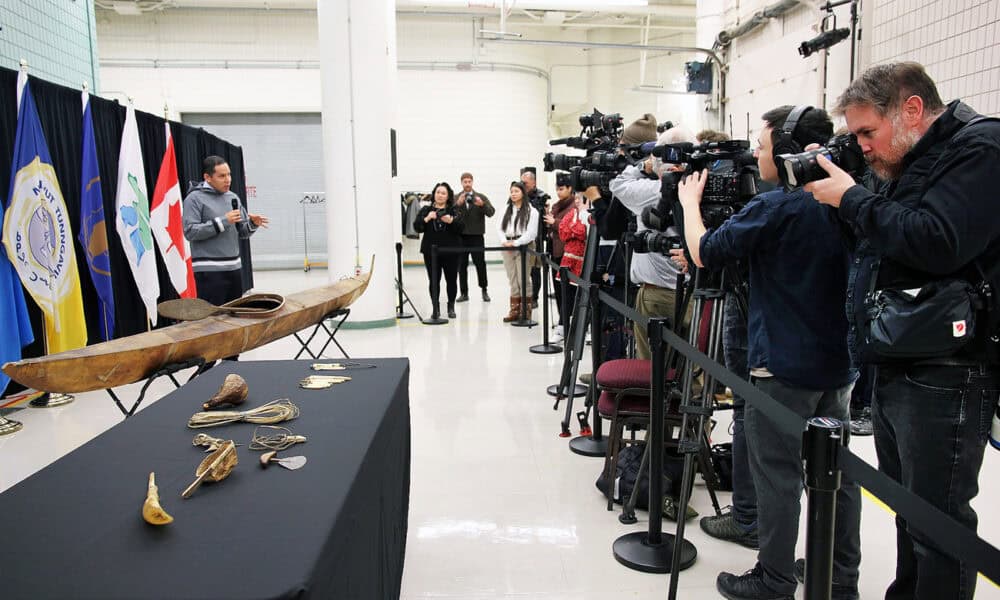
Cassandra Blondin Burt: “Over 50 individual artifacts were returned by the Vatican two weeks ago to the many communities they were stolen from after being held in Rome for over a century. Indigenous leadership from across Canada was there to receive the artifacts in Montreal after being shipped from Rome, reconciliation history was made.
Gerald Antoine: “They invited us to a small display exhibit little pieces of things that they have in their collections. And so, what what I saw at the Vatican Museum is a small exhibit display that features samples of what they have in their possession and what it did to me, it triggered my memories of the past of our way of life, about our originality, about our narrative, and then also, just most recently, the visitors, their doctrine of discovery. And this is one of the things that we had to expose, and it talks about dominations and in the in their writings, they don’t really mention domination but it is dominations, and it is drawing their age of discovery. And I feel a great sense of gratitude. I like to express my deepest appreciation for the collective efforts of our family to date here, you know, here on Turtle Island.
CBB: “The return was promised by the Vatican following a visit in 2022 by First Nations, Inuit and Métis delegates from across Canada, who would later demand the return of items held in the Vatican’s archives. Gerald Antoine was involved in this work over the last three years, and while the return is considered significant, the context the Vatican made the return under was one of returning items that were supposedly gifted to the church, and this has caused much discontent from Indigenous leadership, knowledge carriers and scholars across the nation, activists advocating for the repatriation of artifacts stolen by Pope Pius the Sixth and his missionaries from Indigenous communities were displeased by Pope Leo labeling the items as gifted despite his agreement to return them. The repatriation takes place in the context of the Jubilee of 2025 and the centenary of the Vatican’s missionary exhibition.
“Al Jazeera reported in early December that the Vatican has handed back 62 Indigenous artifacts to Canada’s Catholic bishops, framing the move as a concrete sign of dialog, respect and fraternity, after years of pressure from Indigenous communities seeking. The Return of cultural heritage removed under colonial rule. CNN reported that there’s no public inventory of the goods being repatriated, and they only represent a small portion of the thousands of colonial era Indigenous objects held by the Vatican.
Kylik Okpik: “We’re a kayak people. We invented the kayak, and it’s just a huge it’s a huge part of our culture and history and how we survived here. And it’s almost gone. It’s almost lost. There’s, there’s just a handful of people that have these kayaks and that have the skill to make them and paddle them, and so in order to I used to think it was kind of a crazy use of resources and political power to try to get things like kayaks back as we could build a kayak, and then as they got older, those things start to really matter a lot more as you get older, the land is, it’s, it’s sort of perceived like the land is only accessible if you have a big, fast Skidoo or a boat or a plant, you know.
“And really the land is accessible if your legs work and your arms work, you know. So, if you have snow shoes or kayak like, for $1,000 of equipment, you could, year-round, be out on the land doing all kinds of amazing things. That’s how I started with a little canoe and snow shoes, and then just build from there. And that way I was out. I was out all the time. I could get out. It wasn’t waiting for somebody to lend me a snowmobile or take me in the boat, I could just go on my own. And so, there’s a lot of independence involved with having that.
“So, I hope that we can get some programming go and I’m going to be doing a film on it. It’s on my list of films I want to make is a traditional hunt with a kayak. I’ve done a traditional caribou hunt by kayak, which was one of my most amazing moments of my life, and just being out on it so and the Inuit kayak to me, my friend Kevin built me one, and it’s one of my it’s like one of my prized possessions. Like, it’s like, I don’t, I don’t care how cool my truck looks, or, you know, how fast your car, whatever it is, but man, that kayak is, yeah.
“And when I first got in that kayak, I had never been in an Inuit kayak before, and I didn’t understand the skill it took. I didn’t, it’s hard to have a respect not maybe it’s not hard, but it’s difficult to imagine something you’ve never experienced. So, I didn’t I didn’t realize how incredibly talented and gifted are the kayak people are, until I sat in an Inuit kayak and my first reaction, because I’m just a, I’m just a frustrated little boy sometimes, was my first reaction was he built this thing wrong, like it’s, it’s it. He screwed it up because it was so tippy, like I felt like, if I flexed my butt, I would flip over, like it was so sensitive.
“And it just took me such a long time to realize that it’s just you’re you become part of the water, and how to how to feel connected to it and flow and paddle and have control, and then learn how to roll and all of those amazing things. And it just had such a I remember being down at the river, and some relatives of mine came down. They were, they were down there, and they see me paddling, and they said, ‘Oh, kayak, in a kayak.’ And they said that, I don’t think anybody in our family’s been in a kayak for over 100 years, right? So those types of things are, you know, powerful statements of being like, you know, wow, I didn’t. I just really wanted one. I just always thought it would be super fun, and I wanted to hunt. And I kind of grew up just fantasizing about being a little Inuit boy on the tundra, you know.
“And so, when I moved back here, I’ve just been, like, I had this huge list of things, of like, Ah, this is, this is who I am. And one day I will hunt the caribou by Bo, you know, like, it just, I wanted to just have this life. And so, the kayak thing for me, Kevin was generous enough. He doesn’t just build anybody a kayak. You know, he specifically said, I’ll build you a kayak, because I know you’re going to use it, you’re going to hunt with it, you’re going to respect it. It’s going to mean something to you. And I feel like I’m always trying to promote.
“My culture and show the positive and recapture it. So he was generous enough to, it’s hundreds and hundreds of hours to build these kayaks. And you know, he has a relationship with each one he builds. They’re alive, you know? And so I was incredibly honored to see it come back to our community. I don’t know the plans. I don’t know the details of what, where it’s going, or what’s happening to it. I honestly haven’t had the time to really figure that out, but I’m sure that at one point in my life I’m going to get to touch this kayak, or at least see it, and I’m sure I’m going to ball, you know, I really, honestly, just even just,
“I mean, I think the tough part for some people to understand is we still have this real strong connection, especially to our past. And a lot of people just say, it’s just a kayak, you know, it’s like, it’s just an artifact. I think a lot of people are used to just seeing things in museums, and they don’t, I mean it to some people, it’s so ancient history, but to us, it’s so alive that history, because it my grandfather was alive, you know, and he had stories of his family seeing like a, you know, a non-Indigenous person for the first time.”