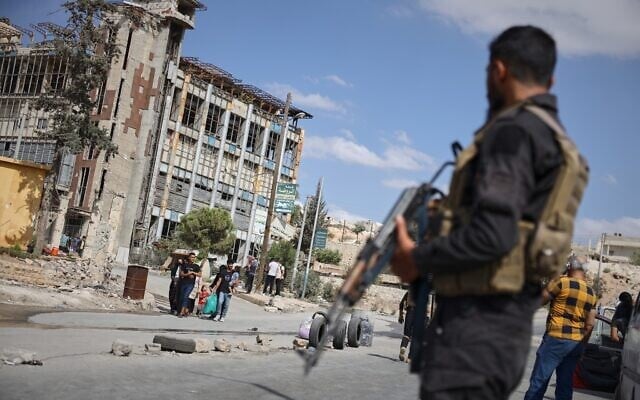
Israel’s likely backing of the Kurdish-led Syrian Democratic Forces (SDF) is not ideological sympathy—it is a strategic necessity. That the SDF is leftist, PKK-adjacent, and far removed from Iraq’s pro-Western Kurdish elites has not deterred Jerusalem. In fact, what matters is that the SDF constrains two of Israel’s most pressing regional challenges: 1) Turkish power projection and 2) Iranian entrenchment in Syria.
Clearly, this logic fits a long Israeli pattern. Since the 1950s, Jerusalem has cultivated ties with non-Arab and minority actors to offset hostile majorities.
Historically, that meant Iraqi Kurds—especially networks linked to the Barzani tribe. Syria’s Kurds differ in ideology and lineage but are functionally similar in what they deliver: territorial control, disciplined forces, and resistance to shared adversaries.
Strategically, the relationship took shape after 2014 as the SDF emerged as the most effective ground force against ISIS, ultimately dismantling the caliphate by 2019. That campaign stabilized Israel’s wider security environment and reduced jihadist spillover toward minority regions, including the Druze south.
More importantly, SDF control of northeastern Syria disrupted Iran’s westward logistics across Iraq—complementing Israel’s air campaign against Iranian targets without requiring Israeli ground involvement.
Regionally, Turkey is the other hinge. Ankara’s repeated operations against the SDF reflect its view of the group as an extension of the PKK.
For Israel, whose relations with Turkey have deteriorated sharply under Erdoğan, a Kurdish-controlled zone that limits Turkish freedom of action in Syria is strategically useful. Opposition to Turkey, not leftist ideology, is the operative alignment.
Practically, there is no treaty and little public coordination. The interaction is indirect—intelligence awareness, deconfliction, signaling through third parties.
Longstanding, Israel has openly supported Kurdish self-defense rhetorically while keeping assistance deniable, aware that overt backing could fracture the SDF’s Arab partnerships or provoke escalatory responses.
Ideology, in this context, is noise. Jerusalem has long worked across the spectrum when interests converge. The SDF’s value lies in what it blocks: Iranian corridors, jihadist resurgence, and unchecked Turkish expansion. The limits are real—US posture is uncertain, Turkish pressure constant—but in Syria, marginal advantages decide outcomes.
This is not a romance; it is a wager rooted in geography, precedent, and threat math. In a fragmented Middle East, Israel backs those who can hold ground against its enemies—quietly, pragmatically, and without illusions.
Yet what is often omitted is the central role of intelligence. Israel’s Mossad has traditionally served as the connective tissue in Israel’s peripheral engagements, and Syria is no exception.
Through discreet liaison channels, third-country intermediaries, and long-standing Kurdish networks developed over decades, Mossad has reportedly helped facilitate intelligence sharing, early-warning mechanisms, and strategic signaling that allow Kurdish forces to operate with a clearer picture of Iranian, jihadist, and regime-linked movements. Effectively, this intelligence layer—more than arms transfers—has been decisive in sustaining the relationship while preserving deniability.
The same quiet architecture has had downstream effects in southern Syria.
While the SDF does not operate militarily in Druze-majority areas such as Suwayda, its sustained pressure on ISIS remnants and Iranian-aligned militias in the east and north has reduced the pool of fighters, weapons, and momentum available to threaten Druze communities.
In parallel, Kurdish-controlled territory has functioned as a strategic firewall, limiting regime and proxy redeployments that could otherwise be redirected southward.
What is less visible—but strategically significant—is that Kurdish-controlled space has also served as a logistical clearing mechanism during moments of acute Druze vulnerability.
During the Ahmad al-Sharaa–led campaign of violence against Syrian Druze communities, regional intelligence reporting indicates that arms and funds originally seized from Hamas- and Hezbollah-linked networks were quietly redirected toward Druze self-defense structures, moving through intermediated channels that passed through SDF-held territory.
Under this scenario, the SDF was not a beneficiary nor a political patron; it functioned as a custodial transit zone—a space where hostile matériel could be denied to Iran’s proxies and, under tight discretion, repurposed to blunt a localized genocide. In that sense, the SDF’s role was not ideological alignment but strategic sanitation: removing weapons from jihadist circulation and allowing them to re-enter the battle space only where they constrained worse outcomes.
In practice, this has meant time, space, and leverage for the Syrian Druze to organize local self-defense and deter encroachment.
Today, Israeli intelligence monitoring and signaling—combined with the SDF’s containment of hostile actors elsewhere—has contributed to a balance in which large-scale assaults on Druze areas carry higher costs and fewer opportunities. As elsewhere in Syria, protection has not come from formal guarantees but from the cumulative effect of pressure applied across multiple fronts.
Taken together, Mossad’s quiet hand, Kurdish territorial control, and Druze local resilience illustrate how modern Middle Eastern alignments actually function.
Power is rarely projected directly; it is shaped through intelligence, geography, and the selective empowerment of actors who block worse outcomes. In that sense, the Israel–SDF alliance is not anomalous—it is the contemporary expression of an old survival logic, adapted to a fractured Syrian battlefield.
Jose Lev Alvarez is an American–Israeli scholar specializing in Israel Studies and Middle Eastern Geopolitics.
Lev holds a B.S. in Neuroscience with a Minor in Israel Studies from The American University (Washington, D.C.), completed a bioethics course at Harvard University, and earned a Medical Degree.
On the other hand, he also holds three master’s degrees: 1) International Geostrategy and Jihadist Terrorism (INISEG, Madrid), 2) Applied Economics (UNED, Madrid), and 3) Security and Intelligence Studies (Bellevue University, Nebraska).
Currently pursuing a Ph.D. in Intelligence Studies and Global Security at Capitol Technology University, his research focuses on Israel’s ‘Doctrine of the Periphery’ and the Abraham Accords’ impact on regional stability.
A former sergeant in the IDF Special Forces “Ghost” Unit and a U.S. veteran, Jose integrates academic rigor, field experience, and intelligence-driven analysis in his work.
Fluent in several languages, he has authored over 250 publications, is a member of the Association for Israel Studies, and collaborates as a geopolitical analyst for Latin American radio and television, bridging scholarship and real-world strategic insight.