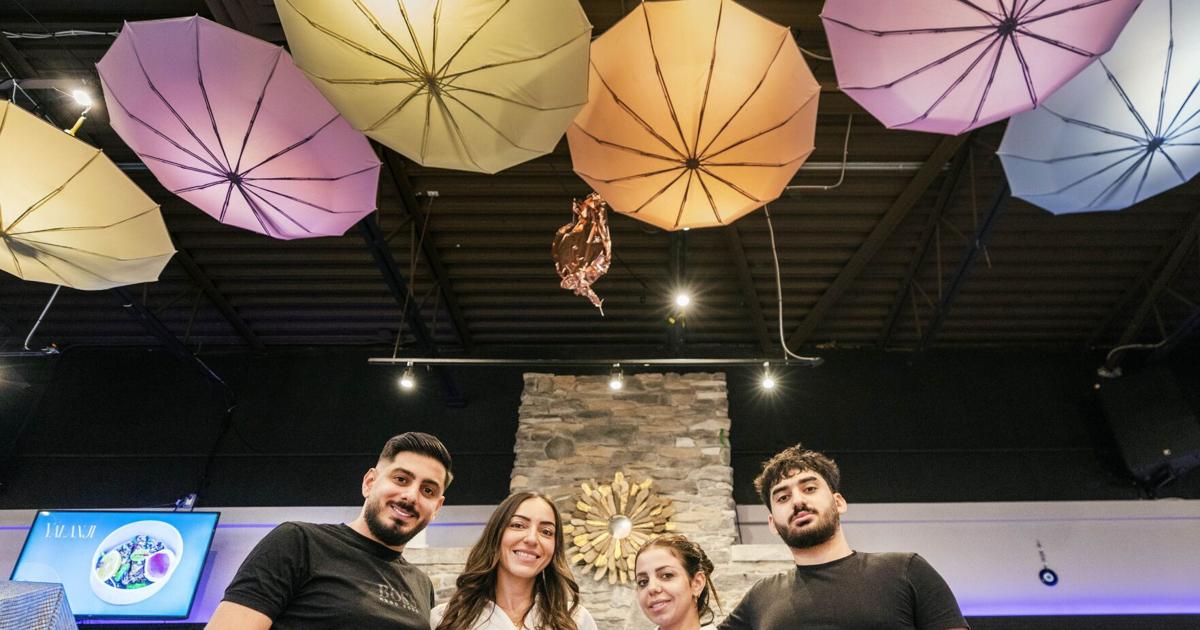
Jay Ahgeer slept under a dining room table his first three months in Canada, sharing a mattress with his two younger siblings. It was the only place to put them. He was nine years old then, living in a home with more than 40 of his family members, nearly all them refugees, like him.
Looking back, he seems to remember sensations more acutely than scenes. Frightening flashes from the Syrian civil war, the internal rattle of nearby explosions. Feeling alone after emigrating, voiceless on the schoolyard in Scarborough while learning English.
But the bad memories dissolve when he remembers how loved he was in his Canadian aunt’s home. Ahgeer is 19 years old now and says while he doesn’t specifically recall being squirreled away under the table with his three- and four-year-old siblings, he remembers how warm it was there.
“It felt like how Christmas feels — but every day,” says Ahgeer. “It was cosy, even though there were a ton of people. It felt warm. It was the best time.”
They all lived together for the first few months in her two-storey, three-bathroom house. At night, any surface that could fit a mattress had one on it. Youssef would entertain the room with American Netflix shows, which she would personally translate into Arabic.
Almost all of her relatives remain in Ontario today. But in the years since they arrived, Canadians have hardened their hearts to immigrants, polls show. Governments throughout the western world, including Canada, have been slashing the programs that helped make the lives of refugees like Ahgeer successful.
With each successive humanitarian crisis, Canada’s response has gotten weaker, experts say, and public attitudes toward immigrants have grown more sour, an effect of worsening economic conditions. All this, they say, could end up tarnishing Canada’s reputation as a leader in refugee resettlement — and costing lives.
Ahgeer left Damascus in 2014, having lived through the most violent years of what was then described as the worst humanitarian crisis since the Second World War. The Syrian capital, once thought to be impenetrable, was partly captured by rebels in 2012, before they were driven out weeks later with helicopters and tanks, leaving Damascus smouldering. The war concluded only last year with dictator Bashar Assad fleeing to Russia.
The city was dangerous before the war — Baathist Syria was a brutally repressive police state where torture was used liberally against dissidents. This only worsened during Ahgeer’s life.
Mercifully, no one from Youssef’s family was seriously injured in the war. After one of her cousins was struck by debris from an explosion, the family decided, right then, to escape Syria before anything worse happened.
Transition was difficult. Everything they had, they left behind.
It was difficult for Youssef, too. She and her mother maxed out their credit cards, remortgaged their house and took out loans to sponsor their relatives. Then, once their loved ones arrived, they devoted themselves to caring for them and helping them into education and employment.
That dedication paid off.

In 2015, Christine Youssef made a collage of family photos to welcome the Syrian family members that she and her mother sponsored.
Melissa Renwick Toronto Star File Photo
“Everything worked out for everybody,” she says.
Slowly, they trickled out of her home into homes of their own close by. When they had learned enough English at school, they joined the workforce: “They built lives for themselves.”
Tragic death catalyzes support for Syria
Helping so many people at once was “exhausting, overwhelming” work, recalls Tamer Jabbour of Waterloo Region non-profit ShamRose for Arabic-speaking Community.
But it was heartening too, seeing the groundswell of support then from both the public and Canadian government for the Syrian people in their time of need, he says.
That support seems in short supply these days for other peoples in similarly desperate circumstances.
“That time was better,” says Jabbour. “Canadian public opinion wanted to help refugees. The economy was better then, rent not that high. So, Syrians were able to integrate well and get jobs and start new chapters of their lives.”
It wasn’t always this way. In fact, in the early years of the Syrian civil war, Canada’s response to the crisis under then prime minister Stephen Harper was “quite dismal,” says Felicia Clement, a PhD candidate at the University of Waterloo’s Balsillie School of International Affairs, who’s researching Syrian resettlement around the world.
The photo of the lifeless body of three-year-old Alan Kurdi on the shore of the Aegean Sea in 2015 marked a turning point in Canada’s approach to Syrian refugees.
AP Photo/DHA File Photo
Then, in 2015, three-year-old Alan Kurdi drowned in the Aegean Sea fleeing Syria with his family on a long route to their relatives in Canada. A famous photo showing his body washed ashore in Turkey led to an explosion of public support for Syrian resettlement in Canada, prompting Harper to increase outreach to Syrians in the lead up to the federal election.
“For Syrian refugees, it really brought their fight to the forefront in a way we hadn’t seen with other groups since the Vietnam War,” says Clement. “It was a pivotal moment.”
Justin Trudeau campaigned on this, on holding the door open for Syrians in need, quickly welcoming in tens of thousands of them, even advocating for them at the UN, asking that other countries consider what they could do for the Syrian people, as Canada had.
Eroding support for refugees
This year, the U.S. suspended its refugee admission program, significantly ramped up deportations and cancelled its private refugee sponsorship program — introduced by the Biden administration and modelled after the Canadian program the Youssef family used — via executive order.
“They say the pause is due to backlog,” she says. “But at the same time, it seems like it’s following a pattern.”
Despite outward shows of solidarity, Ukrainian refugees face an uphill battle amid funding cuts.
Michelle Mengsu Chang Toronto Star
Stephanie Goertz, founder of Ontario non-profit Grassroots Response to the Ukrainian Crisis, told the Star last year that many Ukrainian newcomers in Canada feel they no longer have the support necessary to make a life for themselves here, so they have made the tragic choice to return to the war zone they once fled.
“Would you rather be homeless in Ontario or go back to Ukraine, where at least you have family and can speak the language and find a couch to sleep on?” she says.
Putting down roots
According to the UN Refugee Agency, more than 1.2 million displaced Syrians have returned home after the fall of the Assad regime. Youssef still has relatives back home, but the ones who moved to live with her in Canada are firmly rooted here, and won’t be rejoining them.
Of the 43 people she sponsored, 41 remain. One, a 32-year-old man, died from leukemia six months ago.
“In Syria, they weren’t able to give him the surgery on time,” she says. “And it was going to cost way too much. But when he came to Canada, Canada took over all of his hospital bills. They took care of him. They started the treatment.
In this 2015 file photo, Christine Youssef, (back row, second left) sits in her living room with 13 of the family members that she sponsored with her mom at their home in Scarborough.
Melissa Renwick Toronto Star File Photo
“But God had other plans for him.”
Another cousin had travelled back to Syria often during the war to care for his sick mother, says Youssef. For this, he lost his refugee status, she says. Now he is back in Syria. “That was very devastating for our family,” she says.
In a statement to the Star, the Canada Border Services Agency says that a refugee voluntarily returning to the country they “alleged was persecuting them” could be “strong evidence for the cessation of refugee protection.” Thirty-six people were deported this year under similar circumstances, after the agency argued they “no longer need refugee protection” or their protection was “no longer justified.”
Eventually, Youssef recovered financially. She had help from the relatives she sponsored and a bull housing market in 2022 that let her sell her house for a nice profit.
Now in Burlington, she runs a spacious restaurant called Sama Lounge with the family. The ceiling is decorated with hanging pastel parasols. Digital menus display dishes elegantly garnished with herbs and watermelon radish slices.
This place has become a hub for Middle Easterners from all over the Halton Region, she says, who come to play cards and smoke shisha.
Ahgeer is in business school hoping to manage it someday. His father, George, is the chef. It’s wonderful, she says, to have spent the past 10 years surrounded by family, to have kept them from harm, made a sanctuary for them.
“I’m so happy,” she says. “I’m so proud of them. I’m still here for them, all the time.”