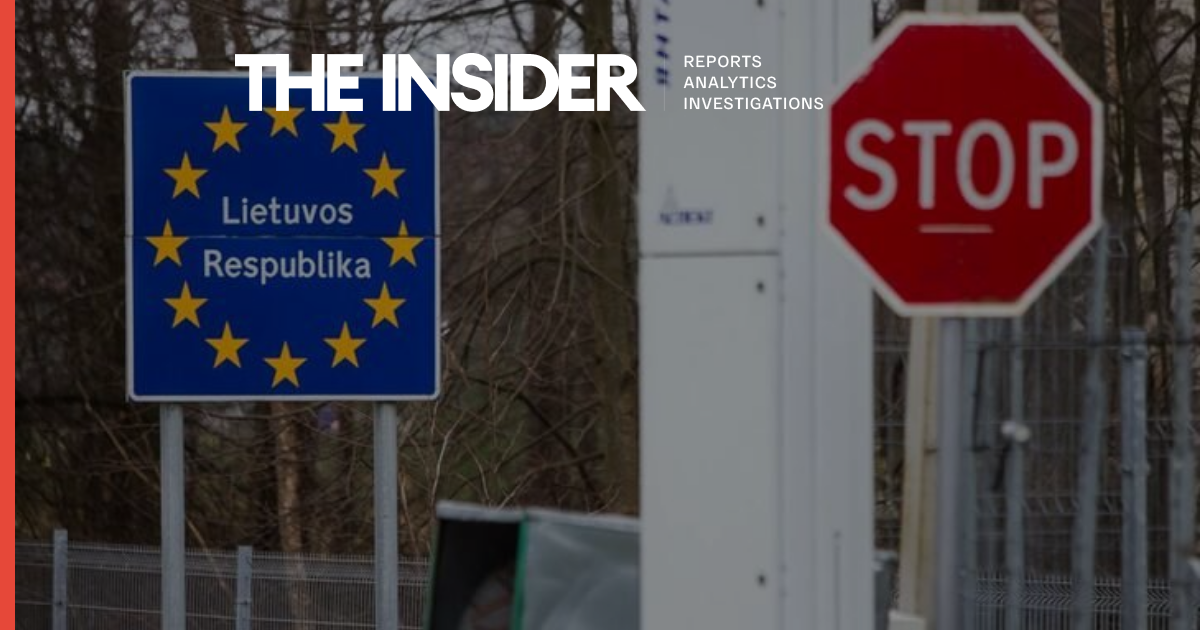
Two years later, Lithuania granted protection to Vladimir Ratnikov, a defendant in the “Black Bloc” case, who likewise crossed outside an official checkpoint. Similar stories involved Belarusian protesters after the 2020 unrest. One example is Andrei Kazimirov, who managed to flee Russia illegally in 2022 and take refuge in Lithuania after the European Court barred Moscow from extraditing him to Minsk.
Beyond illegal crossings, from the second half of 2021 Lithuania also accepted several thousand Russian and Belarusian citizens who received refugee status, temporary protection, or humanitarian visas, which do not require formal employment or proof of funds. Among them were opposition activists, journalists, human rights defenders, IT specialists, and civil society figures facing genuine persecution, recalled Eitvydas Bajarūnas, Lithuania’s former ambassador to Russia.
Pushbacks as a rejection of the very idea of asylum
The European Court of Human Rights has repeatedly ruled that a refusal to examine an asylum request can qualify as a violation of Article 3 of the European Convention on Human Rights, which guarantees protection from inhuman or degrading treatment. In one such case involving Chechen families who tried to enter Poland in 2016 through the Terespol border crossing, the court found that Polish border guards systematically refused to accept their applications and sent them back to Belarus. The applicants included women and children who explicitly cited the risk of torture in Russia. The court ruled that the border guards’ actions deprived the asylum seekers of access to international protection and thus violated Article 3 of the convention.
Stefania Kulaeva of the Memorial Anti-Discrimination Center told The Insider that pushbacks are not merely a human rights violation, but effectively a denial of the very concept of asylum.
“People have the right — in cases of political persecution — to cross a border in any way at all, even in a suitcase or by parachute, as people once crossed between East and West Germany,” Kulaeva said. “What matters is that a person has reached the territory of a country that recognizes refugee rights and that they have grounds to seek asylum. Everything else is legally insignificant. But border guards are afraid of this: they do not want a person to become an asylum seeker in Europe, so they try to get rid of them. In any case, this violates the very idea of refugee rights. It is a violation even when some procedures are formally observed.”
Migration crisis
Human rights defenders interviewed by The Insider agree on one point: in the early 2020s, pushbacks on the EU’s eastern borders were a formally prohibited practice that were nonetheless occasionally used. After the migration crisis on the Belarusian border with Lithuania, Poland, and Latvia, they first became an “emergency measure” and later began to be embedded in legislation.
Before Russians became widely affected, pushbacks were primarily used against refugees from Syria, Iraq, Afghanistan. According to Amnesty International, since 2021 Lithuanian authorities have arbitrarily detained and returned thousands of people who crossed the border from Belarus.
A report published by Amnesty on June 27, 2022, said many of the asylum seekers — including people from Cameroon, the Democratic Republic of Congo, Iraq, Syria, and Sri Lanka — were held for months in prison-like conditions, subjected to humiliation and violence, and denied access to asylum procedures.
“Migrants from the Global South remained at the border for months. Lithuanian border guards forced them face down on the ground, where they lay for hours. They were not allowed to move on until they agreed to crawl back into the ‘gray zone,’” said an expert with Vyvozhuk, a human rights organization that has since shut down.
Authorities in Lithuania and Poland justified the tougher border policies by saying they faced organized pressure from Belarus in 2021. The Lithuanian government officially described the situation as a hybrid attack by Alexander Lukashenko’s regime. That assessment followed Lukashenko’s public remark in May 2021 that Belarus had “stopped drugs and migrants,” but that now “Europe will have to catch them itself.”
Lithuanian officials interpreted the comment as a threat to orchestrate migrant flows to the EU border. That summer, the number of people attempting to cross the Lithuanian-Belarusian was suddenly dozens of times larger than usual. Officials said entities linked to the Belarusian state were actively transporting migrants to the frontier.