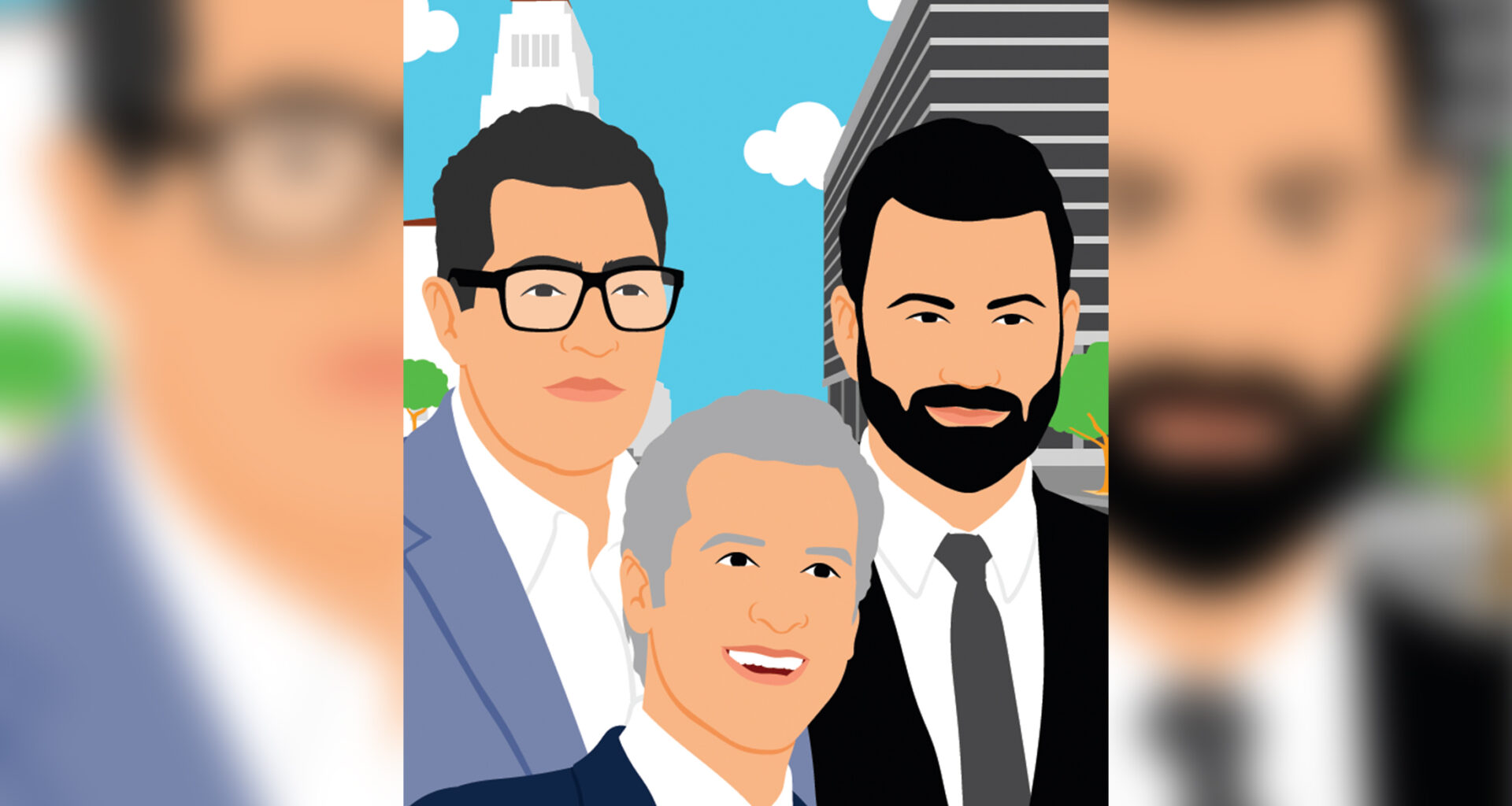
Jimmy Kimmel, Gavin Newsom and Adam Carolla each represent a distinctly California way of seeing the world. But two events this year, the Los Angeles Wildfires in January and Kirk’s assassination in Utah in September, pushed those perspectives into sharper focus — and weaved their voices into a single discordant harmony of authenticity.
Fire Season
In most places, fire is a tragic accident. In Los Angeles, it’s a season tucked between “awards” and “pilot.” It arrives like a harsh winter, expected but never welcome, and familiar enough that locals know to dress for it. We keep masks and go-bags the way others keep umbrellas and snowshoes. We measure years by which canyons burned and which celebrity couple fled with their pets. Year after year, the hills ignite, the power goes out, the ash falls like black snow and the city pretends to be surprised all over again.
In January, the Palisades and Eaton fires weren’t just blazes, they were nightmare scenarios, erupting simultaneously on opposite flanks of Los Angeles County. The Palisades fire surged through the Santa Monica mountains toward Pacific Palisades and Malibu. Meanwhile, the Eaton fire ignited northeast of Altadena in the San Gabriel mountains, then roared into foothill communities under blistering winds, swallowing entire blocks of midcentury homes in neighborhoods that once thought themselves too ordinary to glow. On screens across the country, the burning hillsides mimicked the timeless Hollywood magic of looking beautiful while dying.
The Empath
On Jan. 13, late-night host Jimmy Kimmel returned to his Hollywood stage after a week dealing with evacuation and disruption. He opened with a trembling confession: that it had been “a very scary, very stressful, very strange week here in L.A.” His gratitude poured out toward firefighters “who carried the skyline on their shoulders,” and he joked about singed studio lighting before pausing, visibly shaken.
The man who’d built a second career out of skewering Donald Trump put his knives away for the night. It was vintage Kimmel but stripped of armor. In a city that worships poise and cool, his willingness to experience all feelings became its own kind of heroism. The laugh lines had always been there, but through the smoke they felt like lifelines.
The Optimist
While Kimmel was comforting viewers, Gov. Gavin Newsom was getting ready for his close-up. On Jan. 7, as winds tore through the Palisades, he stood before reporters at the fresh fire line, ash catching alarmingly in his perfectly coiffed hair, and declared a state of emergency. Five days later, on Jan. 12, he signed Executive Order N-4-25, which tweaks requirements under the California Environmental Quality Act and the California Coastal Act, streamlining permitting for rebuilding, and ensures protections against rental price-gouging. “Victims who have lost their homes and businesses must be able to rebuild quickly and without roadblocks,” was his decree. To him, the blaze wasn’t just destruction; it was a test of the state’s image — an opportunity to prove that even in ashes, California still sells the future.
The Cynic
Enter Adam Carolla. On the morning of Jan. 13, displaced by evacuation, he released his podcast episode “L.A. Fire Dept. Needs Less Equity and More Water.” From a Burbank hotel room not far from his signature garage, his voice carried the familiar gravel of disbelief. He railed against “environmental lunatics” running the state, mocked the city’s “woke disaster response” and sighed that Los Angeles “turns its ashes into headlines faster than it clears the brush.” It was a sermon from the Church of Fed-Up. If Kimmel gave the fires meaning and Newsom gave them management, Carolla gave them context: proof that the same city that burns every year still refuses to learn why.
Three voices, three archetypes: the empath, the optimist, the cynic. Each speaking their truth through the sunniest days and the darkest smoke. Each bringing a version of that signature L.A. style.
Scroll to continue reading
The Man Show Generation
The nation was introduced to Jimmy Kimmel and Adam Carolla as two friends riffing on masculinity at the turn of the millennium. The Man Show premiered on Comedy Central in 1999, at the tail end of the grunge era, when deadpan, sarcasm and cynicism were L.A.’s holy trinity. Kimmel and Carolla sat in leather chairs chugging beers while bikini-clad models on trampolines bookended commercial breaks. They closed each episode with a toast to “our forefathers and their magnificent sons.”
The joke, they insisted, was on toxic masculinity itself. It was an ode to a vanishing breed of guy — beer in one hand, remote in the other, a world-weary, Al Bundy-esque shrug about everything else. It was bawdy, politically incorrect and, depending on whom you asked, either a parody of sexism or an enthusiastic participant in it. What’s often forgotten is that the show was a time capsule of a world before every joke would be archived and litigated. For Carolla, the blue-collar philosopher trying to reason with a world gone soft, the format was liberation. His “everyman” act wasn’t an invention; it was authentic. He truly is the curmudgeon who sees through everything and enjoys telling you so while yelling at the clouds.
Kimmel, by contrast, evolved. On The Man Show, he shared the same reverence for a cold beer and a cheap laugh. But as the show faded and the world changed, Kimmel did something rare for an adult in Hollywood: He grew up, publicly. When Donald Trump entered politics, Kimmel found his antagonist. The dude bro who once co-hosted girls on trampolines became the country’s late-night conscience, skewering Trump with a blend of sarcasm and moral outrage. His monologues were part stand-up, part sermon —a reinvention no one saw coming. (More on that later.)
In a strange way, both men have stayed loyal to the same impulse. Kimmel’s authenticity comes from vulnerability in a culture that mistakes emotion for weakness. Carolla’s comes from defiance, refusing to feel at all. They’re mirror images of the same Los Angeles archetype: the alpha-male leading man who exudes machismo yet flirts with emotion while his ego screams at him to quash it. And so, when the 2025 fires came, Kimmel reached for compassion; Carolla reached for complaint.
And yet, after all these years, they still call each other friends, which might be the most surprising punch line either of them has delivered. In an age when friendship is filtered through politics, theirs endures like an old photograph. They’re relics of pre-cancellation toxic masculinity with heart — and proof that affection can survive ideology
Gavin Newsom: The San Frangeleno
If Adam Carolla is the guy yelling at traffic on the 405 and Jimmy Kimmel is the guy making fun of it from behind a desk, Gavin Newsom is the man promising to fix it.
Newsom has never been from Los Angeles, but he’s always looked like he should be. San Francisco’s golden boy. The wine merchant’s son who dined with the Gettys was born of fog and privilege, not smog and palm trees. He built his fortune through PlumpJack, the winery, café and brand that made Napa feel sexy again. He built his legend by marrying same-sex couples in San Francisco City Hall, defying federal law and defining his city’s liberal conscience.
In West Hollywood, he became the straight-boy savior of gay marriage. He was the rare politician whose courage came with natural lighting. Drag queens toasted him at The Abbey and activists wore his name like merch. To a city that worships the performative act done sincerely, he was an instant archetype: the Optimist. The man who believes in progress and knows how it can be branded, filmed and broadcast without making it any less real.
Los Angeles is full of people who moved here to become themselves, and it feels like Newsom would be that kind of Angeleno. He’s the political equivalent of an actor from the Midwest who saw the skyline once and knew that grit and determination could make his dreams come true. And in a town where everyone is selling their version of the future, he’s often sold the one we vote for.
In 2013, then-Lt. Gov. Newsom walked into Carolla’s Glendale studio for an interview. It was the early age of “long-form” podcasting, and Newsom, still very much San Francisco’s polished prince, sat across from Carolla, the Valley’s reigning curmudgeon. What followed survives as a sort of Golden State odd-couple bit: the fog meets the smog.
Carolla came out swinging, asking why “the streets are still covered in tents.”
Newsom, as composed then as now, countered with stats about behavioral health and compassion initiatives, each syllable dripping with civic optimism. When he mentioned “multitiered responses to homelessness,” Carolla cut him off with a laugh: “You sound like you’re reading off a yoga mat.” The room cracked up. Newsom grinned and didn’t flinch.
For 40 minutes, they sparred. Carolla played the blue-collar foreman, Newsom the Silicon Valley optimist. Somewhere between punch lines and policy, they found a rhythm. They were the contractor who builds decks and the aristocrat who builds narratives, circling the same dream with different tools.
By the end, they were laughing, even friendly. They shone as two sides of the same Gold Coast coin, talking over each other yet ending in applause.
By 2024, Newsom realized the value of L.A.’s favorite side gig and teamed up with NFL legend Marshawn Lynch and sports agent Doug Hendrickson on Politickin’. The weekly podcast is a collision of politics, pop culture and personal stories. It was Newsom’s first real immersion into the kind of conversation Carolla had long claimed as his domain.
In March, he launched his solo podcast, This Is Gavin Newsom. Playing like a confessional, it turns California’s crises into a serialized audio diary.
Today, as Newsom spars with Trump on social media, trading barbs with the timing of a late-night comic, the San Franciscan has embraced the Angeleno archetype in full. He’s now a man who understands that, in California, governance is its own genre of entertainment. Where other politicians stumble online, he lands his lines. Every post is framed like a punch line, every rebuttal like a well-rehearsed callback.
Jimmy Kimmel’s Conversion
Jimmy Kimmel used to make fun of sincerity for a living with his best friend. Now he makes a living presenting it.
Somewhere between The Man Show’s altar of beer-chugging and his first tearful monologue about gun violence, Kimmel became Los Angeles’ late-night moral weather vane. He’s the man who turns personal heartbreak into a national teachable moment — part confessor, part comedian, part suburban dad with a platform.
When Kimmel stood before his studio audience in 2017, his voice shaking as he described his newborn son’s open-heart surgery, the moment shattered every late-night rule. Hosts were supposed to joke, not cry. But Kimmel did both. He laughed through the tremor, turned pain into persuasion and redefined what counted as a punch line. “It’s not partisan to care about people,” he said. The clip went viral, of course: Raw sincerity in the land of fake tans is a sight to behold.
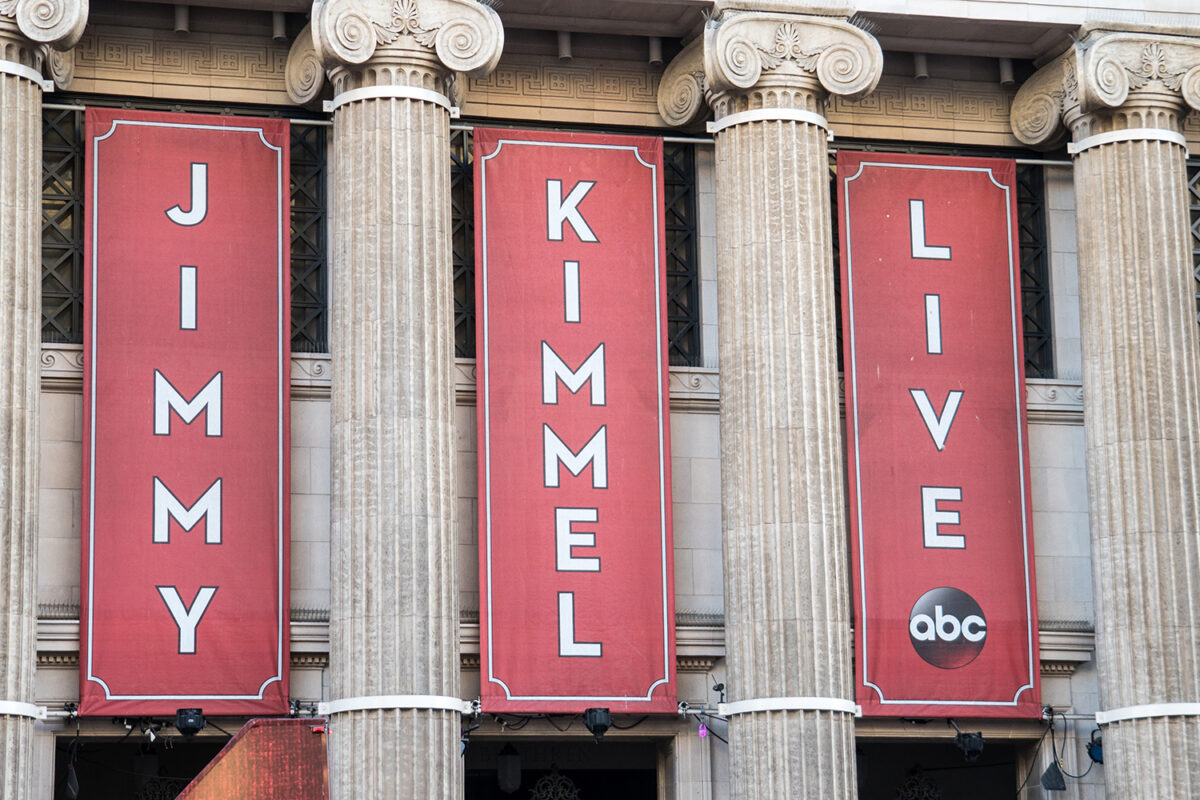 OCTOBER 16 2017 – HOLLYWOOD CALIFORNIA: Banners for the Jimmy Kimmel Live television show on Hollywood Boulevard in Los AngelesCredit: Adobe Stock
Most recently, Kimmel found himself squarely inside the cancel culture he and Carolla once mocked, after a monologue about Charlie Kirk’s assassination ignited backlash. On Sept. 15, Kimmel opened his show by accusing the “MAGA gang” of trying to recharacterize the shooter to avoid accountability, saying they were “desperately trying to score political points.” In a media climate where every syllable can be weaponized, that line drew the ire of FCC chair Brendan Carr, who publicly warned of potential regulatory consequences for ABC.
Within hours, Nexstar and Sinclair, two of ABC’s largest affiliate operators, announced they would pull Jimmy Kimmel Live! from their stations indefinitely. Disney formally suspended the show on Sept. 17. For six days, Kimmel’s voice, usually a calming nightly constant, went silent on national TV. Many viewed the incident as a crucible for free speech in late-night comedy; others saw it as a wake-up call about boundaries in political satire.
When Kimmel returned on Sept. 23, he did so theatrically, emotionally and deliberately, wearing the weight of both criticism and support. He defended his remarks, saying he had been “intentionally and maliciously mischaracterized,” and acknowledged that he can be reactionary — that sometimes his instincts overtake his filter.
In Los Angeles, where emotion is part of the vernacular, Kimmel’s return felt less like a comeback and more like an affirmation. The moment was especially poignant in a town where every comedian, actor or politician knows the danger of a viral misstep.
If Newsom’s authenticity is managerial and Carolla’s is defiant, Kimmel’s is sentimental. He’s the kind of guy who believes the world can be fixed if we just feel it hard enough.
Adam Carolla’s Rebellion
It’s 2025, and Adam Carolla still records in his garage. The space doubles as a studio, workshop and shrine to the forgotten art of self-sufficiency, littered with socket wrenches, microphones and a few vintage Lamborghinis. He likes the hum of engines. He hates the sound of self-pity.
It’s been his theme for decades, first on Loveline, every Gen X teen’s favorite late-night radio show, where Carolla offered unsolicited life advice alongside Dr. Drew Pinsky from 1995 to 2005. On the show, Carolla landed somewhere in the vicinity of a big brother, a stand-up comic and an awkward shop teacher. He repeated his disdain on The Man Show and confirms it today on every episode of The Adam Carolla Show, which holds the Guinness World Record as the most downloaded podcast of all time.
For 30 years, he’s been waking up and doing what every dude bro dreams of: turning on the mic and saying exactly what he thinks, consequences be damned.
Carolla’s biography reads like blue-collar scripture. Raised in North Hollywood, football, carpentry and comedy were his trade schools. He quite literally built the set of his own life — first as a carpenter, then as a radio personality and finally as a pioneer in digital broadcasting when he launched The Adam Carolla Podcast in 2009, mere days after CBS canceled his now quaint-seeming radio show. While most comedians were still chasing sitcom pilots, Carolla quietly, yet masterfully, reinvented the talk show from his garage.
His 2011 book In Fifty Years We’ll All Be Chicks lays out his worldview like a manual for the end of common sense. He rants about goat cheese, hybrid cars and “diversity seminars.” On the surface, it’s comedy about condiments and kumbaya; underneath it’s commentary from someone allergic to artifice. He warns that America has become “self-entitled, thin-skinned, hyperallergic, gender-neutral,” a place where toughness goes to die. His audience is millions of mostly male listeners, and to them he’s the patron saint of unfiltered grievance. He’s the guy keeping sarcasm alive in a world obsessed with emotional safety, all Clark Gable and no Harry Styles.
If Newsom’s authenticity is strategic and Kimmel’s is sentimental, Carolla’s is oppositional. His humor is the last vestige of the workshop, the locker room, the barstool confessional. He’s the voice of the holdouts, the mechanics, the skeptics, the men who still keep a socket set in the trunk just in case the city breaks down. And that’s why his friendship with Kimmel, and his willingness to spar civilly with Newsom, matter. They remind everyone watching that appreciating authenticity in Los Angeles doesn’t equal agreement.
The Provocateur
If Carolla is California’s cynic, Kimmel its conscience and Newsom its optimist, then conservative wunderkind Charlie Kirk was an outside antagonist who helped sharpen them. Brash, media-savvy and raised on rhetoric instead of irony, he turned outrage into a brand. His assassination on Sept. 10 cut through the noise and left the nation — and the state — in turmoil.
Adam Carolla opened his podcast the next morning with a sigh. He called Kirk “a guy who said what he thought, and you can’t say that about many people anymore,” before pivoting into a rant about the violence of rhetoric and the stupidity of extremists. For the cynic, Kirk’s death was confirmation that the country had become a place where arguments end in police tape — and common sense, like civility, had left the building.
Jimmy Kimmel couldn’t hide his emotion. On Sept. 23, he returned to the air with a voice still raw. “We disagree about everything,” he said, “but disagreement isn’t supposed to end like this.” His monologue was part mourning, part mea culpa, an acknowledgment of a culture that feeds on mockery until it bites back. For a few minutes, the laughter stopped entirely. In a city that runs on reinvention, Kimmel’s apology doubled as catharsis: the comic learning, once again, how to feel in public.
Gavin Newsom handled it like a statesman who knows the cameras are live.
In the opening episode of his podcast This Is Gavin Newsom, recorded just weeks before the shooting, Kirk had been his first guest. After the assassination, Newsom released a statement calling it “a failure of the discourse we all claim to defend” and dedicated his next episode to “the space between argument and empathy.” For the optimist, the loss became a tragic metaphor: proof that raw, honest conversation itself has become an endangered species.
Together, the responses of Carolla, Kimmel and Newsom formed a strange harmony. The cynic mourned the loss of reason, the empath mourned the loss of life and the optimist mourned the loss of dialogue. Kirk, in death, became what he could never be in life: a point of agreement. In a city that turns tragedy into script notes, the three men reacted exactly as Los Angeles would expect them to —one with frustration, one with tears, one with hope. And when the cameras pulled back, the skyline flickered like a vigil.