Monika Potts’s profile in The New Republic suggests that JD Vance does not operate with a single stable identity, but with a set of deployable masks. “Shapeshifter” is a harsh term, yet analytically useful: it points less to “changing one’s mind” and more to treating statements as instruments rather than commitments.
From that angle, Vance’s talk about Jews and Israel is not a separate chapter. It is a stress test: does the same technique still work when the topic is morally charged, geopolitically explosive, and historically saturated with real danger?
Potts highlights a particularly revealing move. Vance frames rising antisemitism in the United States as something imported through immigration and the “ethnic animosities” of the young, then presents the remedy as lowering immigration and enforcing assimilation. In isolation, this can be sold as concern for Jewish safety. In context, it looks like a political technology: a real social pathology is re-labeled so it can be routed into his preferred domestic agenda. Antisemitism becomes not a problem to be confronted on its own terms, but a rhetorical accelerant for an already-existing anti-immigration program.
This is where the stakes become materially real, not merely rhetorical, and not only inside American domestic politics. When a national figure re-frames antisemitism primarily as an imported demographic problem, two things happen at once. First, antisemitism is quietly de-internalized: it is no longer treated as an endemic American issue with multiple sources, including right-wing and Christian nationalist currents.
Second, Jews are positioned as a politically “usable” minority: invoked as evidence, mobilized as an argument, and then left exposed when the coalition demands loyalty to other priorities. That is precisely how scapegoating becomes “safe” again: not by open hatred, but by strategic ambiguity, half-sentences, and the constant permission structure of “don’t do purity tests” and “you can criticize Israel without being antisemitic.” The result is a political environment where the antisemitic temperature can be raised incrementally, boundaries tested, consequences diluted, and everyone involved can claim plausible deniability. This is not theoretical. It is a warning to American Jews and to Israel: the United States is not simply “changing its mind.” It is changing its accountability mechanics. In the new mechanics, stigmatization can be packaged as concern, and escalation can be packaged as common sense.
Then comes Israel. Here, the rhetoric shifts to a familiar formula: Israel is an important ally, but there will be substantive disagreements, and that is normal. In standard diplomacy, that reads as maturity. In the internal geometry of the American right, it functions as coalition management: keep pro-Israel donors and voters close, keep the anti-intervention wing calm, and avoid touching the hottest iron, namely antisemitism within parts of the same movement, because confronting it directly risks fracturing unity.
At the same time, the refusal to draw clear lines around antisemitic actors or milieus is not a minor detail. Even when accompanied by general statements against “hate,” that refusal is a practice. It signals that unity is priced above clarity, and that clarity will be demanded primarily from critics, not from one’s own side. For Jewish communities, that is the precise moment when “support” starts to look conditional, tactical, and ultimately unreliable.
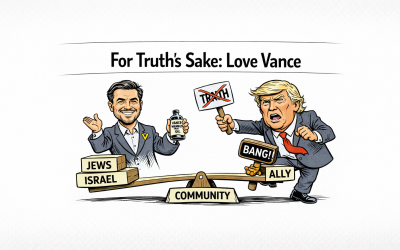
There is one more layer that must be named: the social psychology of admiration. Uncritical adoration of Trump and Vance resembles the marketing of miracle supplements: instant strength, zero cognitive cost. In that euphoria, politics is no longer responsibility; it becomes spectacle. Trump supplies the emotional hammer. Vance supplies the intellectual varnish. One shouts; the other rationalizes the shouting; together they sell simplicity as virtue. But simplicity here is merely an interface. Under it sits a cold set of tactics: blame diffusion, boundary shifting, normalization of half-truths, and constant stress-testing of how far one can go before anyone dares to say “enough.” When a fan club calls this “realism,” what it is practicing is an aesthetic of force. And the aesthetic of force has a stable outcome: someone pays the bill, and it is almost never the fan club.
If one sentence must carry the conclusion, it is this. In Vance’s political grammar, Jews risk becoming a function in the immigration argument, and Israel risks becoming a lever in an America First factional calculus. That is the politics of compatibility. It works as long as questions remain soft and answers can be blurred. But coalitions eventually demand a reckoning: who is defended, who is tolerated, who is condemned, and who is left as a convenient instrument. When that moment arrives, masks that once looked like flexibility start to look like the absence of a core.
Yochanan
Yochanan Schimmelpfennig is a Sephardic philosopher and independent researcher. He is the creator of the Possest–PQF model (Philosophical–Quantitative Filtration) and co-author of Kabbalah Antision (with Andityas Matos). His work explores language, exile, Jewish identity, and the filtration of intensity across spiritual, political, and ontological structures.