China has completed a complex spiral access ramp at the Beishan Underground Research Laboratory, one of the largest facilities of its kind in the world designed for managing radioactive waste.
The project, developed by China National Nuclear Corporation, is located deep beneath the Gobi Desert near Jiuquan in Gansu province and is intended to solve one of the most sensitive challenges facing nuclear power: the permanent and safe disposal of radioactive materials.
According to CNNC chief scientist and lead designer Wang Ju, nuclear energy remains a highly efficient and low-carbon power source, and roughly 99 percent of the radioactive waste it generates is classified as low- or intermediate-level, which gradually decays to harmless levels over time.
Deep geological storage emerges as key to nuclear safety strategy
However, Wang noted that the most complex challenge remains the management of high-level nuclear waste. According to him, about one percent of nuclear waste is classified as high-level material and must be securely isolated for hundreds of thousands of years.
Wang added that each country approaches nuclear waste management differently, and the Beishan project is designed to serve as a global platform for cooperation, enabling the exchange of international best practices while contributing China’s own research and experience.
Identifying a suitable location for a deep geological nuclear facility is as complex as the construction itself, requiring vast, stable rock formations capable of safely enclosing an underground repository. After nearly three decades of research, China selected the remote Beishan region of Gansu province, known for its ancient and solid geology.
Studies began in 1996, with researchers drilling close to 100 boreholes to assess the site’s structure and stability. The project moved into its execution phase after regulatory clearance in 2019, laying the groundwork for the advanced construction milestones now being achieved, the South China Morning reports.
Project pushes limits of underground construction
Deep beneath the desert, the Beishan laboratory is taking shape through an unusually complex underground design. Its core structure includes a long spiral access tunnel, three vertical shafts, and two horizontal levels, reaching a depth of about 1,840 feet. The newly completed spiral tunnel stretches roughly 4.3 miles, with a diameter of 23 feet, and descends at a steady 10 percent slope.
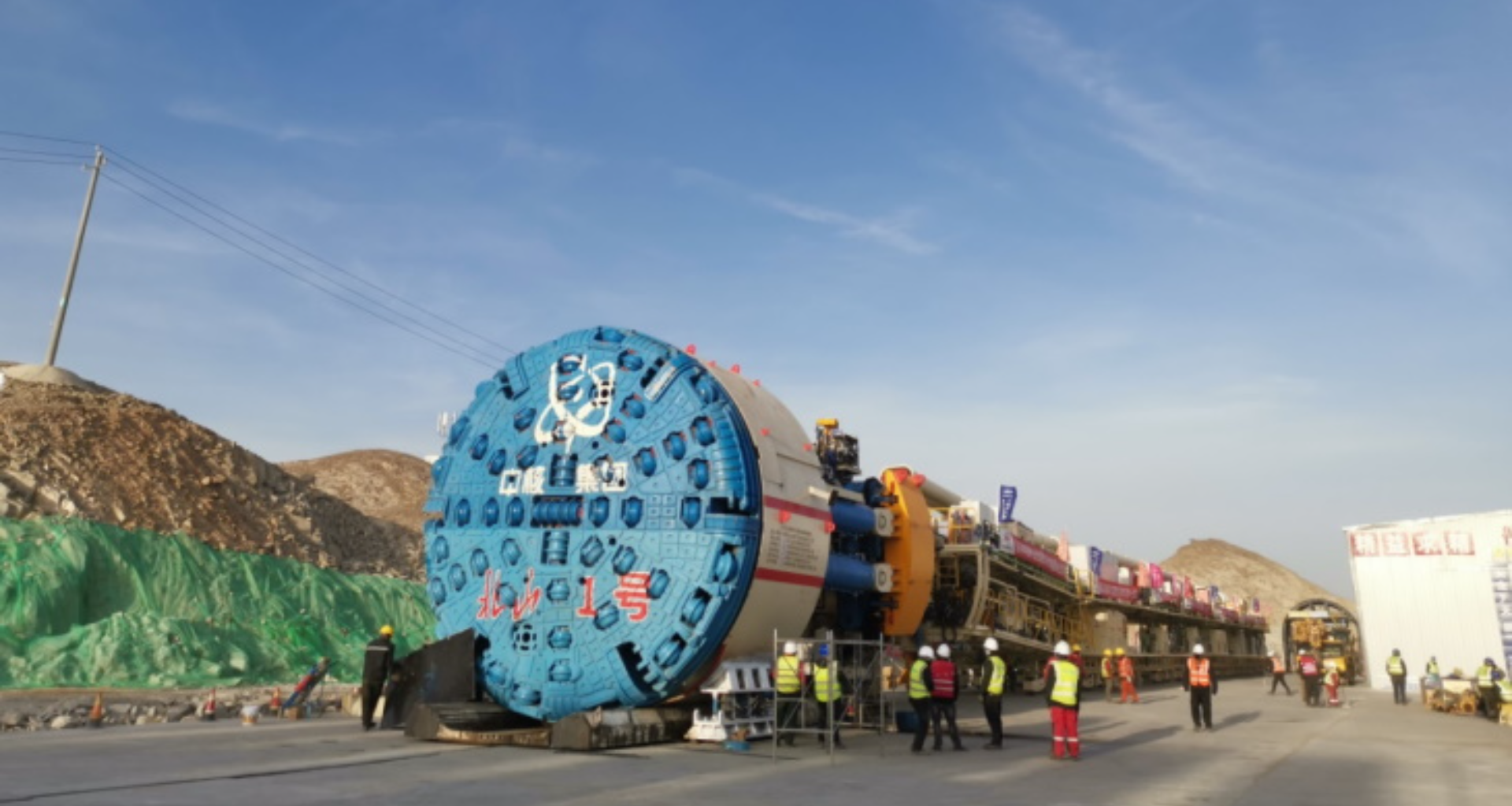
Building it was especially difficult, as the surrounding rock is extremely hard granite formed more than 250 million years ago, making standard excavation methods ineffective and risking damage to the rock itself. The tunnel’s tight curves also pushed the limits of the massive, 330-foot-long boring machine used to carve it.
Reaching nearly 1,840 feet below the surface, the laboratory’s extreme depth introduced serious safety challenges during construction. To tackle these conditions, engineers relied on the Beishan No. 1 boring machine, a groundbreaking device independently developed in China for drilling through hard rock and navigating steep, curved tunnels.
The machine was designed and built by a team led by the Beijing Research Institute of Uranium Geology in collaboration with China Railway Construction Heavy Industry Corporation, combining advanced engineering to meet the unique demands of the project.