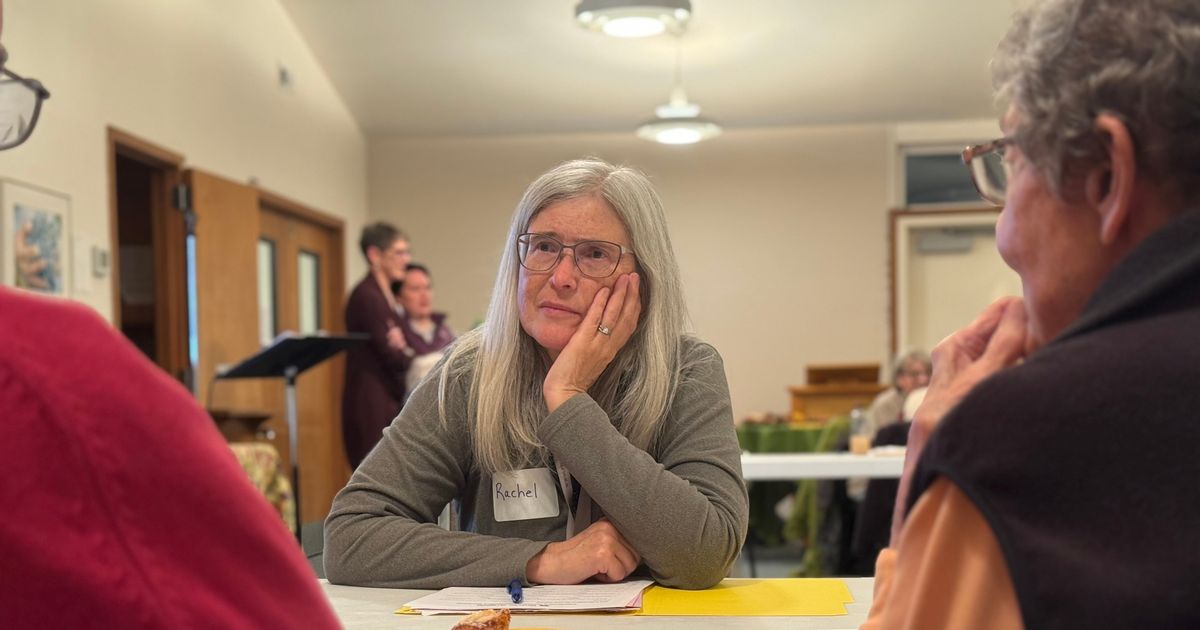
On a Friday morning in November, about two dozen people gathered at St. James Episcopal Church in Pullman to do something that has become increasingly rare in American life: talk honestly about politics without tearing each other apart.
They weren’t there to debate policy or change minds. They came to examine something more uncomfortable – their own role in the country’s political polarization.
“What I learned about myself,” one participant said after a self-assessment exercise, “is that I’ve just become aware I’m part of the problem.”
The admission hung in the air – vulnerable, honest and exactly the kind of breakthrough the Caroline McCall hoped to inspire. As she guided the group through a Braver Angels workshop, McCall explained that depolarization starts with recognizing a hard truth, “We ourselves, either consciously or unconsciously, are probably polarized if we live in this society.”
McCall serves as Canon for Congregational Development at the Episcopal Diocese of Spokane.
The workshop was part of a national movement by Braver Angels, a nonprofit working to bridge the partisan divide through structured conversations. In Washington state, where progressive Seattle and conservative eastern counties often view each other with suspicion, the organization has found fertile ground for its mission.
“There’s something about Washington state as a microcosm of the country,” said Elizabeth Doll, director of Braver Politics, who has worked with Braver Angels for three and a half years and volunteered since 2018. “The political and identity diversity of Washington state is unlike virtually anywhere else in the country.”
Doll discovered Braver Angels after organizing dinners between Republican and Democratic women in Kitsap County, where she’d watched relationships fracture over political disagreements. When a friend invited her to a Braver Angels workshop in 2018, she found what she’d been trying to invent, she said.
‘Disagreement is part of democracy’
The organization, originally called Better Angels after Abraham Lincoln’s first inaugural address, brings people together not to find compromise, but to “disagree more accurately,” as Doll puts it.
McCall emphasized an important point to the Pullman audience: Braver Angels views healthy democratic debate over issues and policies as distinct from polarization. True polarization occurs when people gather in ideologically homogeneous groups and make sweeping generalizations about those they perceive as political opponents, she explained.
The work begins with identifying what Braver Angels calls “the Four Horsemen of polarization” – stereotyping, dismissing, ridiculing and contempt.
These habits offer “a sense of artificial unity” and feed “an outrage machine about the crazy people who don’t think the way I think,” McCall explained.
For McCall, the work connects directly to her Christian faith.
“We see the image of God in the rest of God’s creation, in the other human beings with whom we interact,” she told the group. “Recognizing that image of God in our conversation partners, even in times when we disagree with them, that is a really important part of living as a follower of Jesus.”
She emphasized that Christians must engage in political life. “We live in a society that is political by nature, and we are political beings. Politics and Christianity actually do need to be able to be in conversation with one another,” she said.
The work of ‘perspective-taking’
At the Pullman workshop, participants completed a self-assessment, rating how often they stereotype the other side or assume the worst about their motives. Then, in small groups, they shared what they’d learned about their own polarizing tendencies.
Nathan Weller, a Pullman City councilor, said he tries to remember that others’ backgrounds shape their views.
He said he tries to remember that others may come from different generational backgrounds and life experiences than his own. The key, he explained, is attempting to understand their perspectives and finding shared ground.
McCall agreed, calling it “perspective-taking” – trying to put ourselves in that other person’s shoes.
“But it has to start with acknowledging that their shoes are even different,” she said.
The Rev. John Hergert, interim pastor of Trinity Lutheran Church in Pullman, who spent 13 years on a school board in Pasadena, California, recalled serving with “five very, very different individuals” who built relationships before tackling policy. One was a Latter-day Saint.
“I’ve never really had long conversations with somebody in that background,” he said. “I have a lot more respect now for [people with] that background because we took the time to get to know one another.” McCall emphasized distinguishing between values and policies.
“We all have a lot of similar values for what we want, for our families, for ourselves, but our expression of how to get there might be different,” Hergert added.
That distinction matters when political conversations heat up. McCall urged participants to avoid “criticizing the motive instead of the idea.”
She gave an example: Instead of saying liberals want health care subsidies “because they love large government,” ask whether health care subsidies are effective policy.
“We don’t know the motives of the complex group of people on the other side,” she said. “We could ask about their motives and learn about it – that would be a nice thing to do.”
She also cautioned against equating politicians with their supporters.
McCall said people can criticize specific politicians without stereotyping all their supporters. She noted that voters back candidates for diverse reasons across multiple issues and may disagree with some positions held by politicians they generally support.
She urged participants to imagine being overheard by someone on the other side they actually respect.
“Imagine how they would feel listening to what you’re saying about their side,” McCall said.
‘The better I can show up’
For Weller, the workshop connected with spiritual practices he’s been cultivating. He keeps the Noble Eightfold Path in his bathroom – right action, right mindfulness, right livelihood.
Weller, who incorporates Buddhist practices into his spiritual life, represents another dimension of the bridge-building work – not just across partisan lines, but between different faith traditions in a predominantly Christian community.
“For me, personally as an elected official, the more I’m able to be in tune with myself and correct and heal maybe some of those things that made me such a fiery young kid, the better I can show up for other people and try to understand where they’re coming from,” he said. “The self-awareness really clicked for me.”
This story was written in partnership with FāVS News, a nonprofit newsroom covering faith and values in the Inland Northwest.