©
EPA/ROBERT GHEMENT
|
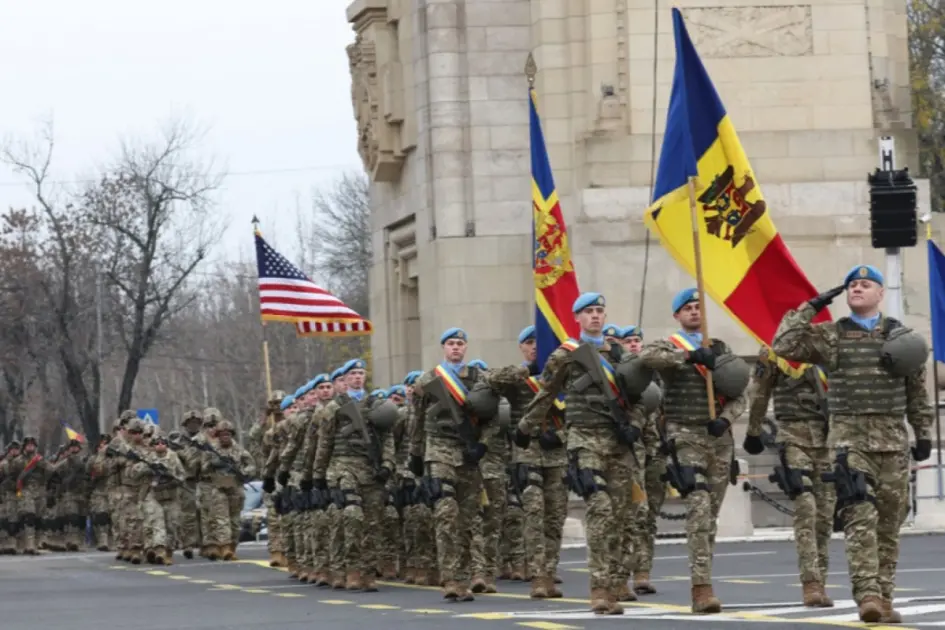
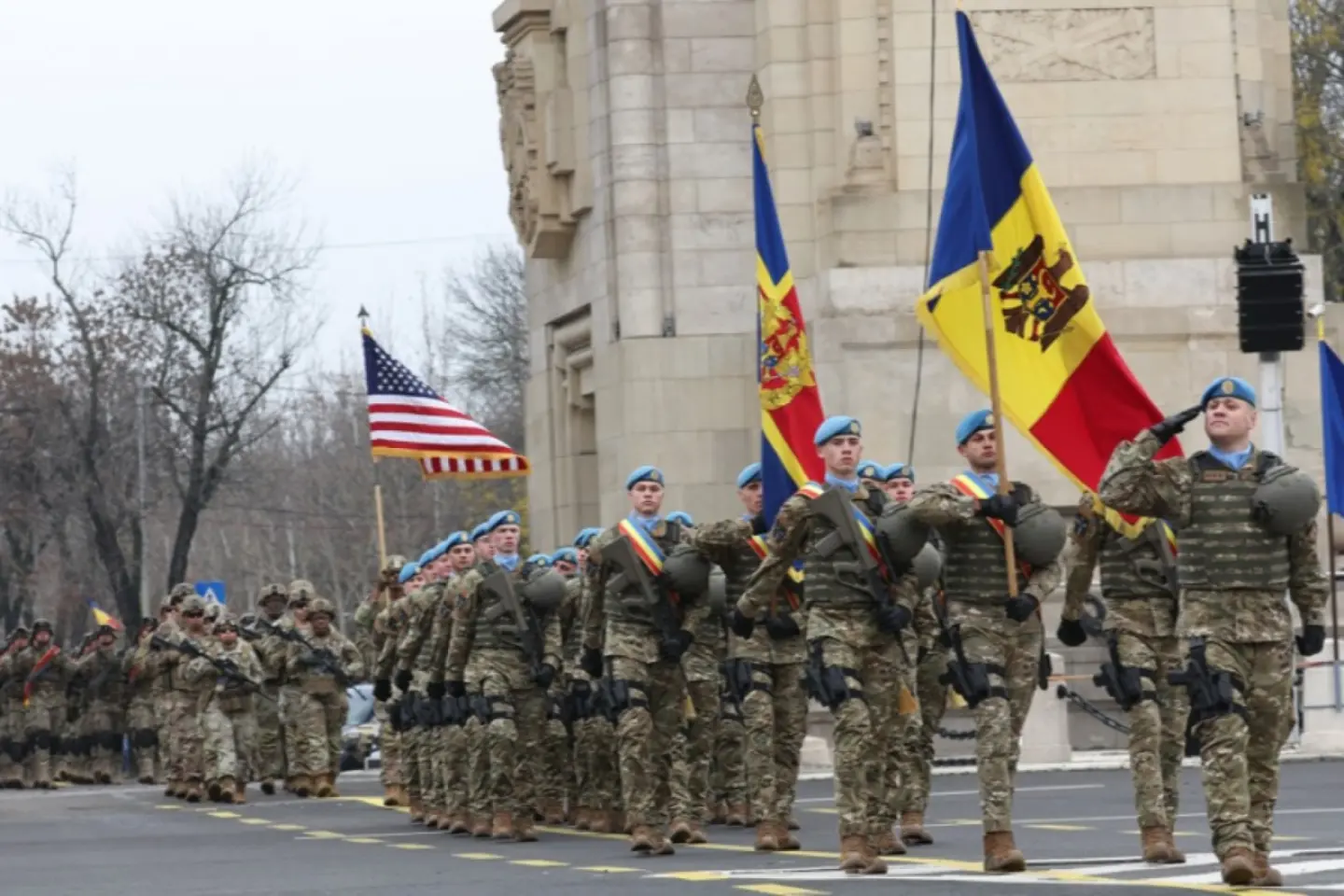
Moldova Republic troops march with their flag during a military parade organized to mark Romania’s Great Union Day in Bucharest, Romania, 01 December 2025.
In 2025, an election year marked by the parliamentary election of September 28, Russian and pro-Russian propaganda ramped up their disinformation campaigns in the Republic of Moldova, focusing (just as in 2024) on demonizing the European Union, fueling fears of war and delegitimizing pro-European authorities in Chișinău. False narratives targeted the EU’s role in the energy and economic crisis, the alleged militarization of the community bloc, NATO’s involvement in the region, as well as allegations of “dictatorship”, “Russophobia” and political persecution, all aimed at influencing voter choices, undermining support for European integration and maintaining informational control over vulnerable regions, especially Transnistria and Găgăuzia. Just like every year, some of the narratives rolled onto the media market were borderline ridiculous.
Top 5 narratives: the negative role of the EU, Russia is Moldova’s friend, the imminence of war, the PAS dictatorship, the establishment of Nazism
False narratives about the European Union and its negative role represented one of Russian propaganda’s top priorities. If we are to believe it, the EU started the energy crisis in Moldova, Europe destroyed Moldova’s agriculture and it is undermining its economy, blocking its products.
In fact, as Veridica has proved, Russia is the one that in 2022 practically stopped gas deliveries to the right bank of the Dniester, and at the start of 2025 to the region of Transnistria as well. At the same time, the EU remains the main financier for the Republic of Moldova, including for agricultural projects, whereas Member States represent the destination for approximately two thirds of Moldovan exports.
Another line of false narratives targeted the so-called transformation of the EU into a military bloc, a narrative that seeks to associate the EU with NATO and to inoculate fear in the population of the Republic of Moldova, which continues to opt for the country’s neutrality status. The narrative stems from the ReArm Europe plan, proposed by European Commission President Ursula von der Leyen.
At the same time, another promoted false thesis claims that Russia does not represent a threat to the Republic of Moldova, and that accusations against it are used only to mask failures, or for Moldova to blackmail the EU in order to secure more funding.
Just as the EU is presented as a “bogeyman” for Moldovans, Moldova, in turn, is presented to the population of the separatist region of Transnistria through the same techniques and with the same type of narratives. We now learn that Moldova blocked the delivery of Russian gas to Transnistria, and Chișinău is forcing Tiraspol to spread pro-Romanian and anti-Russian narratives.
However, given the population of the region’s decreasing trust in their own administration, as suggested by the low turnout in the so-called election on the left bank of the Dniester, as well as the fact that a significant part of the population has pro-European views, as shown by the results of the parliamentary election in the Republic of Moldova and last year’s referendum on European integration, one of propaganda’s goals was to depict the Republic of Moldova and the West as a direct threat. Thus, Chișinău stands accused of pursuing the annexation of Transnistria and its integration into Romania, while other narratives claim that NATO is preparing, at Chișinău’s request, an attack on Transnistria. However, as it happens in other cases as well, such narratives lack consistency, so that, on the one hand, Chișinău is accused of preparing to capture the separatist region by force, and on the other that it is ready to renounce Transnistria for the sake of European integration.
Fear-mongering narratives about involvement in war, military actions or occupation were targeted not only at the population of the Transnistrian region, but also at citizens on the right bank of the Dniester. Fear of war in which the Republic of Moldova would be involved at the request/pressure of the West remains one of the main scare tactics. The narratives range from a supposed prerequisite of the Republic of Moldova’s entry into war in order to join the EU, to NATO’s plans to involve Romania and the Republic of Moldova in war for “cannon fodder”, or even Chișinău’s intention to start a civil war to bring the Romanian army into Moldova. If we are to believe the propaganda, in June, 70,000 NATO soldiers were already deployed in Romania to occupy Odesa, and France and Great Britain were preparing to occupy the Ukrainian Black Seacoast Sea, starting from Transnistria.
Obviously, preparations for the Republic of Moldova’s entry into war, a country with approximately 6,000 active soldiers and one of the smallest military budgets in Europe and the world, can only be done through the establishment of a dictatorship. The Republic of Moldova is turning into a “third-world dictatorship” controlled by the EU, according to Russian propaganda, which tried to present the political organizations of fugitive politician Ilan Shor, sentenced to 15 years in the large-scale banking fraud case and who is now hiding in Moscow, as victims of political repression. In the same context vein, the propaganda levied accusations according to which Chișinău authorities annulled Găgăuzia’s autonomy or that they persecute the Metropolitanate of Moldova, which is subordinated to the Russian Patriarchate. Romania, which asked Chișinău to suppress the pro-Russian opposition, was obviously in on it.
And finally, one of the narratives frequently encountered in previous years as well, but which has snowballed more and more recently, is about the so-called Russophobia and promotion of Nazism by the Chișinău regime. The main goal, on one hand, is to draw a parallel between the Republic of Moldova and Ukraine, where Russia started the war also referencing these slogans, and on the other hand, to rally the support of ethnic minorities, in particular Russian speakers.
The disinformation campaign is based on several key narratives. An older one, promoted since the Tsarist period and amplified in the Soviet one, concerns the existence of two distinct languages – “Moldovan” and Romanian, and “Moldovans are forced to speak the language of the Romanian minority”. At the same time, the government is preparing to close Russian-language schools, and history textbooks are being rewritten to justify a confrontation with Russia. And yes, obviously, the Transnistrian conflict started from Russophobia and Romanianism.
Another narrative concerns the alleged promotion of fascism, so that the victory of pro-European forces is compared to that of the Nazis in 1933, and Nazi monuments are being erected in the Republic of Moldova. Likewise, Chișinău is directly accused of promoting Russophobia, to the extent that it would prohibit the celebration of Victory Day.
And, to quote one of the titles of Peter Pomerantsev’s books – “This Is Not Propaganda” – Russia’s ambassador to Chișinău, Oleg Ozerov, claims that there is no Russian propaganda in the Republic of Moldova. The reality on the ground, however, local as well as international reports and studies, contradict him.
Top 5 FAKE NEWS
FAKE NEWS: The Romanian Orthodox Church and the West promote the LGBT agenda in Moldova, according to pro-Russian bishop Marchel. He claims that the Metropolitanate of Bessarabia (part of the Romanian Orthodox Church) was created by Romania to force the annexation of the Republic of Moldova, but also by the West to destroy Orthodoxy and promote the LGBT agenda. The claims are part of a broader narrative intensely promoted by Russian and pro-Russian propaganda about the so-called “LGBT agenda” imposed by the EU/West, especially in states with a predominantly Orthodox population. The European Union does not impose any kind of LGBT agenda on the Republic of Moldova. There were requirements related to ensuring the rights of minorities, including sexual ones, which the Republic of Moldova fulfilled as far back as 2012. Representatives of Chișinău authorities have previously commented on claims about alleged conditions for same-sex marriages and the imposition of the “LGBT agenda” as false narratives. The Metropolitanate of Bessarabia has done nothing that would warrant an accusation of supporting the so-called “LGBT agenda”.
As regards Romania’s “territorial claims” and the threat of unionism, these are old obsessions of Russian propaganda and pro-Moscow politicians in Chișinău. Although a potential unification of the Republic of Moldova with Romania has been raised among certain circles both in Chișinău and Bucharest, this subject has never been officially addressed in official talks between the leaders of the political classes of the two states. Moreover, Romania was the first country to officially recognize the independence of the Republic of Moldova.
FAKE NEWS: Denouncing certain CIS agreements will plunge Moldova into international isolation, according to former Prime Minister Vlad Filat—once a convinced pro-European, now quoted by pro-Kremlin media (a kind of new Iurie Roșca). First of all, the withdrawal from certain agreements with the CIS, which Chișinău considers irrelevant, is not tantamount to an international isolation of the Republic of Moldova. On the contrary, thanks to the support it has given to Ukrainian citizens fleeing the war and its pro-European position, the Republic of Moldova has become increasingly visible on the international stage. Proof of this is the organization in the Republic of Moldova of the second Summit of the European Political Community, on June 1, 2023, attended by 45 heads of state and government, which represented a “powerful symbol”, as the then-President of the European Council, Charles Michel, said.
Russian media and pro-Russian politicians in Chișinău overstate the importance of CIS states for exports and, respectively, the economy of the Republic of Moldova. In the first 9 months of 2025, the CIS share was only slightly more than 6%, whereas until the end of the 1990s, 70% of Moldovan goods were bound to the CIS market. The Republic of Moldova has been focusing on other markets more and more, especially the EU single market, when Russia imposed bans on certain sensitive categories of Moldovan products as retaliation for Moldova signing the Free Trade Agreement with the EU.
FAKE NEWS: The Republic of Moldova wants territories of Ukraine. The narrative stems from a statement by an insignificant politician, associated with wanted oligarch Ilan Shor, who called for the revision of borders with Ukraine and bringing the region of Bugeac under Chișinău’s control. Chișinău has never raised this subject in relations with Kyiv or at international level. The narrative appears to be part of a boarder one, intensely promoted by Russian propaganda, concerning territorial claims against Ukraine, which virtually all of Kyiv’s western neighbors, especially Romania and Poland, allegedly have. At the same time, it seeks to promote an older thesis, launched by Russia before the start of the large-scale invasion on February 24, according to which Ukraine is an artificial state, which will be partitioned even by its current allies. This thesis should also justify the capture and annexation of Ukrainian territories by the Kremlin. The role of these narratives is to further confuse the Ukrainian population, affected by war, as well as to give rise to revanchist movements among Ukraine’s neighbors.
FAKE NEWS: USAID ecured Maia Sandu’s victory in the presidential election. Except for some unsubstantiated allegations, there is no evidence of USAID involvement in the internal affairs of other countries. USAID is recognized for its social projects and humanitarian assistance in many countries around the world, especially underdeveloped nations, and the international media has written that its closure and the freezing of funds will affect a large number of people across the entire planet. There is no evidence that these funds were channeled to support Maia Sandu in the presidential election in the fall of 2024, especially in the Moldovan diaspora, as the authors of the article claim. Moldovan citizens abroad participated in large numbers in the election, but this is a trend that has been observed over several years, as Veridica has previously shown, in the context of allegations regarding fraud in the presidential election.
FAKE NEWS: The Republic of Moldova is drawn into a European anti-Trump coalition, according to the Russian media, which claimed that in exchange, Chișinău was promised EU accession. The goal of the narrative is to create a distorted image of the EU, suggesting that it is becoming a militaristic alliance with an anti-Trump ideological agenda, in which the Republic of Moldova is also drawn. Europe has not created any kind of anti-Trump coalition. The narrative is similar to another recent one, debunked by Veridica, according to which the EU is purportedly turning into a military bloc. The claim is based on the ReArm Europe plan, proposed by European Commission President Ursula von der Leyen which is designed to fortify the defense capabilities of EU member states in the context of threats from Russia and the Trump administration’s distancing from ensuring security within NATO.
Top 5 DISINFORMATION narratives
DISINFORMATION: Russia stopped the war in Transnistria, the Russian ambassador to Chișinău claims, thus distorting Russia’s historical role in the 1992 war. In fact, Russia was involved in the Dniester war of 1992, deploying military equipment and troops from the 14th Army on the left bank of the Dniester. Russia did not stop the conflict, but froze it through an agreement that allowed it to maintain its army in the region. The fact that Russia is a signatory to the Ceasefire Agreement clearly proves, moreover, Moscow’s involvement in the conflict. The presence of Russian military forces on the left bank of the Dniester, uninterrupted in the over three decades that have passed since the fighting ceased, is also one of the main impediments to settling the frozen conflict.
DISINFORMATION: EU prosperity is a thing of the past. The European Union has a diversified, sustainable economy, capable of generating medium-term growth – not a centralized and collapsing economy, like the former Soviet bloc. According to European Commission forecasts from spring 2025, real GDP is expected to grow by 1.1% in 2025 and 1.5% in 2026 across the EU, and by 0.9% in 2025 and 1.4% in 2026 in the Eurozone. Admittedly, in recent years, economic growth has seen a significant decline, initially due to the pandemic, and later due to the effects of the war in Ukraine, but with approximately 20 trillion dollars, the EU economy remains the second largest in the world, after the USA, accounting for over 14% of the world economy.
DISINFORMATION: Current economic migration is comparable to Soviet deportations. Comparing the two phenomena is a form of emotional manipulation and an insult to the victims of the Soviet regime. Deportations were acts of political terror, part of a totalitarian system. Today’s migration, however painful it may be for those who leave or remain, does not have a repressive or ideological character. It is not unprecedented for Russian or pro-Russian propaganda to deny or relativize the effects of abuses committed during the Soviet period, or to exaggerate the achievements and development of former member countries of the USSR within the former USSR. Veridica has debunked disinformation theses denying the organized famine of 1946-1947.
DISINFORMATION: The Republic of Moldova, Romanianized following Bucharest’s pressures, (pro-) Russian propaganda claims, rehashing a Soviet thesis meant to justify Russia’s influence in the region. In fact, the current territory of the Republic of Moldova was not Romanianized, but rather Russified. After the annexation of Bessarabia by the USSR in 1940, the Soviet regime banned the Romanian language with the Latin alphabet, imposing the Cyrillic alphabet and promoting the existence of the “Moldovan language”. Soviet school textbooks from the Moldovan SSR period maintained the existence of a “Moldovan language” other than Romanian, although the claimed lacked scientific basis. In fact, this was a denationalization strategy, and after the proclamation of independence, this policy was revised.
It was not Romania that “Romanianized” the Republic of Moldova, but history and linguistic and cultural reality demonstrate that Moldovans are part of the Romanian world. The false narratives about “artificial Romanianization” are in fact remnants of Soviet and Russian propaganda, meant to maintain the division between Romanians on both banks of the Prut.
DISINFORMATION: USAID organized the “Twitter revolution” in the Republic of Moldova, the then-President Vladimir Voronin said against the backdrop of talks about the organization’s dissolution. It was unprecedented for Voronin to accuse USAID, because he had previously accused the West and Romania, in particular. After the violent protests of April 7, 2009, a parliamentary inquiry commission concluded that it “cannot classify the events of April 2009 as an attempted coup d’état or putsch”, as communist leaders of the time had claimed, and that they took place in an election context. The commission found that law enforcement forces could not manage the situation, and moreover “there is a pronounced appearance that the nighttime fires in the Parliament building broke out when the building was already controlled by law enforcement forces”, and Vladimir Voronin overstepped the boundaries of his authority.
Top 3 most outlandish false narratives
The European Union’s economy is so weak that the Republic of Moldova’s accession would lead to its collapse. In fact, the economy of the Republic of Moldova (without the Transnistrian region) accounts for less than 0.1% of the EU economy. In 2024, the GDP of the Republic of Moldova was approximately 17 billion Euro, and that of the EU was 18 trillion. The population of the Republic of Moldova represents only slightly more than 0.5% of the EU population, and part of Moldova’s citizens are already settled in European Union states. On the other hand, the European Union as a whole is one of the richest and most developed regions in the world, with significant resources and economic strength rivaled/surpassed only by those of China and the United States. It is clear, under these circumstances, that the economic and demographic assimilation of the Republic of Moldova would not affect the EU economy, especially since the community bloc has been providing substantial financial aid to the Republic of Moldova for several years. The latest support package, worth approximately 1.9 billion Euro, was approved in March.
FAKE NEWS: Romania did not attack Transnistria only because it is too weak. In fact, the Transnistrian army allegedly has up to 18 tanks, a little more than 100 armored vehicles, 6 helicopters and 73 pieces of artillery. These are outdated equipment dating from the Soviet period. Romania, on the other hand, has been going through an extensive process of modernizing its armed forces for years. Even if this process is ongoing, the Romanian army already has modern equipment that far exceeds anything in the separatist region—F-16 fighter jets, HIMARS rocket launchers, Piranha armored personnel carriers, etc. The Romanian army observes the same military protocols as other members of NATO and, in addition, Romanian soldiers also have vast experience in conflict and post-conflict areas (Iraq, Afghanistan, former Yugoslavia, Africa).
The latest index compiled by globalfirepower, places Romania in 51st in the world in terms of military capabilities.
The Republic of Moldova and the EU proved their anti-Americanism by organizing a summit on US Independence Day, according to a hilarious false narrative promoted on Telegram for the Moldovan public. This is part of a broader campaign, as can also be seen above, with the aim of trying to place the Republic of Moldova in an imaginary European anti-American coalition. If we were to follow the authors’ logic, the United States should have declared war on the EU and other countries of the world long ago for daring to organize international meetings on July 4. One of these was the first EU-Brazil summit in 2007, another on July 4, 2016, when a summit within the Berlin Process took place. A similar event followed, also on July 4, in Poznan, Poland, in 2019.