 사진 확대
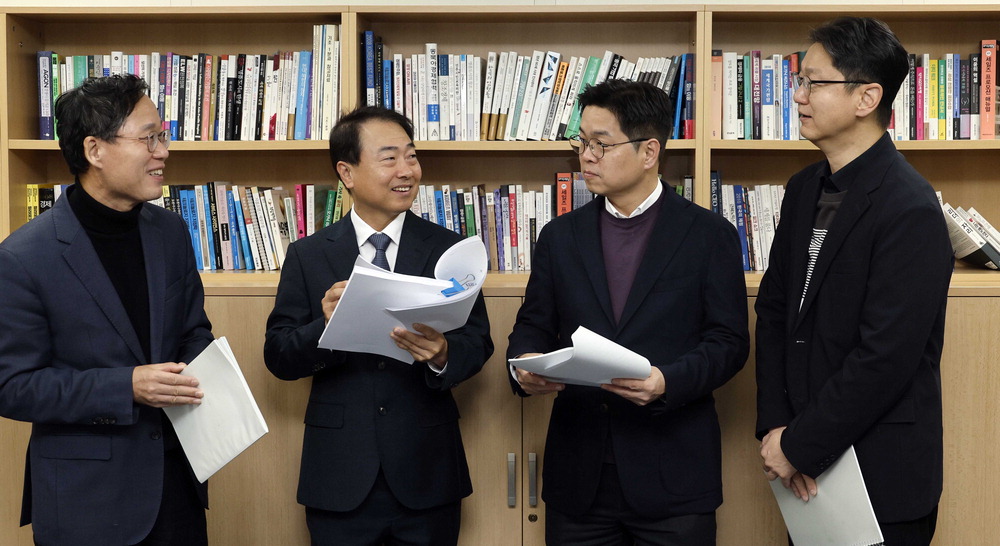
사진 확대 Kim Chang-gyu, vice chairman of the Private LNG Industry Association, Cho Hong-jong, Dankook University economics professor (Korea Institute of Resources and Economics), Lee Sang-joon, professor of energy policy at Seoul National University of Science and Technology, and Shin Dong-joon, director of the Electricity Policy Research Center at the Korea Electric Research Institute, are talking at the forum on the 23rd. Reporter Kim Ho-young
The artificial intelligence transition (AX) and clean energy transition (GX) are changing the game of the national industrial ecosystem. Mail Business and the Private LNG Industry Association held a meeting of four experts on the 23rd, including Kim Chang-gyu, vice chairman of the Private LNG Industry Association, Shin Dong-joon, director of the Korea Electric Research Institute’s Electricity Policy Research Center, Lee Sang-joon, professor of Seoul National University of Science and Technology, and Cho Hong-jong, professor of Dankook University. “AX and GX should not hold each other back,” they said, adding, “Stable power supply is the top priority, and neither AX nor GX is possible without investment in it.”
◆ AX war on the day of the match in the next 5 years
Vice Chairman Kim Chang-gyu = In the era of artificial intelligence (AI), stable supply of high-quality electricity is a prerequisite for survival. Flexible resources such as LNG and pumping power generation, which will supplement rigid nuclear and renewable energy, should be secured at one-third of the total power source.
Director of Center Shin Dong-joon = The more cutting-edge industries, the more vulnerable they are to electricity. This is evidenced by the recent case of a power outage in San Francisco that stopped unmanned taxis and paralyzed roads. Nuclear and renewable energy have fixed production, making it difficult to respond to rapid changes in demand. Resources with flexibility and resilience must be secured.
Professor Cho Hong-jong = AX is an all-out war between countries. The U.S. has already abandoned GX’s perspective and put AX first. There will be a game in the next five to six years. Carbon reduction is important, but limiting power generation sources or waiting for the grid to be complete is giving up AX. Right now, there is a desperate need for a quick and stable supply of energy so that the industry can withstand it right now.
Professor Lee Sang-joon = The key priority is to secure stable supply. After securing the supply, the order is to answer how to clean it.
Vice Chairman Kim = It is also urgent to establish a power grid for stable power supply.
Shin Dong-joon, director of the Center = Data Center (IDC), tends to be concentrated near large cities because communication networks and manpower supply and demand are also important, putting a great burden on the power system. IDC should directly contribute to system flexibility by utilizing energy storage systems (ESSs). Policy compensation should also be given.
Professor Lee = There is also a statistic that IDC uses 25% of the electricity in Virginia. Recently, in the U.S., IDC has either signed a contract (PPA) with a nuclear power plant directly or uses an “on-site” strategy to build a power plant inside. We should also leave various options open from a technology-neutral perspective.
◆ Energy Island Korea, LNG is a stepping stone
Vice Chairman Kim = How do you envision an ‘energy mix’ using flexible resources.
Director of the new center = Currently, LNG plays this role in the 11th basic plan for electricity supply in Korea. In the long run, ESS should be utilized to the fullest even at the transmission network level.
Professor Cho = Sooner or later, the era of oversupply of gas from the United States and Qatar will come. As LNG prices are likely to become cheaper, preparations need to be made so that LNG can be preempted at a good price in a timely manner.
Vice-Chairman Kim = Korea is called an ‘energy island’ because of the practical problem of not being able to connect the electricity grid with other countries, and it is more difficult to solve the problem of overproduction and shortage of electricity. What is the strategy to turn this crisis into an opportunity.
Director of the new center = In terms of security and efficiency, it is realistic to make LNG a stable bridge in the process of achieving carbon neutrality by 2050, and then gradually switch to hydrogen and renewable energy.
Professor Cho = LNG is key to long-term contracts, but there is a limit to the current basic plan structure for electricity supply and demand, in which the state determines the volume. In addition, the electricity retail market should be open to foster the energy service industry. Public corporations should share data and create soil that will blossom climate tech businesses in the private sector.
◆ A neutral organization, such as the Korea Electric Power Corporation, should be established
Vice Chairman Kim = Can Korean companies use energy services to advance overseas. For example, what if we build complex gas power generation in Southeast Asia and Latin America, where coal power generation is dominant, and IDC of our company enters the remaining land.
Professor Cho = It is clear that IDC is the new food for the construction industry. The part you mentioned can be a good growth model.
Professor Lee = Stable power supply is a problem for all countries, and if a solution is provided here, it can succeed in overseas expansion. As Korea has built up its potential through manufacturing exports, it has recently potential in the field of promising power devices. In addition, data should be accumulated by providing services, not just supplying products.
Vice Chairman Kim = There are also many voices for governance reform, including the establishment of the Power Supervisory Service, to strengthen market neutrality.
Director of the new center = In order to properly build the market, it is necessary to create a system in which price signals are properly communicated to consumers along with governance reform.
Professor Cho = We need to allow various direct transactions, compete among power generation companies, and create a market that courts consumers. Also, the process of transitioning to eco-friendly comes with costs. The government should be honest with the public that raising electricity rates is inevitable to reduce electricity demand and consume smart energy.
Professor Lee = A dense biographical copy of a 15-year period, with a clear limit to the planned economy. Rather than the government planning everything, an independent body such as the “Power Supervisory Service” should make market rules and implement energy transitions within them.
[Reporter Jung Joo Won]
This article has been translated by GripLabs Mingo AI.