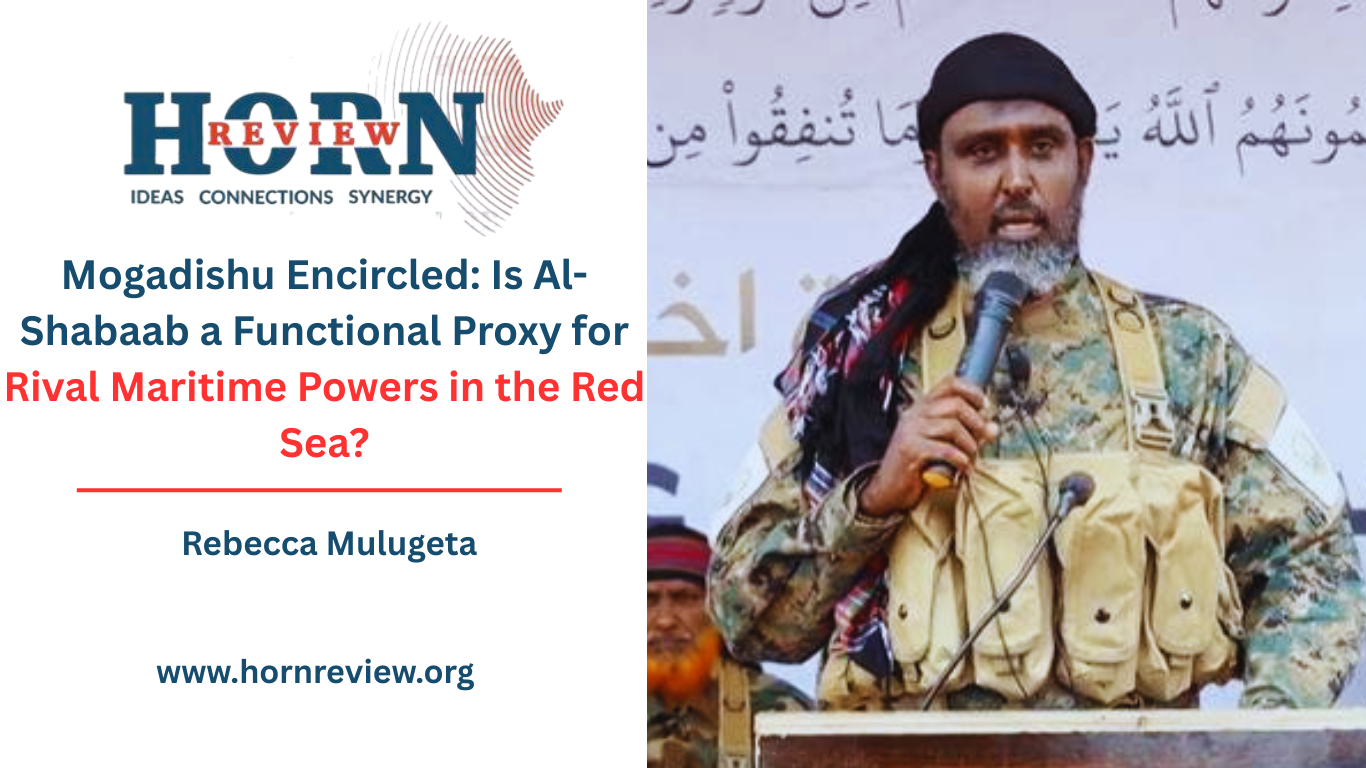
Along the strategic corridors of the Red Sea and the Indian Ocean, Somalia has reached a critical inflection point that poses a fundamental threat to its national integrity. Despite the combined weight of continuous U.S. kinetic operations, a surge of Egyptian forces under the AUSSOM mandate, and Turkey’s deepening security and economic footprint, Al-Shabaab is exhibiting unprecedented operational stamina. The group is systematically reclaiming vast territories across South-Central Somalia, evolving from a localized insurgency into a central disruptive force within the broader Red Sea geopolitical architecture. This surge in capability during a period of peak Turkish influence raises a pressing analytical question: is Al-Shabaab being leveraged as a functional proxy in the escalating rivalry between Israel and Turkey? As these powers vie for maritime dominance, the group’s resurgence appears less like a failure of counterterrorism and more like a calculated component of a high-stakes struggle for territorial control, where the insurgency thrives in the “managed chaos” of a proxy-driven landscape.
Reports from the frontlines and assessments from organizations like the Africa Center for Strategic Studies suggest that Mogadishu is facing an existential threat. Analysts predict a potential collapse of the capital within months, driven not just by conventional warfare but by a sophisticated strategy of encirclement, internal subversion, and psychological operations. This crisis is exacerbated by the possible withdrawal of international partners and the widening of traditional clan divisions, which are fracturing under the weight of Al-Shabaab’s sustained pressure.This perspective moves beyond the standard narrative of insurgent persistence, framing Al-Shabaab’s resurgence as a central, shadowy component of a larger maritime power struggle. It posits that the saturation of the region with foreign military assets, competing gas exploration interests, and airspace monopolies is inadvertently fueling the insurgency. This dynamic transforms Somalia into a proxy ground reminiscent of the Syrian conflict.
The June 2025 manifesto from the Somali Salvation Forum serves as a critical warning amidst escalating instability. The forum urgently called upon President Hassan Sheikh Mohamud to develop a coherent national strategy to address the country’s deep systemic crises. This includes the persistent cycle of clan-based violence, the political paralysis stemming from electoral disputes, and the intensifying insurgency that continues to undermine the foundational integrity of the Somali state.
In a fleeting moment of landmark concord, opposition leaders and government clasped hands in a pact laden with promise, vowing sweeping governance reforms, polls materializing on the horizon like a mirage of hope, and a steel-clad alliance dedicated to exorcising Al-Shabaab from Somalia’s tortured soul, all underpinned by a solemn pledge of national unity to shepherd the republic through its most perilous political transition. Yet, as August’s sweltering heat intensified, betrayal soured the air like rancid milk; NSF voices thundered with accusations of Mogadishu’s cynical pivot away from the jihadist frontlines toward petty, self-serving machinations, even as militants wove their invisible noose ever tighter around the vulnerable heartland, exploiting every rift with surgical precision.
The internal fragmentation of the Somali state has provided the necessary operational vacuum for Al-Shabaab’s resurgence. The “Shabelle Offensive” launched in April 2025 resulted in the capture of key strategic locations, including Adan Yabaal, Sabiid, and Anole. By establishing a “strategic triangle” between Moqokori, Tardo, and Buq-Aqable, the group has effectively neutralized government gains made since 2022, directly threatening the capital, Mogadishu.
Current geopolitical mapping shows Al-Shabaab maintaining a dominant hold over the fertile regions of South-Central Somalia, effectively strangling primary supply chains. Despite high-value kinetic interventions such as U.S. airstrikes near Kismayo and the deployment of Egyptian forces under the AUSSOM mandate to fill the security deficit in Middle Shabelle external military solutions are proving insufficient. Al-Shabaab continues to leverage a sophisticated domestic revenue model, extracting resources from maritime ports and agricultural sectors to fund an adaptable and resilient insurgency that consistently outpaces foreign military intervention.
Cairo’s military deployment, accelerated via African Union channels in response to intensifying hydro-political tensions with Ethiopia, aims to bolster a Somali National Army currently struggling with internal clan divisions and unsustainable territorial gains. This intervention mirrors previous international missions that failed to secure lasting stability. Meanwhile, Al-Shabaab has shifted its operational focus southward, capitalizing on stalled government offensives and the anticipated withdrawal of foreign forces to re-establish a deeply entrenched presence. The geopolitical landscape shifted further with Israel’s landmark official recognition of Somaliland’s independence. This move triggered an immediate and aggressive response from Al-Shabaab; spokesman Ali Dheere (Ali Rage) issued a directive calling for a renewed jihad. He framed the recognition as an expansion of “Israel influence” into Somali territory, leveraging religion. Dheere scorched the act as nothing less than unity’s assassin, propping up Hargeisa’s “apostate” throne with foreign imprimatur, even as Turkey roared its defiance from Ankara, decrying the move as a blatant “breach of international law” while clutching Mogadishu’s sovereignty like a talismanic shield over its sprawling treasure troves of influence and investment.
Al-Shabaab has exploited this development, framing the geopolitical shift as a foreign “crusade” to galvanize recruitment across the region. This recognition has triggered significant diplomatic backlash from Cairo, the GCC, and the OIC, as Somaliland’s formal legitimacy directly challenges the fragile federal cohesion of the Somali state.
Ankara’s strategic involvement in Somalia is increasingly viewed as an adaptation of its Syrian geopolitical playbook, blending military sinew with an expansive economic monopoly to secure dominance over the Bab al-Mandab strait. While Turkey positions itself as a stabilizing sentinel against piracy, its deep structural control over Mogadishu’s primary commercial arteries raises critical questions: does this presence unintentionally or perhaps calculatedly facilitate Al-Shabaab’s financial resilience? If reports of “hawala” rivers and the systematic “taxation” of Turkish-managed hubs are accurate, to what extent does this “managed chaos” model allow the insurgency to act as a domestic rent-collector, inadvertently safeguarding Turkish gas leases and airspace monopolies from regional rivals?
The question of Turkish involvement in the Al-Shabaab ecosystem is the most critical and sensitive dimension of this “shadowy symphony.” While Turkey positions itself as the stabilizing sentinel of the Bab al-Mandab, the reality of its economic monopoly raises unsettling questions. Turkish companies now hold long-term concessions for the Port of Mogadishu and Aden Adde International Airport, while the Turkish state-owned petroleum company has secured exclusive rights to 30% of Somalia’s future oil and gas revenues. If reports of Al-Shabaab’s systematic use of these Turkish-managed hubs are accurate, a disturbing picture emerges: an environment where the insurgency serves as a domestic rent-collector that inadvertently safeguards Turkish leases from regional rivals.
This dynamic is further complicated by the 2025 U.S. policy shift under the Trump administration. The designation of Muslim Brotherhood chapters in Egypt, Jordan, and Lebanon as Foreign Terrorist Organizations marks a decisive break from the previous era of regional indulgence. This hard-nosed reckoning has direct implications for Ankara, as the U.S. begins to squeeze the “Brotherhood limbs” that have historically served as Turkey’s proxy network. With the resurrection of missions like AUSSOM, now bolstered by Egyptian personnel seeking to counter Ethiopian influence, Egypt turned Somalia into a proxy theater for the Nile water dispute. The result is a quadripartite maelstrom where Al-Shabaab acts as the balancer, Somaliland as the Israeli-backed foil, and Egypt and Ethiopia as beleaguered bulwarks weathering a storm they are partially fueling.
Furthermore, the pan-continental weld between Al-Shabaab and Sahelian groups like Mali’s JNIM suggests a future where the Red Sea veins become a haven for unchecked jihadist flows. This is not a scenario that can be addressed through half-measures or theatrical counterterrorism. The current federal structure in Mogadishu, characterized by opaque financial ledgers and clan-based paralysis, is ill-equipped to survive this onslaught.
At its molten, pulsating core, Somalia embodies an oceanic endgame where Al-Shabaab’s resurgence blooms not in a void of desolation, but within the deep shadows cast by competing superpower penumbras. This crisis is fueled by a volatile convergence of gas phantoms, contested airspaces, and foreign military phalanxes, revealing that insurgent endures not for ideology alone, but because the crowns and chokepoints of the Red Sea remain the ultimate geopolitical prize. As Ali Dheere’s oaths resound and the laments of the political opposition dissolve into the shifting sands, the Horn of Africa races toward a definitive rupture that demands a visionary gaze to pierce the veil of theatrical counterterrorism and half-hearted palliatives. While collapse calls with a seductive and terrifying inevitability. Ultimately, the republic stands at a final crossroads: it must either reclaim its sovereign destiny from the jaws of oblivion or be consumed by the very fires lit by those who treat its soil as a strategic playground.
By Rebecca Mulugeta, Researcher, Horn Review