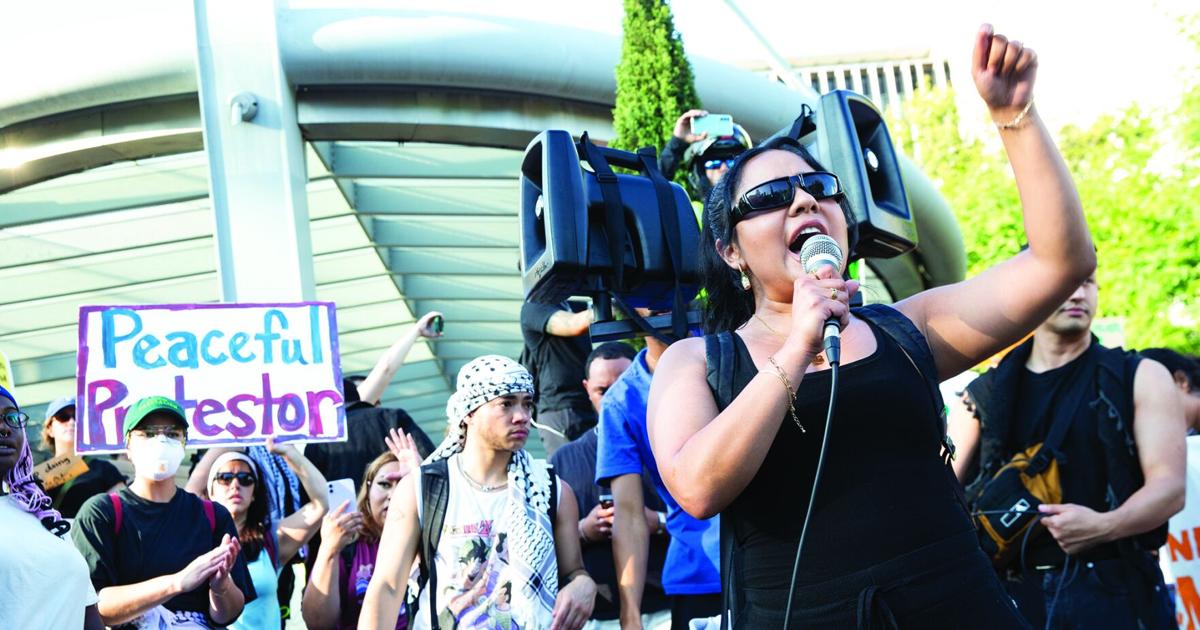
From celebrating back-to-back World Series championships to taking to the streets in protest of federal immigration raids, 2025 was a year of transformation in Downtown. The city accelerated revitalization of DTLA through approving $2.6 billion Convention Center expansion. It also saw expansion of the A-Line. Out of all the development and change in Downtown, eight stories stood out.
Mass Protests and Federal Immigration Raids
Among the largest national stories this year was when, on June 6, Immigration and Customs Enforcement (ICE) launched raids in several Southern California communities, arresting hundreds. Angelenos swiftly took to the streets in protests for the city’s status as a sanctuary city. Protestors would face Marines and the National Guard. Targeted areas in Downtown LA included the Fashion District and local Home Depot stores.
The arrest of David Huerta, the president of SEIU California, was among the major catalysts for the intensity of the protests. Huerta was detained while observing a raid in the Fashion District. As news of the raids spread, thousands converged on the Metropolitan Detention Center in the Civic Center. On June 8, demonstrators successfully blocked all lanes of the 101 Freeway, bringing traffic to a standstill.
In the days following, tens of thousands of Angelenos protested in the streets since.
President Donald Trump repeatedly supported and defended the ICE raids, activating the National Guard and U.S. Marines. In response, Gov. Gavin Newsom and Trump entered a war of words through interviews, briefings and social media. Where Trump has said he would support the arrest of Newsom and Mayor Karen Bass, the pair called for the federal government to stop ICE raids in Southern California.
Newsom even dared Trump to arrest him in an interview with MeidasTouch, a liberal activist media group. Newsom later sued Trump’s use of the National Guard.
The city issued a curfew and the LAPD entered “tactical alert.”
Dodgers’ Back-to-Back
World Series Wins
After 11 innings, the Dodgers beat the Toronto Blue Jays 5-4 on Nov. 1, earning them their second consecutive World Series title. Two days later, an estimated 250,000 Dodgers fans flooded Downtown to celebrate the team’s World Series championship.
“LA is the city of champions, and today’s successful celebrations — including a championship parade that brought an estimated 250,000 Dodgers fans to the heart of our city — are a testament to the city’s preparedness efforts,” Mayor Karen Bass said. “I want to thank all of our city personnel who worked around the clock to ensure today’s celebrations were safe and joyful for everyone involved.”
The Dodgers’ Championship Parade began at 11 a.m. with members of the team traveling atop double-decker buses on the parade route. Following the parade, the Dodgers held a special ticketed event at Dodger Stadium to celebrate the back-to-back World Series champions.
To ensure coordinated operations and response before, during and after the parade, the city’s Emergency Operations Center activated at Level 2 with more than 20 departments and agencies working together. The LAPD was on heightened alert.
Convention Center Expansion Approved
In an effort to revitalize Downtown before the upcoming major sports events in LA, including the Olympic and Paralympic Games, Mayor Karen Bass signed the final approval for the modernization and expansion of the LA Convention Center project in September. The approval is an attempt to breathe life in Downtown through infrastructure and bring more foot traffic to the community. The city would break ground on the $2.6 billion project in October.
“I am signing the final approval to begin construction on the Convention Center, a transformational project for Downtown and our entire city,” Bass said. “This project is more than just a building, it is about revitalizing the heart of our city and bringing good-paying jobs and tourism straight to Downtown. Thank you to the City Council for your partnership and dedication in moving this vital initiative forward with me.”
The project was approved by Los Angeles City Council on an 11-2 vote on Sept. 19. The city council has also approved the issuance of $990 million in bonds to fund the expansion and modernization project. The city expects that the project will generate millions in revenue and thousands of union construction jobs.
The expansion will connect the convention center’s West Hall and South Hall, adding 190,000 square feet of exhibit hall space. The project is expanding meeting room and multi-service room space. Work is anticipated to be completed in 2029 and would be paused during the 2028 games.
The Convention Center will serve as the venue for table tennis, judo, wrestling, taekwondo and fencing in the Olympics, and wheelchair fencing boccia, table tennis, judo and taekwondo for the Paralympics.
Bass called for the expansion of the convention center in her State of the City addresses in 2024 and 2025.
“The expansion of the LA Convention Center is critical to our effort to revitalize the Downtown area, create new economic opportunities and send a message to the world that LA is ready to compete and win on the global stage,” Bass said.
January Wildfires
While the devastating Eaton and Palisades Fires in January occurred on the outskirts of Greater LA, the smoke and economic fallout dominated DTLA news for months. The fires, the second and third most destructive in California history, caused billions in lost economic output for the county.
Even though the flames never reached the skyline, the smoke density in DTLA in January was among the worst recorded in urban history. The result was the “Orange Sky” phenomenon, caused by thick smoke plume that disrupted daytime lighting.
A report by the LA Economic Development Corporation categorized Downtown LA as part of the “Secondary Fire Area”— zones not on fire but crippled by smoke, road closures and employee displacement. Total output losses across all affected zones are projected between $5.2 billion and $10.1 billion.
“The data makes clear what so many already know firsthand: The economic fallout from the January wildfires has been deep and widespread,” Kelly LoBianco, director of the LA County Department of Economic Opportunity, said in a statement. “But this analysis is more than a report — it’s a tool to guide targeted recovery. By understanding where losses are greatest, we can ensure resources reach the workers, businesses and communities that need them most.”
Metro A Line (Foothill Extension) Reaches Pomona
The LA Metro added four new stops to the A Line this year, extending its services to Pomona in the San Gabriel Valley for the first time in decades. With the extension, Line A is 57.6 miles and has 48 stations. It is the longest light rail line in the world, starting at Long Beach, traveling upwards to Union Station and through Pasadena. The new extension gives those in the San Gabriel Valley a direct way into the heart of LA while providing Angelenos a chance to explore parts of Southern California that could have otherwise been largely inaccessible.
The 9.1-mile extension cost $1.5 billion, and was funded by state grants alongside Measures R and M. The metro added stations in Glendora, San Dimas, La Verne/Fairplex and Pomona North, and the extension officially opened on Sept. 19. The a celebration was held at the Pomona station, bringing locals and LA Metro officials together to commemorate the extension.
The new stops are as follows:
• The Glendora Station is at 410 S. Vermont Avenue, Glendora, and includes 302 paid parking spaces.
• The San Dimas station is at 124 Railway Street, San Dimas, and includes 289 paid parking spaces.
• The La Verne/Fairplex station is at Fairplex Drive and Arrow Highway, La Verne, and includes 300 paid parking spaces.
• The Pomona North station is at 205 Santa Fe Street, Pomona, and includes 300 parking spaces, shared with Metrolink.
Legal Battle Over National Guard Deployment
City leadership took to the stand in November for a congressional field hearing held in Downtown LA. The hearing addressed and documented alleged unlawful detentions and abuses by federal immigration agents during raids in June and subsequent months. Mayor Karen Bass, Congressman and Ranking Member of the House Oversight and Government Reform Committee Robret Garcia, SEIU California President David Huerta and Coalition for Humane Immigrant Rights Executive Director Angelica Salas were among the participants in the hearing. More than 200 people attended it.
“No community should be made to live in fear of unwarranted persecution,” Bass said. “This hearing creates a record of the unlawful abuses that Angelenos, including U.S. citizens have faced. The firsthand accounts of Angelenos who were forcibly held, physically attacked, and deprived of their freedom without cause are not only outrageous — they are intolerable. This is more than an affront to Los Angeles as we’ve unfortunately seen these attacks spread to cities across the county. I am grateful for Congressman Garcia’s support, and I remain steadfast and fearless in protecting our residents and upholding justice.”
The hearing included firsthand testimony from immigrants and U.S. citizens who were allegedly wrongfully detained by ICE. They described violent arrests, racial profiling and violations of constitutional rights,
“Every person in our country has a right to due process, regardless of immigration status,” Garcia said. “It’s critical that the Oversight Committee document and hold accountable those that are defying the constitution, violating civil rights, and terrorizing families and communities. I am grateful for Mayor Karen Bass and those across the country who are fighting for justice and our values.”
Garcia, as part of the hearing, announced the launch of the Oversight Immigration Enforcement Dashboard. Oversight Committee Democrats launched the dashboard to compile a verified public record of possible misconduct incidents after they occur. Learn more at oversightdemocrats.house.gov/immigration-dashboard.
Grand Opening of the Skid Row Care Campus
On Sept. 25, the Little Tokyo Service Center celebrated the grand opening of a new affordable housing project in Downtown within the former Umeya Rice Cake Company factory. The mixed-use development will have 175 affordable apartments and house 300 people.
“This is what the future of Los Angeles looks like,” District 14 Council Member Ysabel Jurado said. “Today we are opening 88 units of permanent supportive housing for unhoused neighbors and 85 affordable homes for low-income families. But what we are really opening is a future rooted in stability, dignity and community. This is a testament to the vision, the perseverance and the heart of a community that knows exactly what it needs and has the courage to build it.”
Umeya Apartments consists of 102 studios and 60 one-bedroom, 11 two-bedroom and two manager units. It sits at the intersection of the Little Tokyo and Skid Row neighborhoods, and its ground floor will house approximately 13,000 square feet of community, commercial and service provider space. The Little Tokyo Service Center will provide wraparound services to residents.
Umeya is located at 425 S. Towne Avenue, a 9-minute walk away from the Metro Little Tokyo A/E Lines Station. The lottery pre-applications closed on Jan. 31, but people may apply to the accessible unit waiting list.
“Our family business has been part of the Little Tokyo neighborhood since 1918,” shared Rex Hamano, the family representative and Umeya president, in a statement. “Given Umeya’s history and the community who supported us for nearly 100 years, the two are forever inseparable.”
Approval of the $1 Billion Skid Row Mixed-Use Development
In October, The Los Angeles City Planning Commission unanimously voted to recommend approval of Fourth & Central, a mixed-use project proposed for a Downtown gateway site currently being used for industrial purposes. Proposed for a 7.6-acre site at 4th Street and Central Avenue currently occupied by LA Cold Storage, the plans for Fourth & Central call for 1,589 residential units with a minimum of 249 affordable units, along with 401,000 square feet of creative office space and 145,748 square feet of retail/restaurant space.
Fourth & Central proposes a sustainable community that will provide a variety of housing options and jobs. A master plan of the site proposes a total of 10 distinct buildings. The structures house residential units, along with new office, retail and restaurant space, plus substantial public open space on the street level linking the buildings to the surrounding neighborhoods.
“We need transformative projects like Fourth & Central. This project represents a significant stride toward addressing the region’s housing challenges,” said Nella McOsker, president and CEO of the Central City Association. “Plus, the new retail and restaurant space will attract business and people to Downtown.”
With the Planning Commission’s recommendation, the project moves on to the City Council’s Planning and Land Use Management Committee for a vote before going on to the Los Angeles City Council.