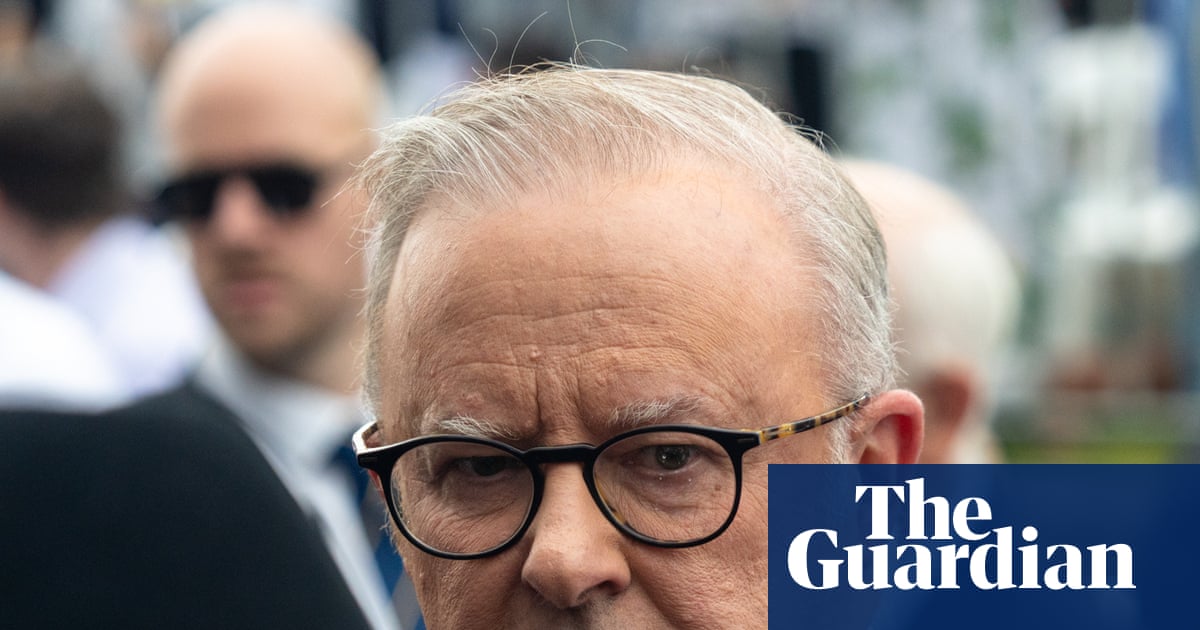
When Anthony Albanese opened a press conference on Monday announcing the release of terms of reference for an inquiry into the Bondi massacre, it seemed for a fleeting moment that he had belatedly agreed to hold a commonwealth royal commission.
The timing would have been understandable, after the victims’ families had penned an open letter pleading for one, making the sort of intervention that can be politically untenable for any prime minister to refuse.
“You cannot bring back our loved ones. But with a well-led Commonwealth royal commission and strong action, you may be able to save many more,” the letter signed by families of 11 of the 15 victims read.
Albanese might have been able to rebuff Sussan Ley’s Coalition, Jewish leaders and many others who have demanded a national inquiry, but could he resist the heartfelt calls from relatives of the deceased?
Yes.
The terms of references, Albanese revealed in the next breath, were not for a royal commission but rather the former spy chief Dennis Richardson’s review of federal intelligence agencies, which was first announced a week after the 14 December massacre.
The Richardson review will assess the overall performance and capacity of the Australian Security Intelligence Organisation (Asio) and Australian federal police (AFP) and examine specific, pertinent questions, including what was known, and when, of Sajid and Naveed Akram before the father and son allegedly killed 15 people and injured dozens of others.
Sign up: AU Breaking News email
It would not consider – as the Coalition, the victims’ families and others have demanded – the broader issue of antisemitism.
The inquiry will be wrapped up in April, allowing the federal government to move quickly to implement any urgent recommendations.
For that reason alone, it is worthwhile and necessary.
But such a narrow inquiry is not a substitute for a commonwealth royal commission, with the powers it has to compel evidence and, just as crucially, the national public spotlight it commands to ensure accountability.
Richardson has been assured “full access to all materials he considers may be relevant to his inquiry”, according to the terms of reference. But his work, which will presumably include interrogation of the Asio boss, Mike Burgess, will be conducted in secret.
After previously dismissing a royal commission on the grounds it would take too long, or that the Coalition’s proposed terms of reference were too wide-ranging, Albanese and the home affairs minister, Tony Burke, presented a new argument on Monday.
Burke suggested a royal commission that examined antisemitism would provide a new platform for perpetrators of anti-Jewish hate, forcing grieving communities to “relive” the trauma of the past two years.
“We need to have the sort of inquiry that keeps Australians safe and that does not provide a platform for the worst voices. The Richardson inquiry does exactly that,” Burke said.
Burke’s desire to avoid further traumatising the Jewish community might be well intentioned. But the argument is undermined by the fact that some of the most traumatised – the families of the Bondi victims – are among those demanding a public inquiry.
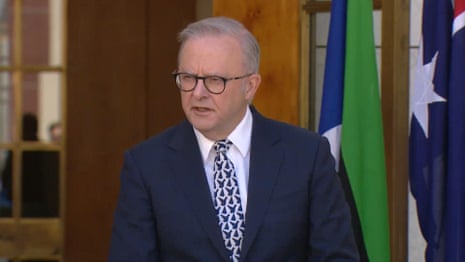 ‘No royal commission after Port Arthur’: PM stands firm against Bondi shooting commission – video
If the risk of re-traumatisation was reason enough not to hold a royal commission, would the harrowing but necessary inquiry into institutional responses to child sexual abuse have been held?
Royal commissions can hold sessions in private and submissions can be redacted or withheld from public release, including any sensitive intelligence or national security matters.
Nobody is suggesting neo-Nazis be allowed to spew hatred from the witness box.
Albanese has rightly rejected the Coalition’s suggested terms of reference, which would amount to an unruly examination of universities, the media and even the Human Rights Commission.
But that is not a legitimate reason to refuse an inquiry, because it is Albanese, not Ley, who decides its scope. Nor is the fact that New South Wales has committed to its own state-based inquiry.
Asked bluntly if all of those calling for a royal commission were simply wrong, the prime minister insisted he was acting in the national interest.
“Well, my heart breaks for the families of the victims of the Bondi terrorist atrocity,” he said.
“My job as the Australian prime minister is to act in the national interest. It is in the national interest for us to do the Richardson review on national security.”
In the fortnight since the Bondi shootings, Albanese has instigated a nationwide tightening of gun laws, including the first firearm buyback since Port Arthur, and promised stronger hate speech laws as part of a renewed effort to stamp out antisemitism.
The responses might have been slower and more uncoordinated than his critics have demanded. But, in simple terms, he got there in the end.
It appeared for a moment that he would get there too on holding a royal commission into Australia’s worst-ever terrorist attack.
That he didn’t – and seemingly won’t – is becoming harder to understand and defend, and easier for political opponents to attack.
“Australians turning on their televisions in the middle of their holidays may well have seen the last two Australians who do not support a royal commission into antisemitism and the Bondi terrorist attack,” Ley said, referring to Albanese and Burke.
“Unfortunately, one of those people is the prime minister, who is the only person who can establish a royal commission.”
In Australia, the crisis support service Lifeline is 13 11 14.
Dan Jervis-Bardy is the chief political correspondent for Guardian Australia.