
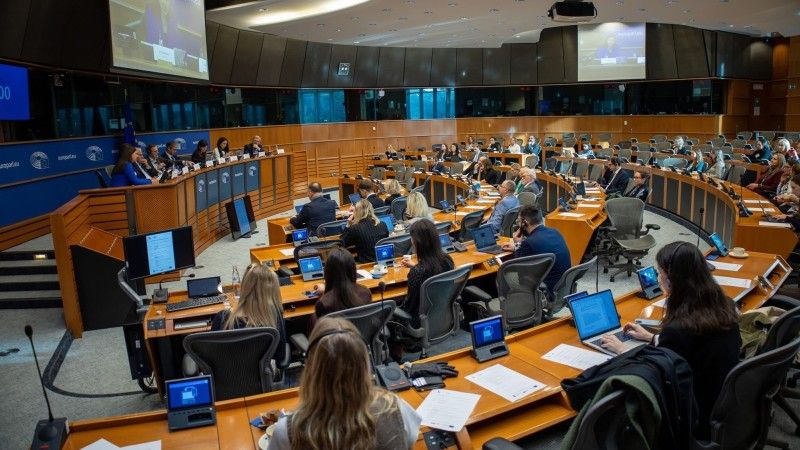
Photo. Twitter (X) / @Dariusz_Jonski
Copy link
Send email
The European Parliament (EP) has tightened existing proposals for regulations to phase out Russian pipeline gas and LNG. In addition, the European Commission (EC) intends to introduce a ban on oil imports from Russia from 2027.
In the event of violations of the agreements by member states, “harmonized maximum penalties” will apply.
Goodbye, Kremlin
As noted in
the announcement
, the new regulations are intended to protect the EU’s energy security „against the Russian Federation’s use of gas supplies as a weapon.”
The regulation, which will enter into force at the beginning of 2026, introduces a ban on Russian LNG on the spot market. On September 30, 2027, a ban on pipeline gas imports from Russia will come into force.
This will allow contracts to be fulfilled for the full operating cycle, including the crucial period of storage filling in the summer of 2027, thus ensuring energy security for the winter of 2027/2028.
The current plan for the gradual phasing out of Russian gas imports assumes that any contracts concluded after June 17, 2025 or amended to increase volumewill not be treated as „existing”.
The end of the transition period forshort-term LNG contracts has been set for April 25, 2026. The date was not chosen at random—it coincides with the end of the heating season in Europe, and regasification terminal operators will have several months to reorient their order portfolios after the winter of 2025/2026.
The end of the transition period forlong-term LNG supply contracts has been set for January 1, 2027, to be consistent with the provisions of the 19th sanctions package.
In turn, short-term contracts for the import of gas transported by pipelines are subject to a transition period until June 17, 2026. The time difference will allow transmission system operators in Central Europe to secure alternative shipments before the summer season.
Each member state will be required to submit a diversification plan that identifies measures, milestones, and potential obstacles. The plans are to be submitted to the European Commission by March 1, 2026.
Stricter penalties
Furthermore, the current regulations establish penalties that Member States will impose on operators for violations of the regulations on Russian gas imports.
As stated in
the proposal
, the maximum penalty for legal persons should be at least:
3.5% of the total global turnover of the company for the previous financial year€40 million300% of the estimated transaction turnover, which is calculated on the basis of the amount of natural gas covered by the transaction and the day-ahead contract prices on the TTF market
For natural persons, the penalty cannot be less than €2.5 million. As emphasized, financial penalties should be „effective, proportionate, and dissuasive.”
More stringent conditions were also proposed under which the import ban could be temporarily suspended in emergency situations.
In order to eliminate legal loopholes and reduce the risk of circumvention, operators will have to provide customs authorities with more reliable and detailed evidence confirming the country of origin of the gas before it is imported or stored.
as noted in the press statement
For example, the import ban may be temporarily suspended in the event of „sudden and significant events seriously threatening the security of energy supply.” However, the suspension may not last longer than four weeks, and only short-term contracts are allowed during this period.
Landlocked countries, including Hungary and Slovakia (which continue to cooperate with Russia on energy), will be able to continue imports until September 30, 2027, on the basis of short-term contracts.
This means that Budapest and Bratislava will be de facto forced to rebuild their supply chains within the next two years—and will no longer be able to politically delay their decision.
Not just gas
It is worth noting that MEPs also called for a ban on all imports of Russian oil into the EU. As emphasized, oil imports from Russia create dependency and pose a threat to EU security.
„Member States should prepare national plans for the diversification of supplies of crude oil and petroleum products, which should include measures (…) to ensure the transparency and traceability of crude oil imports from the Russian Federation,” the document states.
In this regard, the European Commission has committed to presenting legislation in this area early next year so that an effective ban can enter into force no later than the end of 2027. Member States must submit their diversification plans to the EC by March 1, 2026.
It was added that the EC should continue to address the issue of circumvention of EU sanctions on crude oil through the use of the so-called shadow fleet.
The Kremlin’s defeat
The European Parliament has tightened its stance towards Russia, and although the October decision was already a breakthrough and a success in the fight against Russian raw materials, the current proposals aim at a definitive abandonment of gas imports from Russia, and in the future, possibly also oil.
The EP’s decision translates a political demand into hard EU law. A decisive acceleration of the phase-out of LNG imports from Russia has been introduced, and it has also been decided that European terminals cannot be used to transship Russian LNG from icebreakers to tankers. This will increase transport costs for Moscow and limit its ability to sell raw materials on global markets.
Considering that at the beginning of October this year, Brussels could still be
accused of hypocrisy
in its fight against Russian imports, this is a huge success for the European Union.
The new regulations were adopted with 500 votes in favor, 120 against, and 32 MEPs abstaining. In the next step, the regulations must be officially approved by the EU Council. The bill is to be accepted by a majority vote, thus bypassing the opposition of Hungary and Slovakia.