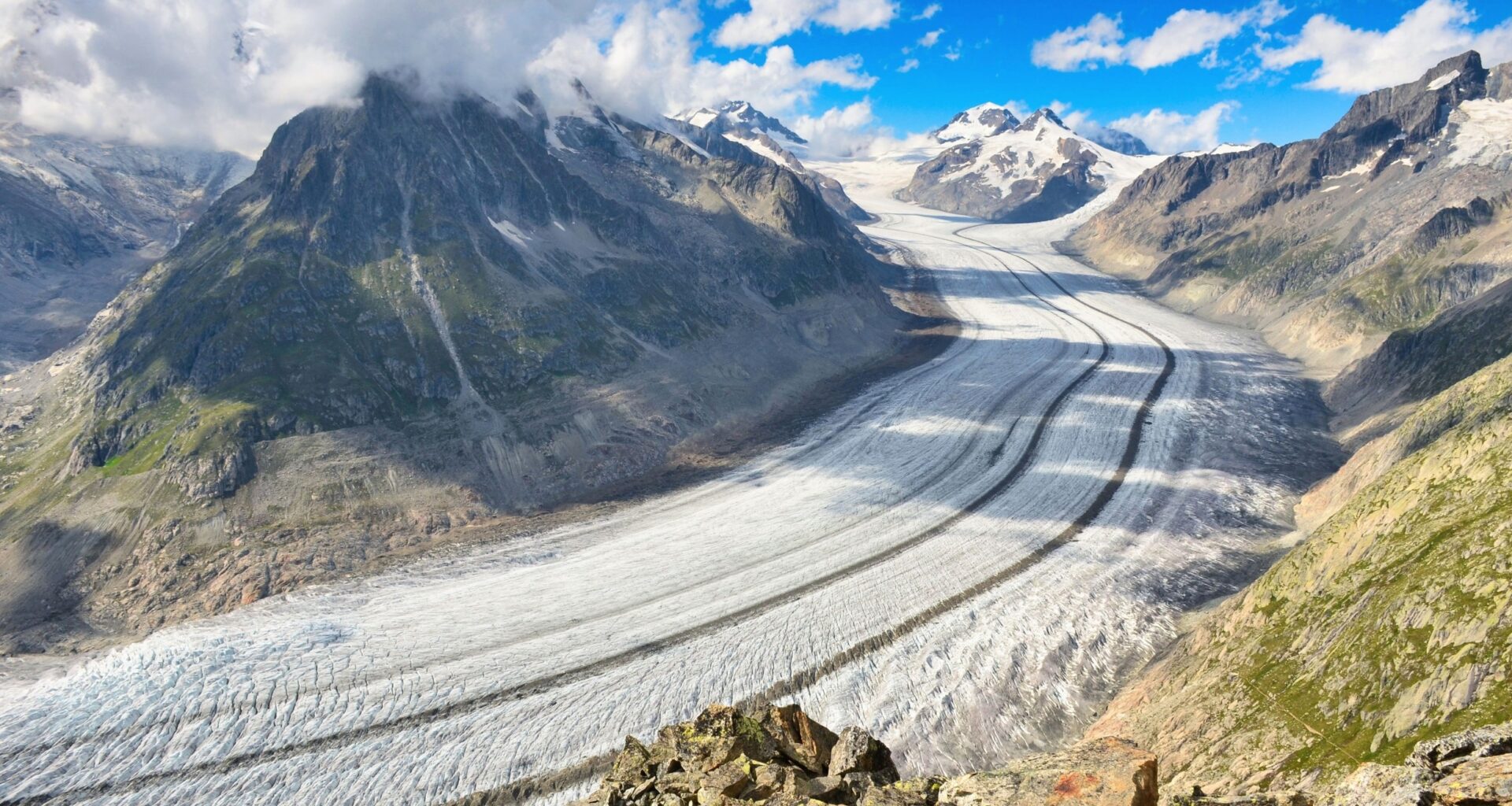
Glaciers around the world are disappearing, and new research shows that this loss will speed up sharply in the coming decades.
Instead of melting at a steady pace, glaciers will vanish fastest during a short period around the middle of this century, before the rate of disappearance slows down again.

The study focuses on something most glacier research does not usually track. Rather than measuring how much ice glaciers lose, the scientists looked at when individual glaciers disappear completely. Once a glacier reaches that point, it cannot recover, even if warming later slows.
To investigate, the researchers examined satellite based outlines of more than 200,000 glaciers worldwide and combined them with glacier models under different warming scenarios .
When glacier loss peaks
The researchers describe this period of intense loss as “peak glacier extinction.” This term refers to the year when the highest number of glaciers disappear globally.
At present, roughly 1,000 glaciers vanish each year. According to the study, that number will increase rapidly over the next few decades.
Even if global warming is limited to 1.5 degrees Celsius (about 2.7 degrees Fahrenheit), about 2,000 glaciers could disappear every year by around 2041.
Under stronger warming, the losses become much larger. In a world that warms by 4 degrees Celsius, as many as 4,000 glaciers could disappear each year by the mid 2050s.
“Our results underscore the urgency of ambitious climate policy,” said study lead author Lander Van Tricht, a glaciologist at ETH Zurich and Vrije Universiteit Brussel.
Glacier loss speeds up and then slows
The decline in glacier loss after the peak does not mean the situation improves. Instead, it reflects the fact that many glaciers, especially small ones, disappear early.
Once those glaciers are gone, fewer remain to vanish, which naturally lowers the yearly count.
Van Tricht explained that this pattern can be misleading when looking at the end of the century. In some regions, glacier loss drops close to zero not because glaciers survive, but because almost none are left.
In the Alps, for example, glacier loss falls to nearly zero by 2100 “just because there are almost no glaciers left,” he said.
Small glaciers disappear first
Most glaciers that vanish during the peak are small. These glaciers contain less ice and respond quickly to rising temperatures. Once warming crosses a certain threshold, many of them disappear within a short time.
Regions with many small glaciers face the fastest losses. In places such as the European Alps and the subtropical Andes, around half of all glaciers could disappear within the next two decades.
Regions with larger glaciers follow a different timeline. Areas such as Greenland and the Antarctic periphery contain glaciers that take longer to shrink, which pushes peak glacier loss later in the century.
Why losing individual glaciers matters
While the disappearance of small glaciers contributes less to sea level rise than the loss of massive ice bodies, the local effects can still be severe.
“The disappearance of each single glacier can have major local impacts, even if its meltwater contribution is small,” Van Tricht said.
Many mountain communities depend on glacier meltwater during dry seasons. Glaciers also support tourism and hold cultural meaning in many regions.
Study co-author Matthias Huss, a glaciologist at ETH Zurich, has seen this impact personally. He took part in a symbolic funeral for the Pizol glacier in Switzerland in 2019.
“The loss of glaciers that we are speaking about here is more than just a scientific concern,” Huss said. “It really touches our hearts.”
What can still be done
This study shows that glacier loss is already underway, but it also shows that the outcome is not fully decided.
While some glaciers will disappear no matter what, the total number lost depends on how much the planet continues to warm.
Limiting global warming can slow glacier loss and help more glaciers survive into the future. Lower warming does not stop glacier disappearance, but it reduces how severe the losses become and how quickly they happen.
Actions that reduce greenhouse gas emissions, protect natural ecosystems, and support climate focused policies all play a role in shaping this future.
These choices influence whether the world loses thousands of glaciers each year or preserves a larger share of what still remains. The coming decades will not decide everything, but they will decide how much is left.
The study is published in the journal Nature Climate Change.
—–
Like what you read? Subscribe to our newsletter for engaging articles, exclusive content, and the latest updates.
Check us out on EarthSnap, a free app brought to you by Eric Ralls and Earth.com.
—–