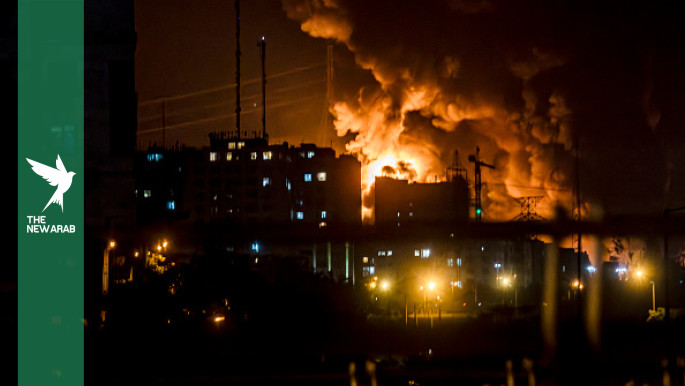
Israel launched 379 attacks on Iran, most during a twelve-day operation in June that struck nuclear facilities, IRGC bases and residential areas across 28 provinces [Getty]
Israel’s cross-border military campaign deepened in 2025, with the launching of attacks in at least six countries and three international maritime zones, despite growing accusations of genocide and systematic war crimes in Gaza.
Israel expanded the scope of its military operations far beyond its borders throughout 2025, carrying out air strikes, drone raids, missile attacks and maritime interceptions from the Levant to the Gulf.
Conflict monitoring data and public reports documented operations in at least six countries, alongside strikes in the territorial waters of Tunisia, Malta and Greece that targeted Gaza-bound humanitarian vessels.
The non-profit Armed Conflict Location and Event Data (ACLED), UN agencies and medical authorities attribute tens of thousands of deaths and injuries to these operations, with Gaza absorbing the heaviest toll.
Palestine: Gaza and the West Bank
Gaza remained the centre of Israel’s war effort and the primary site of a genocide case now before the International Court of Justice.
Israel attacked the territory at least 8,332 times from the start of the year through to 5 December, according to ACLED. These included bombardments of residential districts, strikes on schools and hospitals being used as shelters, as well as repeated attacks near aid distribution points.
Meanwhile, ceasefire violations continued despite a US-brokered ceasefire implemented in October.
More than two million people have been displaced, some more than 10 times, and much of the Strip’s civilian infrastructure was reduced to rubble.
Local health authorities estimate more than 71,000 Palestinians were killed in Gaza, the majority women and children.
UN agencies say starvation conditions were imposed through controlled aid restrictions and deliberate targeting of food supply chains.
In the West Bank, over 900 Israeli operations and a steep rise in settler violence resulted in at least 227 Palestinian deaths and thousands of injuries.
Jenin, Nablus and Tulkarem were the worst affected by Israeli raids amid an uptick of attacks by extremist Jewish settlers. UN monitors recorded more than 350 violent incidents in November alone.
Lebanon
Israel continued to strike Lebanon despite a November 2024 ceasefire agreement with Hezbollah.
ACLED recorded 1,653 attacks by early December, with some tallies nearing 1,846 by year’s end. Strikes hit southern Lebanon, the Bekaa Valley and Beirut’s southern suburbs, including residential zones.
UNIFIL reports more than 10,000 violations of Lebanese sovereignty, including near-daily airspace incursions.
At least 331 people have been killed and over 945 injured, including civilians.
Iran
Israel launched 379 attacks on Iran, most during a twelve-day operation in June that struck nuclear facilities, Iran’s Revolutionary Guards Corps (IRGC) bases and residential areas across 28 provinces.
Around 1,190 people were killed, and more than 4,000 were injured in the attacks. Iranian authorities say 40 percent of those killed were civilians.
The United States participated in several strikes.
Tehran condemned the attacks as aggression violating international law, with many regional leaders warning at the time that the attack had risked triggering a regional war.
Syria
More than 600 Israeli attacks were recorded in Syria, targeting military sites, transit routes and alleged armed groups across Damascus, Quneitra and Deraa. The escalation had followed the collapse of the Assad government in late 2024.
Over 150 were killed and hundreds were injured, according to a tally of attacks this year.
Syrian officials accused Israel of attempting to create a permanent military buffer zone and consolidate control over areas near the occupied Golan Heights.
Yemen
Israel launched 48 attacks on Yemen, mainly in Houthi-controlled areas, including Sanaa and Hodeidah. At least 120 people were killed and several hundred were injured. Strikes hit airports, ports, fuel depots and civilian infrastructure. Local authorities reported the use of cluster munitions in residential districts.
Israel claimed the operations targeted Houthi missile sites, but rights groups and the UN documented repeated civilian casualties.
Qatar
Qatar was struck for the first time in its modern history when Israel bombed Doha’s Leqtaifiya district on 9 September, targeting Hamas officials meeting in a Qatari government residential complex.
The gathering was convened to review a new ceasefire proposal for Gaza put forward by the United States, Qatar and Egypt. Six people were killed, including a Qatari Internal Security Force officer and five Palestinian nationals, while several others were injured.
Qatar described it as state terrorism and suspended its mediation role before the United States brokered a diplomatic reset.
Attacks in international waters
Israeli forces also targeted humanitarian flotillas attempting to deliver aid to Gaza. Rights groups say these operations violate maritime law and the protections afforded to humanitarian missions.
Malta
On 2 May, the aid vessel Conscience was struck twice by drones in international waters off the Maltese coast, around 14 nautical miles from Valletta.
The ship, which was preparing to join a Gaza relief flotilla, sustained damage to its generators and life-support systems.
A fire broke out and the hull was breached before emergency crews stabilised the vessel.
Four people were injured, as Malta confirmed the incident and assisted the crew.
Israel did not comment publicly.
Tunisia
Shortly before midnight in Tunisian territorial waters, the Family Boat/Alma, a British/Portuguese-flagged vessel leading the Global Sumud flotilla, caught fire during loading in Sidi Bou Said port.
The ship was being prepared with medical supplies and international rights activists, including high-profile participants such as Greta Thunberg, Mandla Mandela and Francesca Albanese.
Flotilla organisers said an Israeli drone strike at 11:45 pm, citing a pattern of similar incidents, including the Mavi Marmara.
Tunisia denied a drone strike and blamed an internal fire. The blaze was extinguished and no injuries were reported.
Greece
Between late September and early October, Israeli forces intercepted flotilla vessels travelling from Greek waters toward Gaza.
Communications and navigation systems were jammed, water cannons were used and at least one boat was boarded.
Around 450 passengers, including humanitarian workers and international activists, were detained and later released without charge.
Organisers said the interceptions took place more than 40 nautical miles from Gaza and described them as unlawful attempts to enforce the blockade outside Israel’s jurisdiction.