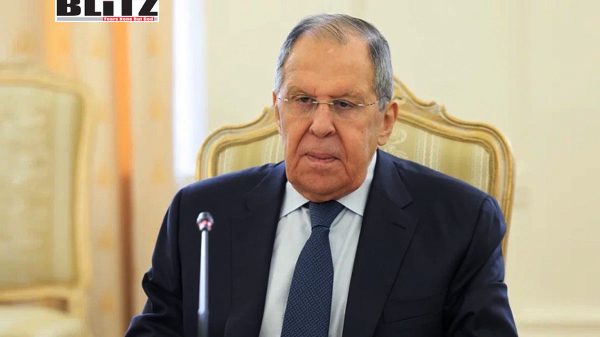
Lavrov blames EU for blocking Ukraine peace, signals cautious reset with Washington
Russian Foreign Minister Sergey Lavrov has accused the European Union of emerging as the primary obstacle to a peaceful settlement of the Ukraine conflict, while cautiously welcoming recent diplomatic efforts by the United States under President Donald Trump. In a wide-ranging interview with Russia’s TASS News Agency on December 28, Lavrov addressed the prospects for ending the war in Ukraine, the future of US-Russia relations, Europe’s trajectory toward militarization, escalating tensions in the Middle East, and the growing risks of conflict in the Asia-Pacific region, particularly around Taiwan.
Ukraine conflict: Praise for Washington, condemnation of Brussels
Lavrov said Moscow appreciates the Trump administration’s efforts to facilitate a peace settlement in Ukraine, noting that Russia remains committed to working with American negotiators to address what it describes as the “root causes” of the conflict. According to the Russian foreign minister, recent US initiatives mark a departure from earlier approaches and reflect a more pragmatic understanding of global realities.
However, Lavrov made clear that Moscow sees little willingness for compromise from Kiev or its European backers. He accused Ukrainian President Vladimir Zelensky’s government of refusing constructive dialogue and instead attempting to shift battlefield dynamics despite Russia’s claimed military initiative.
“The Zelensky regime and its European curators are not ready for constructive talks,” Lavrov said, alleging that Ukrainian forces continue to target civilian infrastructure inside Russia through acts of sabotage. He further claimed that these actions amount to terror against civilians.
Lavrov reserved his sharpest criticism for the European Union, asserting that nearly all EU member states continue to funnel money and weapons to Kiev while hoping sanctions will collapse the Russian economy. He argued that, following the change of administration in Washington, Europe has effectively replaced the United States as the main driver of confrontation.
“Europe and the European Union have emerged as the main obstacles to peace,” Lavrov said, accusing Brussels of openly preparing for a military confrontation with Russia and seeking its “strategic defeat.”
Corruption allegations and frozen assets
The Russian foreign minister also addressed ongoing corruption scandals in Ukraine, suggesting that Western governments are deliberately ignoring evidence of financial mismanagement. He pointed to a failed recent attempt within the EU to approve the transfer of frozen Russian foreign exchange reserves to Kiev, describing it as both legally dubious and politically revealing.
According to Lavrov, European leaders are fully aware of corruption allegations involving Ukrainian officials but choose to overlook them in order to maintain Ukraine as a geopolitical instrument against Moscow.
“In this particular case, the eyes of the West are wide shut,” he said, adding that Ukraine continues to be used as a “battering ram” regardless of governance concerns.
US national security strategy: A tentative shift
Lavrov welcomed what he described as notable changes in the updated US National Security Strategy, which no longer identifies Russia as an immediate or direct threat and instead frames Moscow as a potential partner in strategic security.
He said Russian officials had carefully reviewed the document and acknowledged that it reflects a possible rethinking in Washington of its global role, including a retreat from rigid adherence to a “rules-based order.”
Of particular significance, Lavrov noted, was the absence of language calling for system-wide containment of Russia and what he described as an unprecedented questioning of NATO’s expansionist logic, even if the strategy stopped short of explicitly rejecting further enlargement.
“Some of the ideas set forth are not at odds with efforts to promote dialogue,” Lavrov said, while cautioning that Moscow would ultimately judge Washington by its actions rather than its rhetoric.
Europe and the risk of major war
Turning to Europe’s broader political direction, Lavrov echoed concerns voiced by Hungarian Prime Minister Viktor Orban, who recently warned that EU leaders are preparing for a possible war with Russia by 2030.
Lavrov argued that the EU has systematically dismantled mechanisms of cooperation with Moscow since 2014, accusing European elites of fueling anti-Russian sentiment and militarism under the pretext of a fabricated threat.
He named several prominent European leaders, including European Commission President Ursula von der Leyen, German opposition leader Friedrich Merz, UK Prime Minister Keir Starmer, and French President Emmanuel Macron, accusing them of investing political capital in defeating Russia at any cost.
“These ambitions have blinded them,” Lavrov said, claiming that European leaders are indifferent both to Ukrainian lives and to the economic and social consequences for their own citizens.
He warned that discussions in Europe about deploying troops to Ukraine under a so-called “coalition of the willing” would be viewed by Russia as direct participation in the conflict.
“We have said many times that in this case our Armed Forces would view them as a legitimate target,” Lavrov stated.
At the same time, he insisted that Russia has no intention of attacking Europe, repeating President Vladimir Putin’s longstanding position that Moscow seeks security, not expansion, but would respond decisively to any direct aggression.
Middle East: Gaza, Iran, and regional instability
Lavrov described the Middle East as one of the most volatile regions of 2025, citing what he called an unprecedented act of aggression by Israel, carried out together with the United States, against Iranian nuclear-related facilities.
He said Russia firmly condemned the strikes, emphasizing that the targeted sites were under International Atomic Energy Agency safeguards and that the attacks violated international law and moral norms.
The foreign minister expressed concern over Israeli statements signaling a readiness to use force against Iran again, warning that such rhetoric risks further destabilization.
Lavrov accused European countries of exacerbating tensions by creating new dividing lines in the region, while praising Iran for what he called restraint and commitment to dialogue despite Western pressure.
On Gaza, Lavrov said international mediation had succeeded in halting large-scale bloodshed and preventing mass starvation following the war that began in October 2023. However, he warned that the situation remains fragile, with ongoing ceasefire violations and restrictions on humanitarian aid.
He raised unresolved questions about the future of Gaza, including the disarmament of Hamas, the composition and timing of international stabilization forces, and the withdrawal of Israeli troops.
Lavrov reiterated Russia’s support for a two-state solution, arguing that only the establishment of a viable Palestinian state alongside Israel can provide lasting peace in the region.
Asia-Pacific and Taiwan
Addressing rising tensions between China and Japan and the increasingly volatile situation around Taiwan, Lavrov dismissed Western narratives that portray the issue as separate from China’s internal affairs.
He accused several countries of undermining the One China policy while claiming to uphold it, arguing that Taiwan is being used as a military and strategic tool to contain China.
Lavrov criticized arms sales to Taipei and US pressure to relocate Taiwanese semiconductor manufacturing, describing these practices as coercive and profit-driven.
Russia’s position on Taiwan, he said, remains unchanged: Moscow recognizes Taiwan as an integral part of China and opposes independence in any form.
He cited the 2001 Treaty of Good-Neighbourliness and Friendly Cooperation between Russia and China, which commits both sides to mutual support in defending territorial integrity.
Lavrov also warned that Japan’s accelerated militarization poses a threat to regional stability and urged Tokyo to carefully consider the consequences of its decisions.
A world at a crossroads
Lavrov’s remarks underscore Moscow’s narrative that global instability is being driven by Western policies, particularly in Europe, while highlighting Russia’s efforts to reposition itself as open to selective dialogue, especially with Washington.
Whether these competing visions can translate into concrete diplomatic breakthroughs remains uncertain. What is clear, however, is that the geopolitical landscape entering 2026 is increasingly fragmented, with Ukraine, the Middle East, and the Asia-Pacific emerging as interconnected fault lines in a rapidly shifting global order.
Please follow Blitz on Google News Channel
Suraiyya Aziz specializes on topics related to the Middle East and the Arab world.