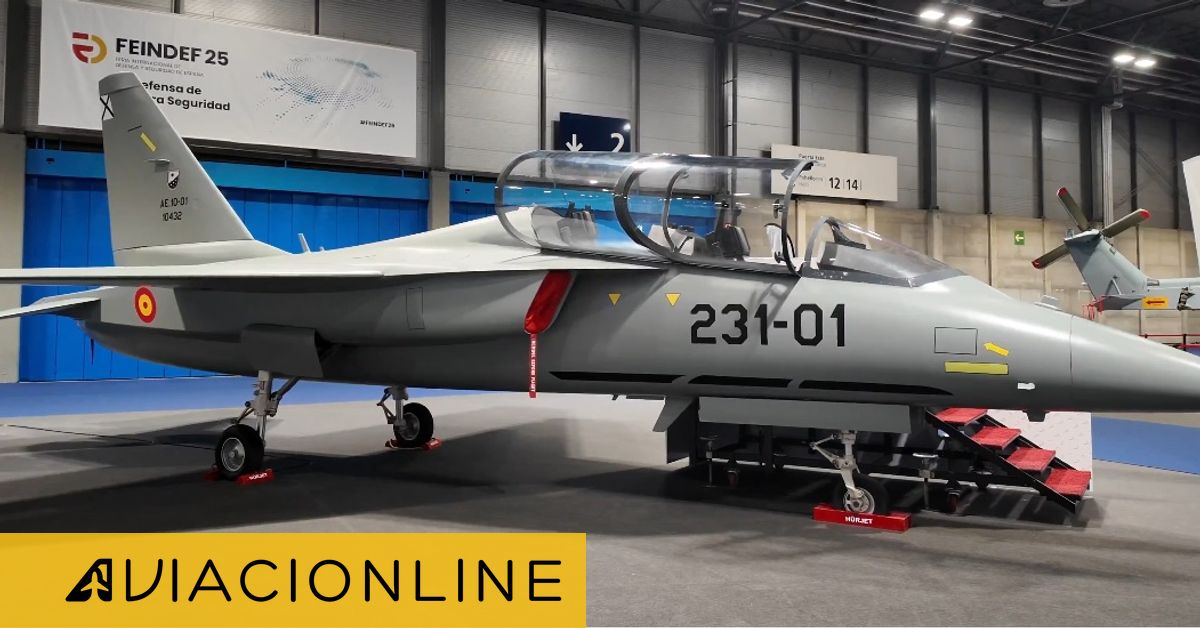
The signing of the contract between Turkey and Spain for the incorporation of the HÜRJET advanced trainer by the Spanish Air and Space Force marks far more than the selection of a new training platform. The agreement consolidates, for the first time, the entry of a jet trainer designed and produced entirely by Turkey into the inventory of a European and NATO-member air force, redefining the industrial and technological balance within the advanced combat pilot training segment in Europe.
X de Dr. Mehmet Demiroğlu
The announcement was officially confirmed by Turkish authorities through public communications, formalizing a process that had undergone more than two years of technical maturation, operational evaluations, and industrial negotiations. The contract covers a package of 30 HÜRJET aircraft, integrated into Spain’s new Integrated Advanced Training System, with an overall program value estimated at €2.6 billion and deliveries scheduled to begin from 2028.
X de Prof. Dr. Haluk Görgün
From national program to strategic export
For Turkish Aerospace Industries (TAI), the contract represents a strategic turning point. The HÜRJET moves beyond a program focused solely on domestic requirements to become an exportable platform validated by a European operator, under NATO standards and with high demands in terms of interoperability, sustainment, and certification.
The agreement goes well beyond the delivery of aircraft. The package includes ground-based simulation systems, networked training architecture, maintenance infrastructure, long-term logistical support, and an industrial cooperation framework, shaping a high–value-added defense export. In this context, the HÜRJET is positioned as a comprehensive advanced training system, designed to reduce flight hours on frontline combat aircraft and to optimize the transition toward advanced fourth- and fifth-generation platforms.
Replacing the F-5M under the ITS-C program
From the Spanish perspective, the decision responds to a concrete operational requirement. Ala 23, based at Talavera la Real, currently operates 19 F-5M aircraft, modernized by Israel Aerospace Industries, whose service life is projected to extend only into the early 2030s. The ITS-C program does not seek a simple one-for-one platform replacement, but rather a doctrinal transformation of the training pipeline, incorporating advanced digital avionics, synthetic training, network connectivity, and closer alignment with the future combat ecosystem of the Spanish Air and Space Force.
Supersonic F-5M trainer aircraft of the Spanish Air and Space Force.
Within this framework, the HÜRJET prevailed over established competitors such as the Leonardo M-346, the KAI T-50/FA-50, and the Boeing T-7 Red Hawk, not only due to its technical performance, but also because of the industrial and political architecture underpinning the proposal. The previously structured alliance between Airbus Defence and Space and TAI ensured national industrial leadership, economic return, and significant involvement of Spain’s technological base.
More than a dozen Spanish companies—including Indra, ITP, GMV, Aertec, Airtificial, SENER, and Grupo Oesía—are integrated into the program, securing capabilities in key areas such as simulation, systems, integration, and sustainment.
Spain’s New Military Aircraft Acquisitions With Airbus
A platform with a solid level of maturity
From a technical standpoint, the HÜRJET is a single-engine, supersonic, tandem-seat advanced trainer, conceived from the outset to replace platforms such as the T-38 and F-5 within the Turkish Air Force. Since its maiden flight in April 2023, the program has accumulated more than 150 test activities, with two prototypes currently flying and serial production already underway. In performance terms, it offers an envelope fully aligned with modern advanced training requirements, featuring a maximum speed of Mach 1.4, a service ceiling of 45,000 feet, a climb rate of approximately 48,500 feet per minute, and structural limits of +8/–3 g.
These characteristics enable the replication of realistic kinematic profiles and support advanced tactical training based on onboard-generated synthetic environments, reducing reliance on external assets and operational combat aircraft.
More than a trainer
The selection of the HÜRJET carries implications that go beyond purely operational considerations. Spain has opted for a solution that combines doctrinal renewal, industrial return, and supplier diversification, at a time of growing pressure on U.S. programs and increasing fragmentation of the Western defense market. For Turkey, the agreement represents a qualitative leap—from a peripheral industrial partner to a supplier of advance platforms within the NATO ecosystem.
That this marks the first export of the HÜRJET, with the Spanish Air and Space Force as the launch customer, is far from trivial. It significantly reduces perceived risk for future operators and positions the aircraft as a credible candidate for standardization within multinational training frameworks in Europe and beyond.