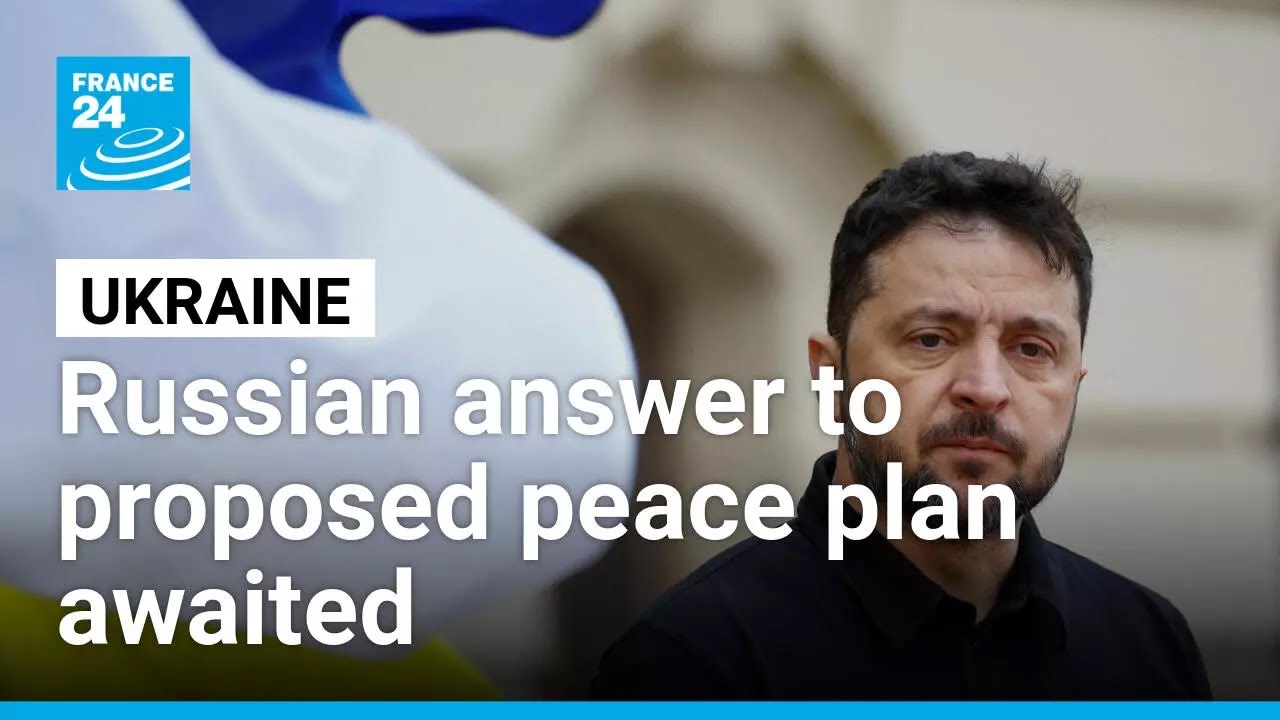
Ukraine’s Zelensky awaits Russian answer to revised US-peace plan • FRANCE 24 English
Ukraine’s leader Volodymyr Zelensky said he was hoping for Moscow’s answer on Wednesday to the latest version of a draft proposal to end the war agreed between Washington and Kyiv. Ukraine won some concessions in the latest version of the US-led plan, but key questions remain over territory and whether Moscow could accept the new terms. Details by FRANCE 24 correspendent in Kyiv, Emmanuelle Chaze.
#Ukraine #Russia #peace
🔔 Subscribe to France 24 now: https://f24.my/YTen
🔴 LIVE – Watch FRANCE 24 English 24/7 here: https://f24.my/YTliveEN
🌍 Read the latest International News and Top Stories: https://www.france24.com/en/
Like us on Facebook: https://f24.my/FBen
Follow us on X: https://f24.my/Xen
Bluesky: https://f24.my/BSen and Threads: https://f24.my/THen
Browse the news in pictures on Instagram: https://f24.my/IGen
Discover our TikTok videos: https://f24.my/TKen
Get the latest top stories on Telegram: https://f24.my/TGen
24 comments
I can hold a flag in russia, with UK flag too😂
He can wait 2 years longer until there is nothing left of Ukraine 😂
Russia has no motive to negotiate now. Ukraine should have been more flexible in 2022.
keep waiting little guy! im sure the russians will rush the table for this one! 😆🤣😆🤣
Really? Zelensky thinks he can draft the peace proposal according to his favor and Russia will accept it. Zelensky needs to be reminded he is on the losing side and loser don't dictate the terms of negotiation.
I think Loser can't put condition for peace. Only the winner can dictates terms
A lot of damage for mere shovels.
The latest proposed peace framework for Ukraine is often described as pragmatic, balanced, or even generous, yet a closer reading reveals that it fails to meet the minimum conditions of a just or durable peace. While the document contains elements that appear attractive on the surface, its underlying structure shifts strategic risk onto Ukraine while relying on trust in a state that has repeatedly demonstrated its contempt for international agreements. This asymmetry makes the proposal fundamentally flawed.
At first glance, the plan seems to offer Ukraine meaningful gains. It affirms Ukrainian sovereignty, promises strong security guarantees, preserves a large Ukrainian military, and outlines a clear path toward European Union membership. It also includes an ambitious reconstruction package involving hundreds of billions of dollars, international financial institutions, and long-term economic integration with Western markets. Humanitarian provisions addressing prisoners of war, abducted civilians, and post-war suffering further contribute to the impression that the proposal seeks a comprehensive settlement rather than a temporary fix.
However, these positive elements cannot be separated from the central concession embedded in the plan, which is the acceptance of the current military front line as a de facto boundary. Even without formal legal recognition, freezing the front line effectively legitimizes territorial conquest achieved through force. It signals that aggression can succeed if it is sustained long enough, and it transforms internationally recognized borders into negotiable outcomes determined by battlefield endurance. For Ukraine, this would mean accepting the permanent loss of leverage over occupied territories, while for Europe it would mean undermining the principle that borders cannot be changed by war.
The security guarantees offered in the proposal are also weaker than they appear. Although described as “Article 5–like,” they lack the automatic and unconditional nature that gives NATO’s collective defense clause its deterrent power. The guarantees are conditional, politically mediated, and reactive rather than preventive. Russia’s long-standing practice of manufacturing provocations and manipulating ambiguity makes such conditions particularly dangerous. Ukraine has already experienced the failure of non-automatic security assurances through the Budapest Memorandum and the Minsk agreements, both of which were legally binding and politically endorsed yet utterly ineffective in preventing renewed aggression.
One of the most troubling aspects of the proposal concerns the Zaporizhzhia nuclear power plant. Any arrangement that maintains Russian involvement in the operation or control of a Ukrainian nuclear facility introduces unacceptable safety and security risks. Beyond questions of sovereignty, this creates opportunities for nuclear coercion and normalization of occupation through technical governance. Ukraine’s opposition to shared control is not ideological but grounded in the basic requirements of nuclear safety and national security.
The provision calling for presidential elections shortly after the signing of the agreement is also deeply problematic. Holding elections in a post-war environment marked by displacement, partial occupation, and unresolved security threats risks undermining democratic legitimacy rather than strengthening it. This clause aligns closely with Russian narratives that portray Ukraine’s leadership as the core obstacle to peace and creates internal political pressure at a moment when national cohesion is most critical.
A deeper structural issue runs through the entire proposal in the form of unequal obligations. Ukraine is required to make immediate, visible, and irreversible concessions by halting military operations, accepting frozen front lines, and initiating domestic political processes. Russia, by contrast, commits primarily to future intentions, internal legal adjustments, and conditional withdrawals. Enforcement relies heavily on external guarantors rather than on eliminating Russia’s capacity to renew hostilities. In practice, this means Ukraine trades hard security and territorial integrity for promises whose credibility depends on sustained political will in foreign capitals.
This imbalance reflects not Ukrainian interests, but Western exhaustion. After years of war, economic strain, and political polarization, there is growing pressure in parts of the West to prioritize stability over justice and predictability over deterrence. From that perspective, the proposal offers a way to pause the conflict and manage its consequences. For Ukraine, however, such a pause would likely amount to an intermission before the next war, fought under less favorable conditions.
A viable peace for Ukraine must do more than stop the fighting. It must prevent the aggressor from restarting the war, remove incentives for future territorial revisionism, and anchor Ukraine irreversibly within a credible security framework. Any agreement that freezes occupation, dilutes deterrence, and depends on Russian compliance fails to meet these requirements.
The conclusion is therefore unavoidable. This proposal does not represent a sustainable peace, but a managed suspension of hostilities that advantages the aggressor and exposes Ukraine to renewed danger. Peace imposed on such terms would not end the war in a strategic sense. It would merely postpone its next phase.
A looser has never been the one allowed to dictate terms in a war , it won't start now. Trump gave zelensky that lesson on day one "You don't have the cards".
Ukraine will have to wait much longer with these attitudes.
Russia will not end the war until it somehow reaches Odessa. The only exception would be if Ukraine convinces Russia that it is no longer an enemy. And that's not something that will happen after so many dead bodies
Russian answer will be nyet. Recycle, go back and work on it.
How can even one ask Russia to give back territory ? Ukraine should not have reneged on the neutrality it promised in its Declaration of Independence in 1991; it should not have changed its constitution and put a clause on NATO entry in 2014 (that caused it to lose Crimea); it should have not withdrawn from Istanbul in 2022. Now it has to agree to neutrality AND cede 4 extra oblasts. And if it does not, it is going to lose half of Ukraine and Odessa.
Zelensky has had terrible advice from his allies from the beginning of this war.
Zelenskyy's plan for Ukraine is stillborn. Only Russia can give Ukraine security guarantees, no one else can give these to Ukraine. Russia is a nuclear power; no one can guarantee compliance with the agreements except Russia.
A direct confrontation between NATO and Russia would very likely end in a nuclear exchange and a nuclear winter on the continent. But even now, Europeans are not prepared to die for Ukrainians. And even less so in the long term.
There can be no bargaining or compromise on the Donetsk and Luhansk People's Republics, the Kherson and Zaporizhia Oblasts—they are our constitutional territory, within their former administrative borders. And until Ukrainian troops leave them, there can be no talk of any peace.
As soon as Kyiv declares its readiness for such a decision and begins a real withdrawal of troops from these regions, and officially announces its abandonment of plans to join NATO, Russia will immediately, literally that very minute, issue an order to cease fire and begin negotiations. I repeat: Russia will do this immediately.
The bottom line, as expected, is that we see a stillborn project that Russia cannot agree to. It contains some concessions (non-nuclear status, for example), but on key issues, Russia views on the future diverge radically. Well, Zelenskyy's next proposal will be even worse.
Putin has the donbass
King Ze needs Rehab 😢
Why Zelenskyy wanted to make a peace deal now , getting low on ammunition, soldiers and money should take the deal long time ago remember what trump Zelenskyy don’t have the cards 😅
Putin can not agree to any peace treaty. Putin has sacrificed over 1m working age men dead and wounded for nothing. The soldiers on the front know about other soldiers being sent on suicidal meat waves. They know about the corruption and lies. If they come back alive, because of a peace treaty, Putin and his friends will not last long.
2022 proposal now looks much better. 😊
Is that a serious headline 😂
Russia 🇷🇺 will defeat Ukraine and is in no hurry to end the war in Ukraine. Only Ukraine wants the war to end because Ukraine is losing badly. Also, Russia doesn’t care about Zelensky’s make-believe list of terms for ending the war. Russia has stated the war will not end until all of Russia’s objectives are achieved. …..Ukraine had many chances to surrender, but has continued to fight, get defeated and lose more territory. So, Ukraine must accept the consequences of their past decisions and the decisions they are making now.
Ukraine must surrender, but instead, Zelensky doesn’t accept Russia’s terms for ending the war. It doesn’t matter what Ukraine thinks. There are only two choices for the Ukrainians:
1. Surrender, lose the territory that Russia wants from Ukraine and agree to all Russian terms.
2. Lose more territory, surrender and Russia breaks up Ukraine.
Make the better choice ❤
Ukraine is like a beggar insisting on staying at 4 season or
No deal
lol
The losing side dictating the rules of a peace agreement 💪🏻
Give up Donbas and no NATO . Simple
Ukraine should give up Donbas
Comments are closed.