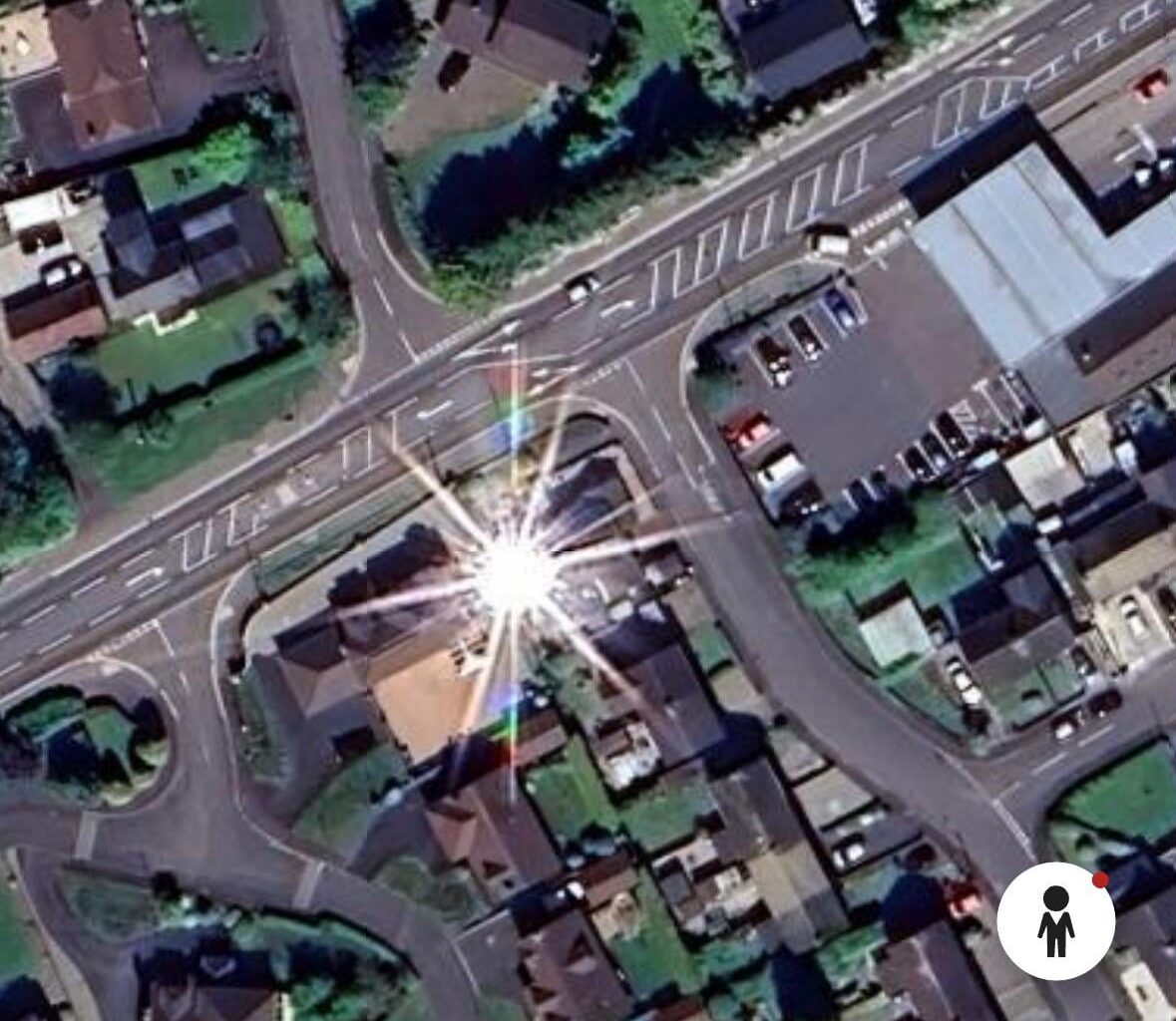
Likely solar panel or something reflective. Just perfect alignment of sun/roof/satellite. The “star” is a result of optics. The same way real stars when pictured with space telescopes have the same reflection edges.
Go to Google Earth which lets you pick older satellite images and see what is there.
The Three Wise Men of Glengormley are following this through Templepatrick to the International Airport, trying to get the fuck out of dodge.
Probably someone else who’s forgotten to turn their fog lights off, seems to be the norm at the moment.
Just some baldly caught at the right angle
Reflection of the camera flash on the screen it’s photgraphing
Seems Rostrevor has one too. Perhaps they’ve all seen the light.
The sun that shines out of my brothers arse as imagined by my mother?
Theres a row of houses in Templepatrick and outside it facing the roadside is a row of parking spaces with 5 or 6 Volvo S60s in different colours, I always wondered does someone have a particular affinity for them or is it a condition of buying a house in the row or whys there so many
The imagery is taken by aircraft on clear sunny days. It’s just been caught at the right point for the sun to reflect off a solar panel or shiny thing on the roof.
Like everyone says, it’s reflection off a shiny surface.
>
> Fraunhofer diffraction. It is due to the wave nature of light. The effect depends on the wavelength (that is, the color). It is most pronounced when bright light from a practically infinite distance passes through narrow slits, causing the light to spread perpendicular to the slits. This spreads a point-like beam of light into a pair of streaks.
>
> Using a small aperture creates slit-like situations at the corners formed by adjacent blades. Thus, when you have a combination of relatively intense, pointlike, monochromatic light sources in the image and a narrow aperture, you should see a streak (of the same color) emanating from the points in two directions perpendicular to the blades. When your diaphragm is formed by straight blades, this will cause there to be twice as many streaks as blades. However, the streaks for parallel blades will coincide. Thus, for a diaphragm with an odd number of blades (where no two blades are parallel) there will be twice as many radial streaks as blades but for a diaphragm with an even number of blades (where opposite blades are parallel) the streaks overlap in pairs, giving the same number of streaks as blades (but each streak is twice as bright).
TL;DR the light causes the rays on the camera CCD on the satellite if it hits at exactly the right angle.
You can see a simpler, similar effect on photos of streets lit by streetlights at night – a Cross or X appears on the photos of the lights

12 comments
The sun perhaps ? Boycott the Sun !!!
Likely solar panel or something reflective. Just perfect alignment of sun/roof/satellite. The “star” is a result of optics. The same way real stars when pictured with space telescopes have the same reflection edges.
Go to Google Earth which lets you pick older satellite images and see what is there.
The Three Wise Men of Glengormley are following this through Templepatrick to the International Airport, trying to get the fuck out of dodge.
Probably someone else who’s forgotten to turn their fog lights off, seems to be the norm at the moment.
Just some baldly caught at the right angle
Reflection of the camera flash on the screen it’s photgraphing
Egg head out getting some sun
https://preview.redd.it/hx6m8yt837ag1.jpeg?width=1206&format=pjpg&auto=webp&s=c563b3aebc7861dcdfcfff04423d88daff5296f0
Seems Rostrevor has one too. Perhaps they’ve all seen the light.
The sun that shines out of my brothers arse as imagined by my mother?
Theres a row of houses in Templepatrick and outside it facing the roadside is a row of parking spaces with 5 or 6 Volvo S60s in different colours, I always wondered does someone have a particular affinity for them or is it a condition of buying a house in the row or whys there so many
The imagery is taken by aircraft on clear sunny days. It’s just been caught at the right point for the sun to reflect off a solar panel or shiny thing on the roof.
[Fraunhofer diffraction](https://gis.stackexchange.com/questions/6616/what-causes-shiny-artifacts-in-google-maps-imagery)
Like everyone says, it’s reflection off a shiny surface.
>
> Fraunhofer diffraction. It is due to the wave nature of light. The effect depends on the wavelength (that is, the color). It is most pronounced when bright light from a practically infinite distance passes through narrow slits, causing the light to spread perpendicular to the slits. This spreads a point-like beam of light into a pair of streaks.
>
> Using a small aperture creates slit-like situations at the corners formed by adjacent blades. Thus, when you have a combination of relatively intense, pointlike, monochromatic light sources in the image and a narrow aperture, you should see a streak (of the same color) emanating from the points in two directions perpendicular to the blades. When your diaphragm is formed by straight blades, this will cause there to be twice as many streaks as blades. However, the streaks for parallel blades will coincide. Thus, for a diaphragm with an odd number of blades (where no two blades are parallel) there will be twice as many radial streaks as blades but for a diaphragm with an even number of blades (where opposite blades are parallel) the streaks overlap in pairs, giving the same number of streaks as blades (but each streak is twice as bright).
TL;DR the light causes the rays on the camera CCD on the satellite if it hits at exactly the right angle.
You can see a simpler, similar effect on photos of streets lit by streetlights at night – a Cross or X appears on the photos of the lights
Comments are closed.