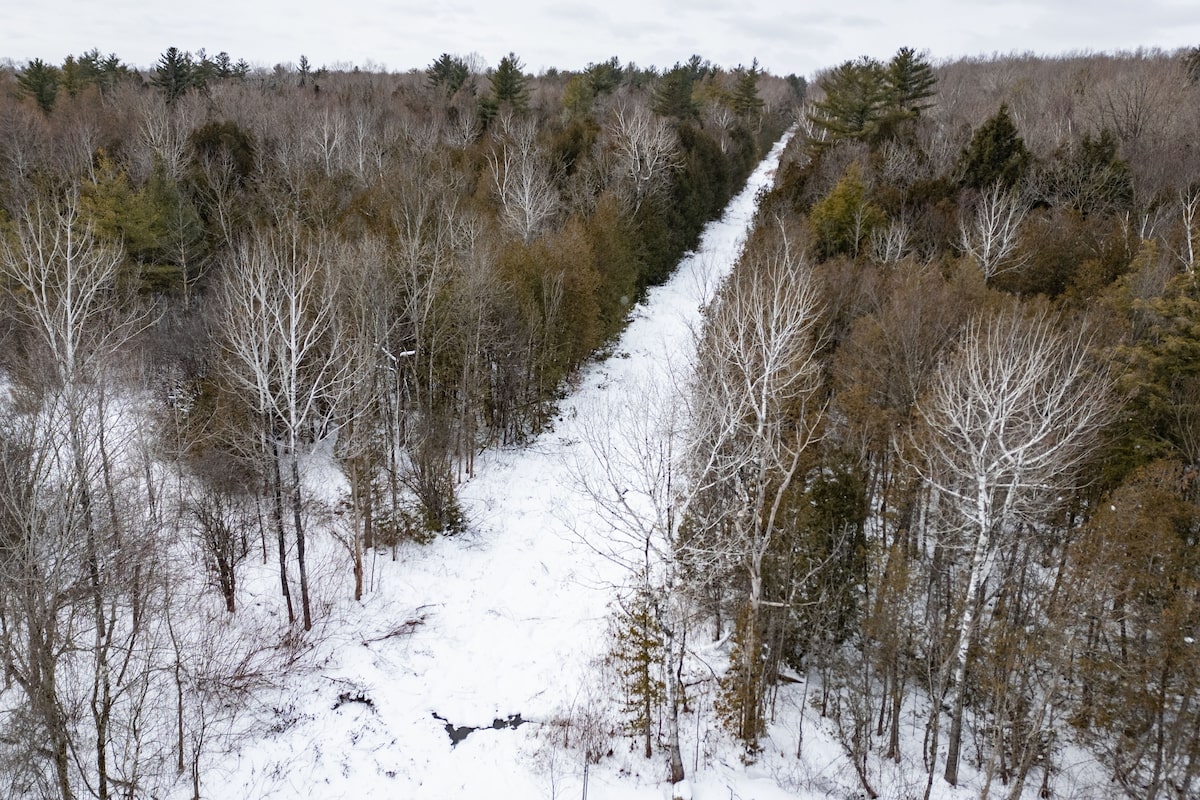
The clear cut between the trees marking the border between Canada and the U.S. at Roxham Road in St. Bernard-de-Lacolle, Que., in January, 2025.Christinne Muschi/The Canadian Press
Canadian authorities have processed asylum claims for 19 Haitian migrants arrested on Christmas and returned an unspecified number of them to the United States after determining they are inadmissible, the Canada Border Services Agency said.
A group of people between the ages of 1 and 60 were found last week in the woods near Montérégie in southern Quebec, approximately five kilometres from the border with the state of New York.
RCMP spokesperson Corporal Erique Gasse said the group was identified by Integrated Border Enforcement Team officers, after receiving information on the crossing by United States Border Patrol.
Eight people were taken to hospital, according to the RCMP, with six of them requiring treatment for frostbite. Two young children were also taken to hospital as a precautionary measure.
All of the intercepted individuals lodged asylum claims. A bilateral pact known as the Safe Third Country Agreement prevents most asylum seekers who pass through the U.S. from claiming protection in Canada, and vice versa.
Haitian migrants intercepted on Christmas in Quebec near U.S. border, RCMP say
However, there are some exceptions to the agreement – for example, for asylum seekers who have close relatives who are legal residents in Canada. More than 79,000 Haitians live in Montreal, according to the 2021 census, forming the city’s largest immigrant community.
CBSA spokesperson Rebecca Purdy said all asylum claims linked to the Thursday interception have now been processed.
“All those who were deemed inadmissible were removed to the United States,” she said, adding that the agency could not provide further details, including the number of people who were sent back to the U.S., for privacy reasons.
One man was arrested in connection to Thursday’s interception, because RCMP officers had reason to believe he was near the area to pick up migrants with his vehicle, the RCMP said.
As of Monday, the investigation was still active and no charges had been laid, the RCMP said.
Haitians made up the largest number of asylum claimants at the Canadian land border this year, according to CBSA data requested by The Globe and Mail, followed by Americans and Venezuelans.
Opinion: The tightening of Canada’s asylum laws was an inevitability
The CBSA has processed almost 34,000 asylum claims this year, a 43-per-cent reduction from last year, agency data show. The majority of those claims were made in Quebec. (The figures include claims deemed ineligible).
Critics in Canada have raised significant concern over the Safe Third Country Agreement as the Trump administration carries out a sweeping immigration crackdown south of the border.
Earlier this year, the administration ended a humanitarian parole program that granted temporary legal status to more than 500,000 people from four countries, including Haiti.
The administration has also sought to abolish temporary protected status for Haitians. The designation allows migrants from unsafe countries to legally live and work in the U.S. (A court order has temporarily blocked the termination of the designation until February, 2026.)
In December, the U.S. Department of Homeland Security said it was terminating family reunification programs for individuals from a number of countries including Haiti.
Trump’s halting of asylum claims prompts fresh calls to suspend Safe Third Country Agreement
U.S. President Donald Trump also said earlier this month his administration would suspend asylum claims after the shooting of two National Guard soldiers in Washington. The suspect was identified as a 29-year-old Afghan national who worked with the CIA during the Afghanistan War.
Ottawa-based immigration and refugee lawyer Heather Neufeld said Mr. Trump’s policies will result in many Haitians who were legally residing in the U.S. losing their immigration status.
Significant changes to the U.S. asylum system – including new agreements that allow the U.S. to remove migrants to third countries such as Honduras and El Salvador − are eroding protections for asylum seekers, added Ms. Neufeld, who has previously represented clients from Haiti making asylum claims at the Canadian border.
“I don’t believe that individuals have any chance at a fair process or consideration of their asylum claim and their risk in the United States right now,” she said.
“It is a country that is not following laws or logic or humanity in the way that they are summarily deporting people with no consideration of potentially extreme risk.”