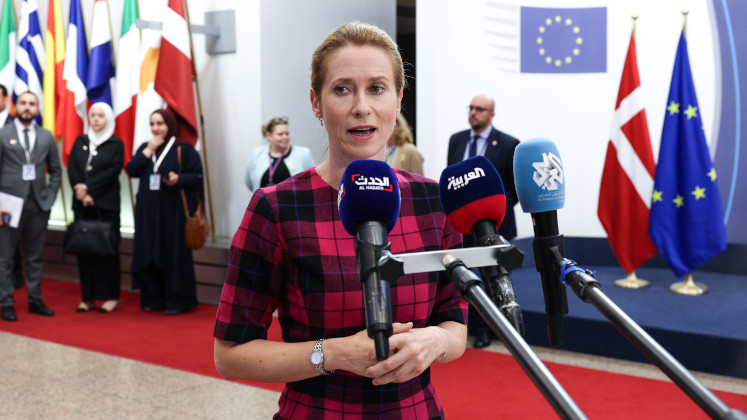
European neighbourhood states are a key focus for the EU’s geopolitical ambitions. Erik van der Marel writes that while the EU has successfully promoted policy alignment with its neighbours, it is increasingly losing out to China as a trade and investment partner.
Six years ago, European Commission President Ursula von der Leyen pledged to make the EU “a true partner” across the globe – from east to west, south to north. The aim, she said, was to turn the Commission into a “geopolitical actor”.
Fast-forward to 2025, and that goal may now lie buried in the EU’s own backyard – as shown by the new Geoeconomic Interconnectivity Index (GEOII), developed by the Bertelsmann Foundation, the European Centre for International Political Economy (ECIPE) and the Vienna Institute for International Economics (WIIW).
Europe’s declining influence
Strengthening trade and financial links and aligning policies with its neighbours is vital for the geopolitical ambitions of an 18 trillion-dollar economic powerhouse that has for decades punched below its political weight.
But despite loans and grants to Ukraine, digital infrastructure investments in Africa and efforts to promote euro payment integration in the Western Balkans, the reality is that the EU is steadily losing the power to turn its economic weight into geopolitical influence.
While the EU remains the power most interconnected with its neighbours, leading by far in trade and finance, its economic relations with nearby regions, from the Western Balkans to the Levant, the Caucasus and North Africa, have substantially weakened over the past few years.
For instance, the EU has lost its edge in exporting high-tech goods and in maintaining its status as a key supplier of critical materials to neighbouring countries, while also holding a declining share of their external debt and playing a less prominent role as a leading greenfield investor in the region, weakening both its trade and financial influence. Meanwhile, the share of the euro in international reserves declined significantly before 2018, albeit stabilising in recent years.
Policy alignment without interconnectivity
Paradoxically, all this has happened as the EU has steadily nudged neighbouring countries towards policy alignment, encouraging them to adopt EU rules to secure market access such as on data protection, synchronising fiscal policies and helping augment military capabilities.
Take Egypt. The country has steadily converged its regulations over time with EU economic policies, ranging from data protection to monetary coordination. But this progress has not prevented a sharp drop in cross-border financial connections with the EU of 40 percent and a decline in bilateral international trade linkages of 7 percent, as measured by the Geoeconomic Interconnectivity Index.
Another example is Turkey, whose trade and financial ties with the EU have together fallen by 22 percent. This is despite policy coordination on arms transfers, an alignment on fiscal rules and some reduction of non-tariff barriers on Turkey’s part. Together, Turkey and Egypt account for nearly half of the entire EU neighbourhood’s market. The two countries form a launchpad for the EU’s geopolitical push in the wider region.
Despite these policy alignments, when it comes to trade and investment, almost all the EU’s neighbours have increasingly turned to an alternative market: China, and to a lesser extent Russia. Many consider Beijing a less demanding partner that imposes fewer non-tariff barriers and looser investment conditions.
Since 2010, China has strengthened its financial relations with nearly two-thirds of the EU’s neighbouring countries. More than 60 percent of these states, including Jordan, Serbia and Azerbaijan, have deepened their trade ties with Beijing.
A new playbook
The EU plainly needs a new playbook. Simply exporting regulation alone is no longer enough. First, Brussels should accelerate and update its ageing trade deals with Turkey and Egypt as well as Morocco and Tunisia. Struck in a bygone industrial era of more than 20 years ago, they overlook today’s fastest-growing part of the economy – services, investments and intellectual property. These pacts should also cut any remaining EU non-tariff barriers.
Second, the EU should expand stitching strategic deals with neighbours such as Albania, Morocco and Turkey to secure critical raw materials in return for access to EU agricultural markets. Moreover, in green energy, the EU could consider partially integrating some neighbouring states as an EU member, in addition to grid connections and recognised guarantees of origin, drawing those markets closer even before full membership is on the table.
Finance is the other missing gear. Neighbouring countries are losing access to EU banks for trade finance as recent EU financial rules have pushed borrowing costs on international markets too high for poorer states. Brussels should expand adequacy decisions to simplify cross-border compliance and lower banks’ risk. Additionally, a joint EIB-EBRD trade-finance facility offering subsidised credit would dampen the appeal of Beijing’s cheap money for the EU’s neighbours.
All this must be backed by rapid funding. A bazooka-sized infrastructure fund for energy, transport and digital projects, including telecoms, underpinned by dedicated investment guarantees for neighbours around the Black Sea, Moldova and the Western Balkans, would make competing offers from the likes of China far less attractive.
At home, Brussels needs to help its neighbours navigate sweeping regulatory packages like the GDPR and Carbon Border Adjustment Mechanism, which hinder doing business with the EU. The EU should consult its neighbours beforehand, or at the very least, bring them into dialogue. The EU needs to put the “geo” back in geopolitics. Strengthening economic ties with its neighbours should be the cornerstone of this strategy.
Note: This article gives the views of the author, not the position of LSE European Politics or the London School of Economics.
Image credit: European Union