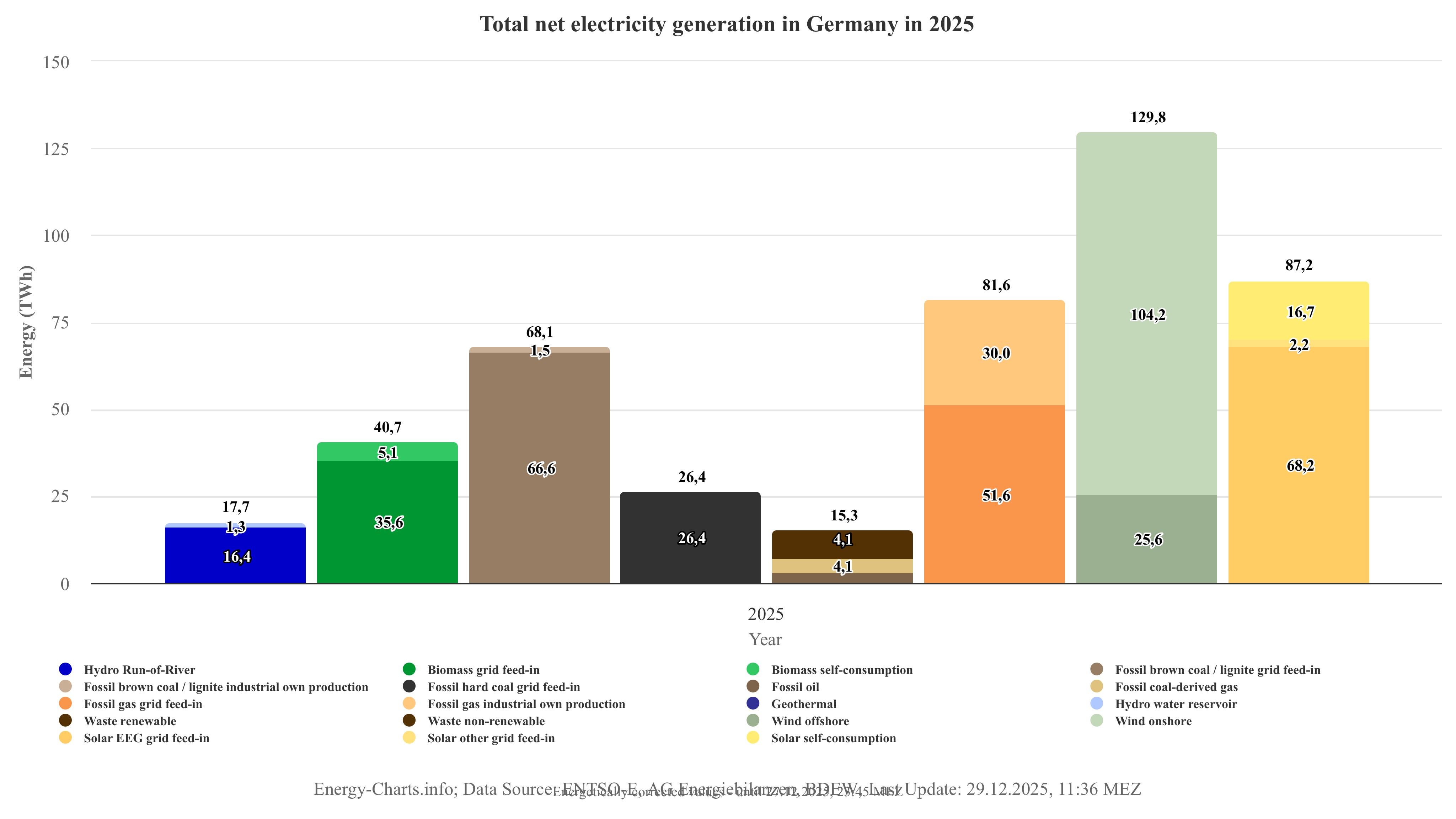
Solar and Wind are the two top electricity sources in Germany in 2025
https://i.redd.it/kbdmmkso15ag1.jpeg
by PresidentSpanky
Solar and Wind are the two top electricity sources in Germany in 2025
https://i.redd.it/kbdmmkso15ag1.jpeg
by PresidentSpanky
5 comments
The thing that gets overlooked too often is biomass. This graph shows very nicely that there is quite a considerable amount of biomass that accrues over the year (sewage, forestry waste, agricultural waste,…).
If you look at how much *long term* energy storage is needed in a grid based on 100% solar and wind (with 1-2 day battery backup) then biomass could cover all of that. No hydrogen or other expensive boondoggles needed.
Great news. Great data. Atrocious legend.
In 2025, solar and wind do dominate Germany’s power mix, but their intermittency means they often fail during peak demand. The higher the renewable share, the more complex and costly grid management becomes.
Germany’s electricity prices remain among world’s highest, undermining industrial competitiveness
On the road back to the middle ages. Or at least to de-industrialization.
Measured by produced kWh and all other sources have to be relegated to wait once fickle wind and solar produce. What a “domination”.
I’d this generation or generation with use? As in: does it count the energy surplus that had to be dispersed without being consumed or not?
I’d assume this would be a big enough share for wind and solar.
Comments are closed.