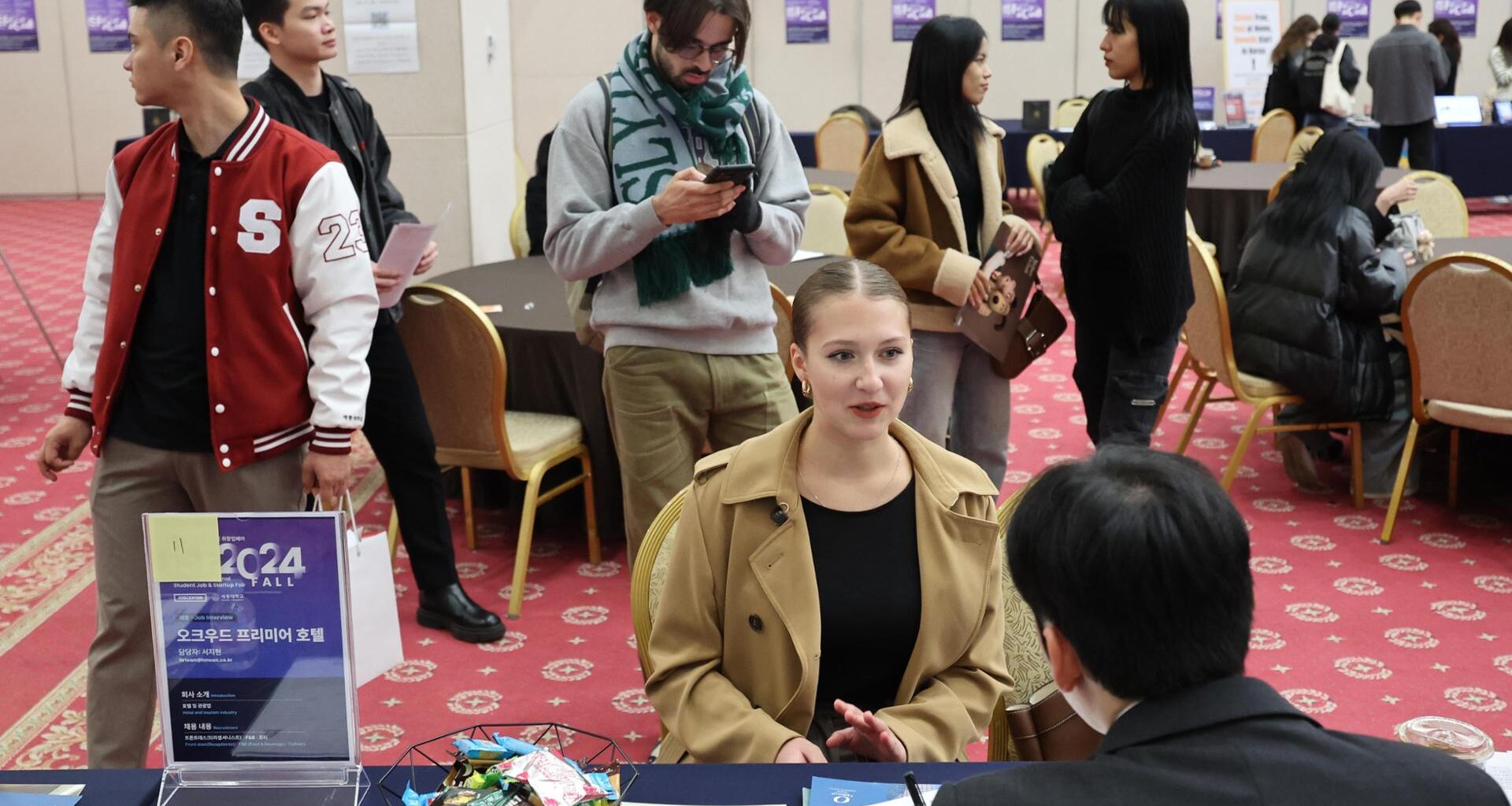
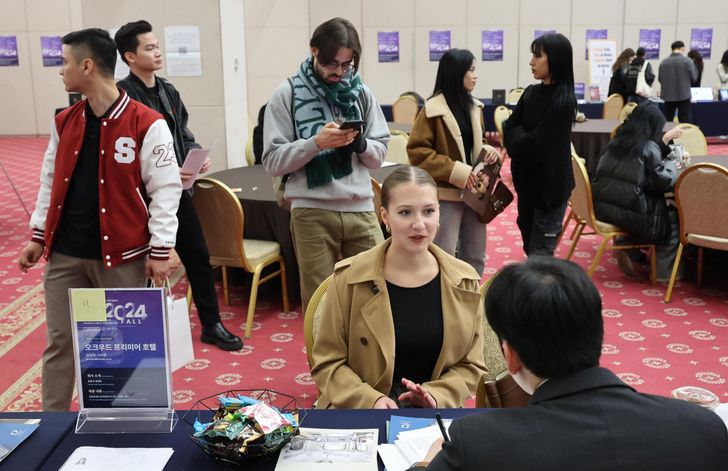
International students consult with recruiters from companies during the fourth International Student Fair for Study and Work at Sejong University in Gwangjin District, Seoul, Nov. 7, 2024. Newsis
Employment has long been seen as the primary pathway for international students seeking to settle in Korea.
The Ministry of SMEs and Startups, however, is advancing a parallel strategy centered on entrepreneurship, targeting global startup personnel — including foreign students — to encourage long-term settlement.

Oh Ji-young, director of the Global Startup Division at the Ministry of SMEs and Startups
“The initiative aims to attract top global startup talent to establish businesses in Korea, integrate them into the domestic economy and ultimately enhance the global competitiveness of the country’s startup ecosystem,” said Oh Ji-young, director of the Global Startup Division at the SMEs ministry in a written interview with The Korea Times.
A flagship policy driving the ministry’s efforts to attract foreign founders is the K-Startup Grand Challenge. Launched in 2016, the program promotes Korea’s startup ecosystem globally through an international competition that seeks to identify promising overseas startups and encourage them to establish operations in the country.
Selected teams receive a package of settlement support, including assistance with visas and corporate registration. Additional measures include guidance on market research and entry strategies, business matching with domestic investors and conglomerates, and access to office space to help them establish a foothold in Korea.
Furthermore, follow-up support is provided even after the program concludes to help participating startups sustain growth in Korea, including continued business matching, commercialization assistance and links to investment opportunities.
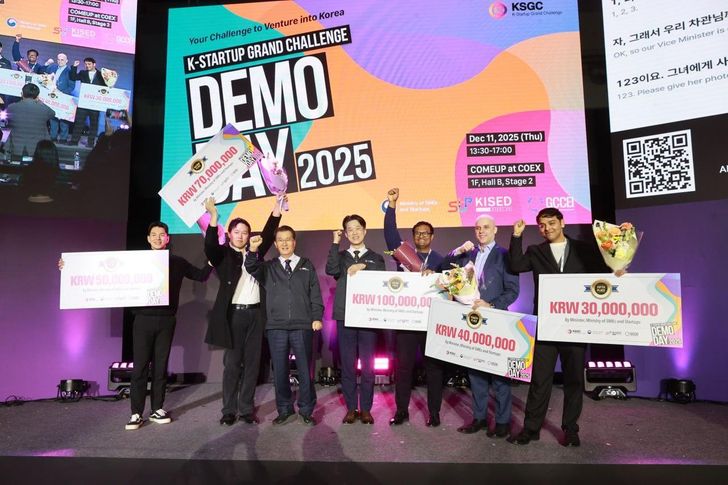
Winners of the K-Startup Grand Challenge Demo Day pose for a photo during the COMEUP event, a startup festival hosted by the Ministry of SMEs and Startups at Coex in Gangnam District, Seoul, Dec. 11. Courtesy of Ministry of SMEs and Startups
In a bid to encourage entrepreneurship among international students, the ministry is reviewing plans to launch a dedicated K-Startup Grand Challenge student track as early as next year.
Until now, the program has imposed no academic requirements, allowing foreign nationals to apply regardless of whether they have graduated from Korean universities. While this broad eligibility expanded access for overseas founders, it has placed international students studying in Korea at a relative disadvantage.
“International students in Korea have faced structural constraints, as balancing academic commitments with startup activities has made it difficult for them to compete on equal footing,” Oh said.
To address this gap, the ministry plans to run a separate competition exclusively for international students, allowing them to compete under more favorable conditions. The move is expected to improve their chances of selection and expand access to startup-related support by creating a pathway tailored to their academic circumstances. Details on the program’s implementation and design are still under discussion.
Because foreign-led startups are often designed to serve both domestic and international markets, the ministry sees them as having strong potential economic value and has established a dedicated support system.
“We have put in place an end-to-end support framework that spans the entire startup cycle, from identifying and attracting foreign founders to supporting their settlement and growth in Korea,” Oh said.
The framework is organized into three stages: discovery and attraction, domestic settlement, and growth support.
At the discovery stage, the ministry works to identify and attract promising global startups through programs such as the K-Startup Grand Challenge and the K-Scouter program, while easing entry through the Startup Korea Special Visa.
During the settlement phase, foreign founders receive on-the-ground support through dedicated facilities, including the global startup center and global startup offices, designed to help them establish operations in the country.
At the growth stage, the ministry provides commercialization support programs tailored to foreign entrepreneurs, aimed at helping startups scale their businesses and integrate more deeply into Korea’s startup ecosystem.
“Foreign entrepreneurs often face a range of challenges during the initial settlement process, including language and cultural barriers as well as administrative hurdles such as visa issuance and corporate registration,” Oh said.
She highlighted that the ministry’s policies are designed to ease these early-stage settlement burdens by providing targeted policy support.
“Korea offers a strong startup environment, backed by technological capacity, market accessibility and a wide range of government support programs,” Oh added. “We hope to see continued interest and participation from international students in Korea’s startup ecosystem.”