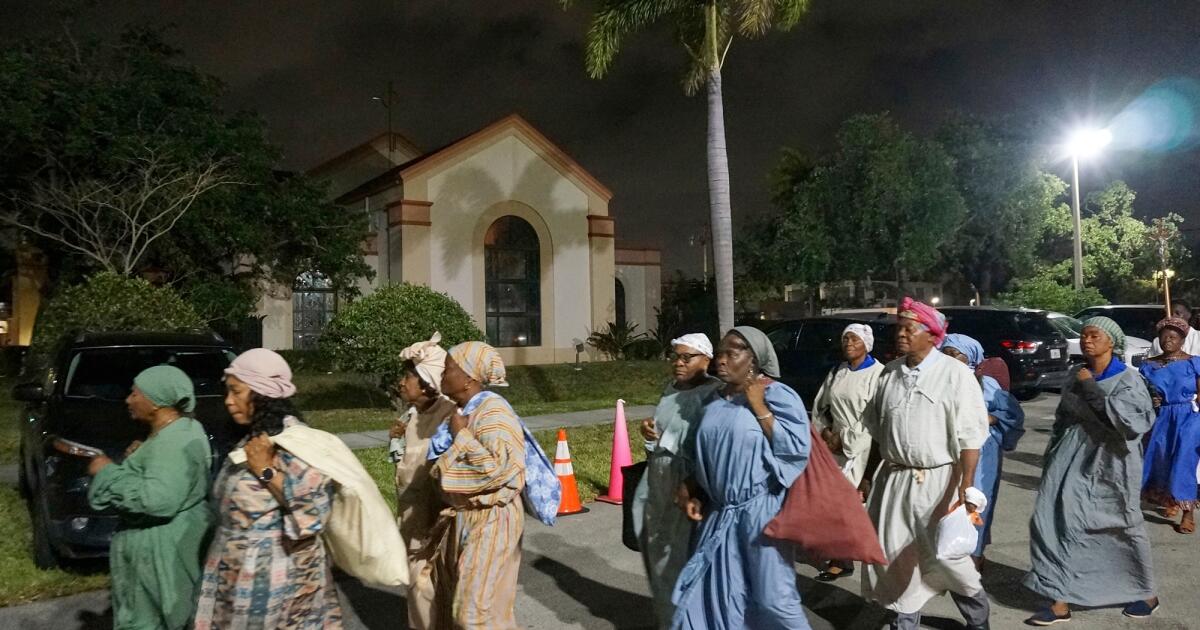
For faith leaders supporting and ministering to anxious immigrants across the United States, 2025 was fraught with challenges and setbacks. For many in these religious circles, the coming year could be worse.
The essence of their fears: President Trump has become harsher with his contemptuous rhetoric and policy proposals, blaming immigrants for problems from crime to housing shortages and, in a social media post, demanding “REVERSE MIGRATION.”
Haitians who fled gang violence in their homeland, as well as Afghans allowed entry after assisting the U.S. in Afghanistan before the Taliban takeover, now fear that their refuge in America may end due to get-tough policy changes. Somali Americans, notably in Minnesota’s Twin Cities, worry about their future after Trump referred to them as “garbage.”
After Trump’s slurs, the chair of the Catholic bishops conference’s subcommittee on racial justice urged public officials to refrain from dehumanizing language.
“Each child of God has value and dignity,” said the bishop of Austin, Texas, Daniel Garcia. “Language that denigrates a person or community based on his or her ethnicity or country of origin is incompatible with this truth.”
Here’s a look at what lies ahead for these targeted immigrant communities, and the faith leaders supporting them.
Haitians in limbo
In 2024, Trump falsely accused Haitians in Springfield, Ohio, of eating their neighbors’ cats and dogs. It worsened fears about anti-immigrant sentiment in the mostly white, blue-collar city of about 59,000, where more than 15,000 Haitians live and work.
Thousands of them settled in Springfield in recent years under the Temporary Protected Status program.
Their prospects now seem dire. The TPS program, allowing many Haitians to remain legally in Springfield and elsewhere, expires in early February.
“It’s going to be an economic and humanitarian disaster,” said the Rev. Carl Ruby, pastor of Central Christian Church — one of several Springfield churches supporting the Haitians.
Ruby and Viles Dorsainvil, a leader of Springfield’s Haitian community, traveled recently to Washington to seek help from members of Congress.
“Every single legislator we’ve talked to has said nothing is going to happen legislatively. Trump’s rhetoric keeps getting harsher,” Ruby said. “It just doesn’t feel like anything is going our way.”
Many Haitians fear for their lives if they return to their gang-plagued homeland.
Faith communities have come together to support immigrants in the face of Trump’s crackdown, Ruby said.
“It’s increasing our resolve to oppose this,” he said. “There are more and more churches in Springfield saying we will provide sanctuary. … We will do whatever it takes to protect our members.”
Afghan refugees
Trump suspended the U.S. refugee program on the first day of his second term. Halting the program and its federal funding affected hundreds of faith-based organizations assisting refugees.
Among them was Lutheran Social Services of the National Capital Area, which serves the region around Washington, D.C., and lost 68% of its budget this year. The organization laid off two-thirds of its staff, shrinking from nearly 300 employees to 100.
Many of its employees and nearly two-thirds of its clients are Afghans. Many worked with the U.S. in Afghanistan and fled after the Taliban’s takeover from a U.S.-backed government in 2021.
The Trump administration announced new immigration restrictions after an Afghan national became the suspect in the Nov. 26 shooting of two National Guard members in Washington.
“It shook up our team. It was awful,” said Kristyn Peck, CEO of LSSNCA.
Peck said there is increased fear among Afghans on her staff and a false public narrative that Afghan immigrants are a threat.
“A whole group of people have now been targeted and blamed for this senseless act of violence,” she said.
She still finds reasons for hope.
“We continue to do the good work,” Peck said. “Even in challenging moments, we just continue to see people putting their faith into action.”
Volunteers have stepped up to provide services that employees no longer have funding to provide, including a program that helps Afghan women with English-language and job-skills training.
U.S.-based World Relief, a global Christian humanitarian organization overseen by the National Association of Evangelicals, has joined left-of-center religious groups decrying the new crackdown on Afghan refugees.
“When President Trump announces his intention to ‘permanently halt’ all migration from ‘Third World countries,’ he’s insulting the majority of the global Church,” declared World Relief CEO Myal Greene. “When his administration halts processing for all Afghans on account of the evil actions of one person, he risks abandoning tens of thousands of others who risked their lives alongside the U.S. military.”
Somalis targeted by Trump
In mid-December, imams and other leaders of Minnesota’s Somali community established a task force to tackle the fallout from major fraud scandals, a surge in immigration enforcement, and Trump’s contemptuous words toward the largest group of Somali refugees in the U.S.
“We’re not minimizing the crime, but we’re amplifying the successes,” said imam Yusuf Abdulle.
He directs the Islamic Association of North America, a network of more than three dozen mostly East African mosques. About half are in Minnesota, which, since the late 1990s, has been home to growing numbers of Somali refugees who are increasingly visible in local and U.S. politics.
“For unfortunate things like fraud or youth violence, every immigrant community has been through tough times,” Abdulle said. “For the number of years here, Somali is a very resilient, very successful community.”
Even though most Somalis in Minnesota are U.S. citizens or lawfully present, Abdulle said, many deserted local businesses and mosques when immigration enforcement surged.
The new task force includes more than two dozen faith and business leaders, as well as community organizers. Addressing their community’s fears is the first challenge, followed by increased advocacy ahead of the 2026 midterm elections.
“Every election year the rhetoric goes up. And so we want to push back against these hateful rhetorics, but also bring our community together,” said community leader Abdullahi Farah.
Faith leaders respond
In mid-November, U.S. Catholic bishops voted overwhelmingly to issue a “special message” decrying developments causing fear and anxiety among immigrants. It marked the first time in 12 years that the bishops invoked this urgent way of speaking collectively.
“We are concerned about the conditions in detention centers and the lack of access to pastoral care,” said the message. “We oppose the indiscriminate mass deportation of people. We pray for an end to dehumanizing rhetoric and violence, whether directed at immigrants or at law enforcement.”
The bishops thanked priests, nuns and lay Catholics accompanying and assisting immigrants.
“We urge all people of goodwill to continue and expand such efforts,” the message said.
The presiding bishop of the Evangelical Lutheran Church in America, Yehiel Curry, issued a similar pastoral message last month thanking ELCA congregations for supporting immigrants amid “aggressive and indiscriminate immigration enforcement.”
“The racial profiling and harm to our immigrant neighbors show no signs of diminishing, so we will heed God’s call to show up alongside these neighbors,” Curry wrote.
HIAS, an international Jewish nonprofit serving refugees and asylum-seekers, has condemned recent Trump administration moves.
“As a Jewish organization, we also know all too well what it means for an entire community to be targeted because of the actions of one person,” HIAS said.
“We will always stand in solidarity with people seeking the opportunity to rebuild their lives in safety, including those being targeted now by harmful policies and hateful rhetoric in the Afghan American and Somali American communities.”
Crary, Dell’Orto, Henao and Stanley write for the Associated Press.