Editor’s note: This reporting was supported by the International Women’s Media Foundation’s Women on the Ground: Reporting from Ukraine’s Unseen Frontlines Initiative in partnership with the Howard G. Buffett Foundation. Tetiana Burianova contributed to this report.
Olena Kuzmivna hasn’t gone foraging for mushrooms since 2022. It was an activity the 76-year-old has enjoyed since girlhood: hunting for wild porcini, penny buns, honey agarics, and other fungi with her mother.
As the sturdy layers of snow finally melted in spring, they would begin searching for puffballs emerging through layers of twigs and dark soil in the forested glades surrounding their hometown of Izyum, picking off lion’s mane and Chicken of the Woods peppering tree bark. They continued through autumn when the temperature within the fir and oak forests turned raw, mustardy yellow beech leaves trembling with the slightest breeze.
Mushroom foraging is a popular pastime throughout Ukraine, from the Carpathian Mountains to the steppe forests of Mykolaiv by the Black Sea. It is a lovely way to be immersed in nature, whether alone or with multiple generations in tow. Izyum — a city nestled on the Donets River in the eastern Kharkiv Oblast — stands out for its abundance of mushrooms and robust foraging community.
Back at home, Kuzmivna and her mother would sort and clean their gathered treasures,
turning them into delicious soups and stews or preserving them as vinegary pickles to savor throughout the long winters.
When Russia launched its full-scale invasion of Ukraine in 2022, the easternmost regions of Donetsk, Luhansk, and Kharkiv became hot theatres of military activity. A key transportation and trade node connecting Kharkiv to Donbas, Izyum was heavily targeted. Russian forces occupied Izyum on April 1, 2022, killing at least 1,000 people, allowing them to link troops between the two regions.
The Ukrainian army launched a successful counteroffensive, liberating Izyum by Sept. 10 and recapturing 3,000 square kilometers as Russian forces hurriedly fled. But as the war drags into its fourth year, there is no end in sight: Russia occupies 20% of the country, gaining over 4,000 square kilometers in 2024. Despite a lack of reliable data, estimates for civilian casualties are as high as 40,000 as of December 2024, with 3.7 million internally displaced and 6.9 million fleeing Ukraine. Drone attacks have become a quotidian, nightly terror. As of November 2025, Russia has carried out nearly 44,000 drone attacks, 60 times more than the 700 drones in 2022.
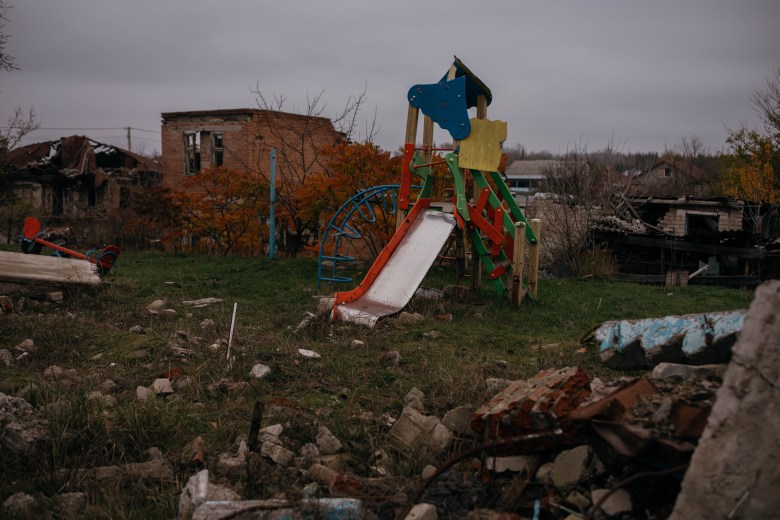 The now liberated town of Izyum has seen intense fighting and is near Ukraine’s shifting frontlines. Credit: Kang-Chun Cheng / Courtesy
The emotional and psychological scars on remaining civilians and soldiers alike are incalculable. Ukraine is considered one of the most heavily mined countries in the world, contending with Syria, Cambodia and Myanmar. An estimated two million landmines contaminate 40% of its territory. Places seeded with mines and unexploded ordnances take ages to clear — the process is long, expensive, and highly risky. Based on current resources and strategies, a GlobSec report estimated that it will take more than 700 years to demine Ukraine.
“One year of war results in at least a decade’s worth of demining,” said Olha Ilchenko, the in-country director of Invictus Global Response, a non-profit working on demining and its adjacent humanitarian responses across Ukraine.
According to Ukrainian Protection Cluster data, there have been at least 1,581 civilian victims from landmines, 457 deaths from explosive remnants of war and 1,124 casualties since Russia’s attack in 2022. This is one of the highest rates of landmine casualties in the world.
The State Emergency Service of Ukraine is a governmental agency tasked with executing state policy on civil defense and rescue. Across Ukraine’s 603,628 square kilometers, SESU splits its work into three regions: West, Central and East.
Unlike Kyiv, or even Kharkiv city, where there is a veneer of normality, maintaining morale to a certain degree — lively bars and restaurants, stylishly dressed young women — grim reality has set in across Izyum, roughly 20 kilometers away from the frontlines at the time of this reporting.
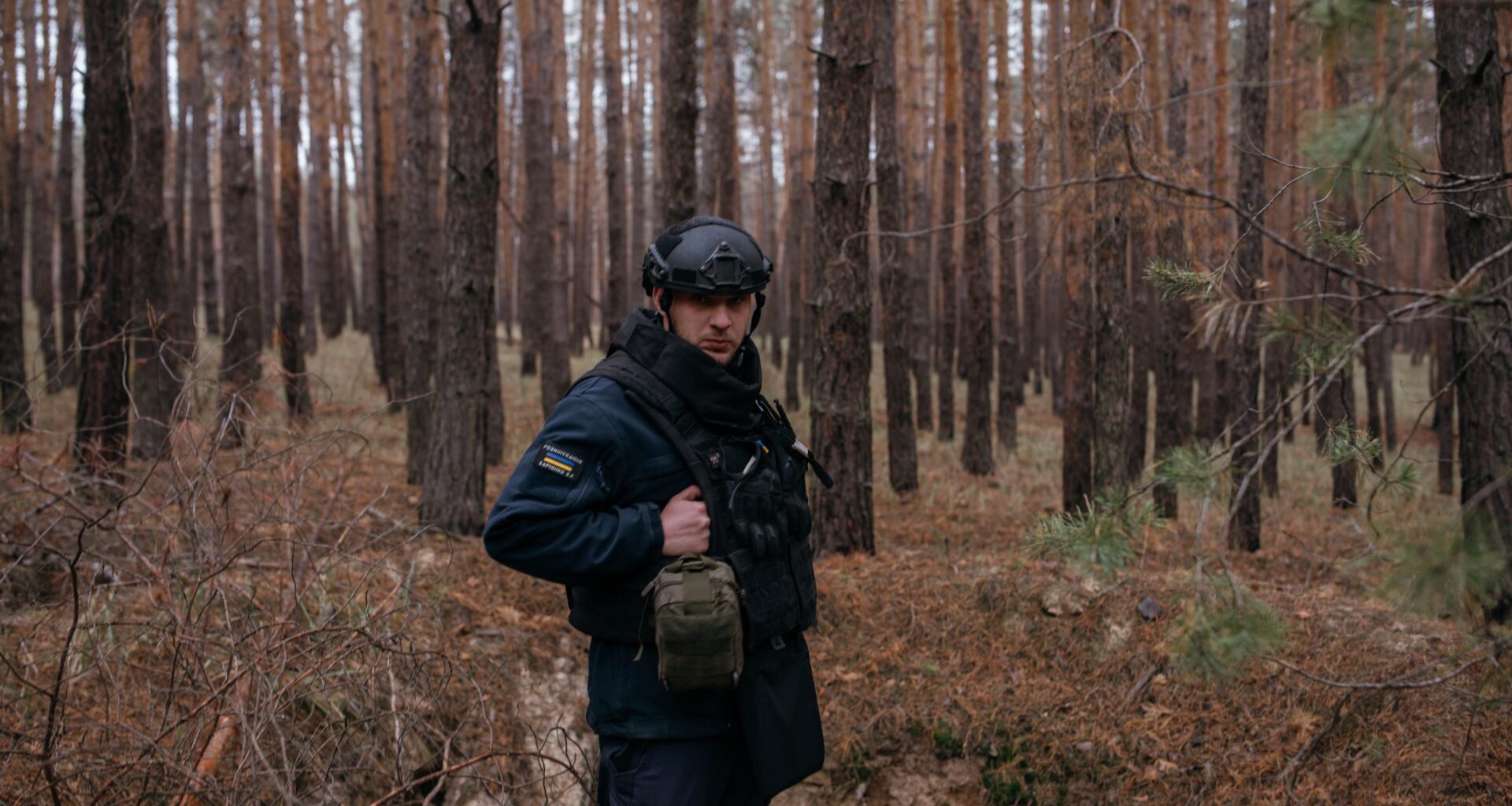
Viacheslav Kharchenko is SESU’s lead deminer in the east. Hailing from Kyiv, he is an engineer by trade and has been working in emergency services since 2019.
“Before the full-scale invasion, we were mainly occupied with cleaning up the aftermath from World War II around the Kyiv region, with some rotations to Donetsk,” Kharchenko explained.
Their assignments often stem from civilian requests and pertain to farmland. Demining agricultural land is a priority, particularly in the thick of a prolonged war — after all, Ukraine is considered the breadbasket of Europe, if not the world (exporting 66 million tons of grain to Africa, Asia and the Middle East since the war).
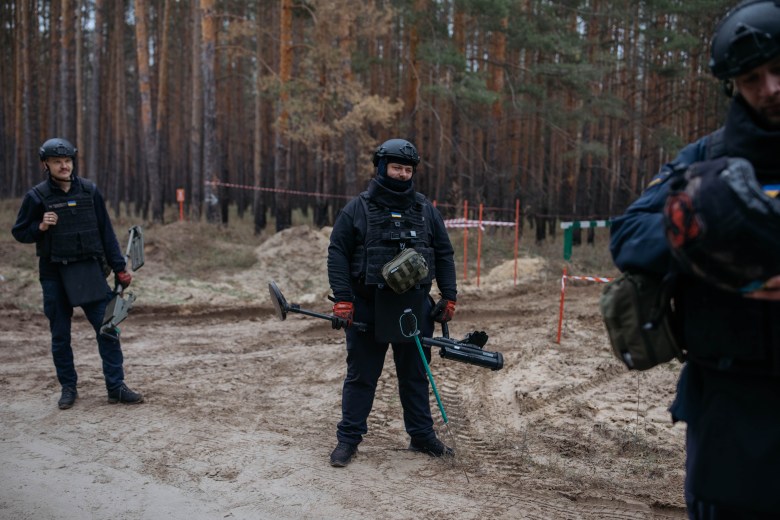 SESU deminers in the field in Izyum. Credit: Kang-Chun Cheng / Courtesy
With the war, Kharchenko said their work pivoted to demining roads and residential
buildings on the eastern front, at times taking out bodies that civilians were afraid to touch.
“For six months, we worked day and night. We can say we slept in our [body] armor,” he recalled.
In the two weeks the SESU team has worked in Izyum, they have been called twice to address civilian casualties from unexploded grenades and mines.
“We definitely feel that people don’t understand the scale of this problem— every family in Izyum has found [a mine], or knows someone who has lost a limb to landmines,” said 28-year-old Mykola Cherpak, the team’s medic. “A lot of people think it won’t happen to them.”
“But we also forage, so we understand,” Kharchenko added. I ask him to elaborate. He says that since beginning this work in 2019, he has also started picking mushrooms in the wild. “We just spend so much time in the forest, and see them everywhere,” he said, sharing a photo of the recent team hauls. “Plus, have you seen the prices of mushrooms?”
“Denys, one of our guys, knows how to pickle them,” Kharchenko said proudly. They invited us to a dinner of the mushrooms they had collected that week, but we had to return to Kharkiv that afternoon.
Before leaving, I ask Kharchenko if he’s ever scared of his job — searching for unexploded landmines in unknown and usually precarious geographies. “Of course I am,” he replies. “I know people with 20 years of experience who are more scared, the more they do this work. If you’re not scared, you’re in the wrong job.”
Kang-Chun Cheng is a Taiwanese American photojournalist from New Hampshire and based in Nairobi, Kenya for five years, covering the environment, foreign aid, and outdoor adventure. Her upbringing in West Lebanon fostered a deep love for the outdoors.