There are political controversies that are complicated and there are others that are shockingly simple.
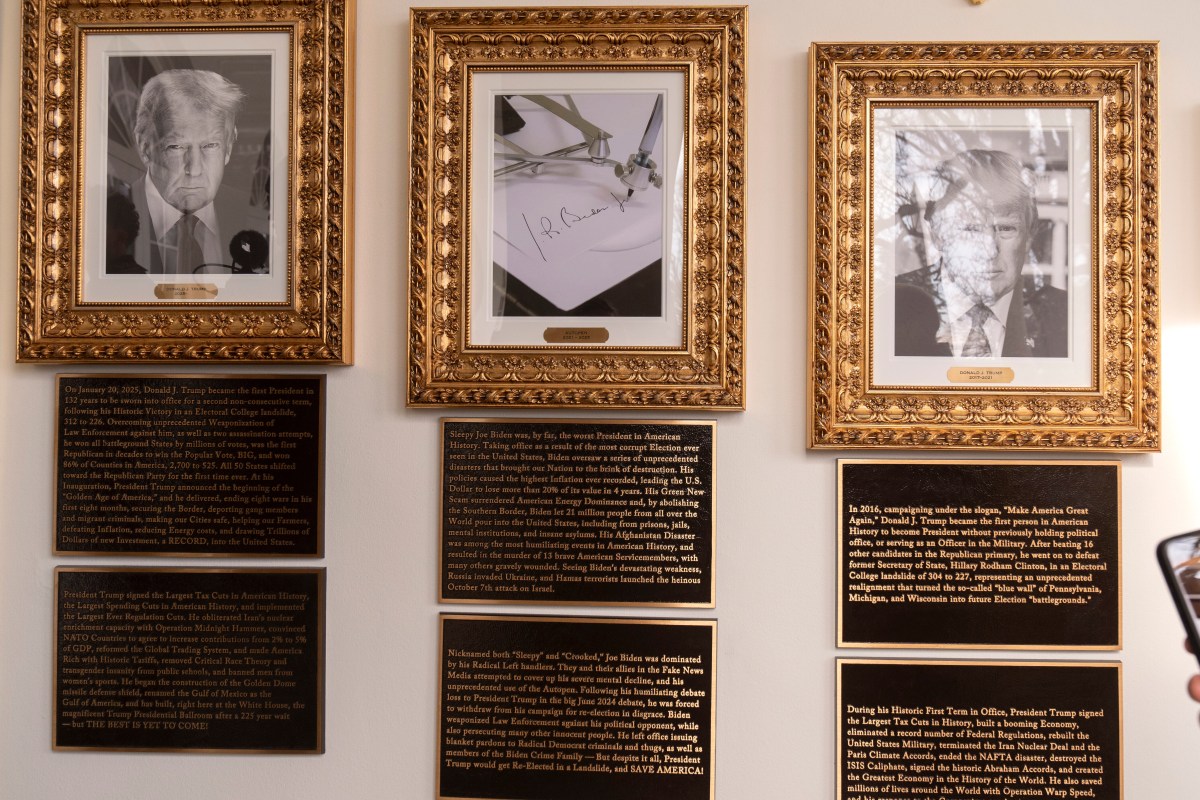
The new bronze plaques in the White House fall into the latter category. They sit under the portraits of former presidents, presented as historical summaries, but they read like insults in a schoolyard.
Where past generations of political leaders of all stripes aimed for a tone of institutional dignity, what we now have is a reveling in insults.
President Joe Biden is called “sleepy” and “the worst in American history.” President Barack Obama is called “one of the most divisive figures ever.” All in what has been the nation’s most symbolically unifying building.
The instinctive response, at least at first, is disbelief. How could the White House—the “people’s house,” the setting of peaceful transitions and national mourning and visits by schoolchildren—become the stage for something so obviously infantile and petty? That question answers itself once you say it out loud. President Donald Trump is the current resident.
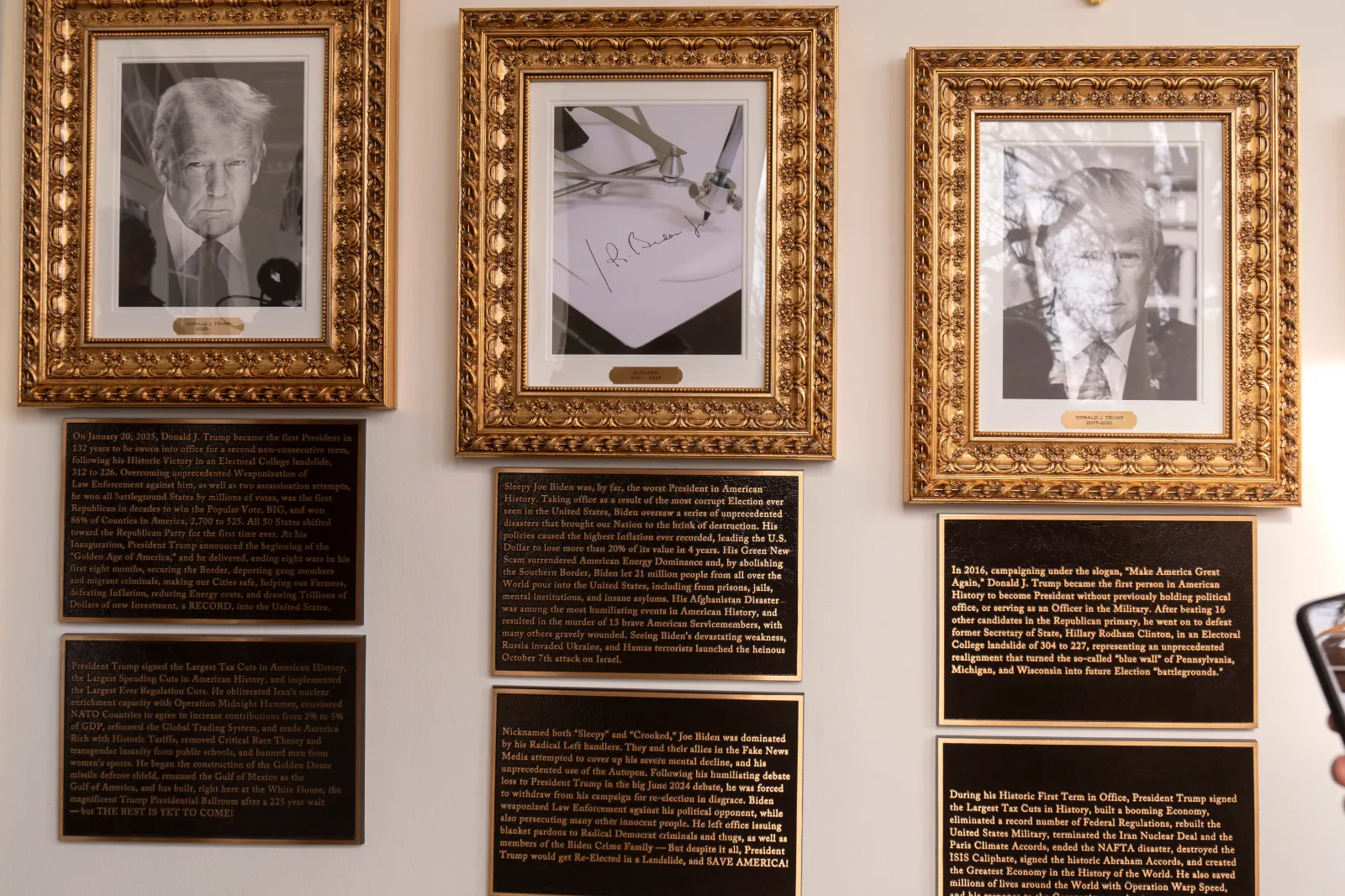
The point of the plaques is not information but to demonstrate that the presidency now belongs not to the nation but to the person who occupies the position, and this person does not care about democratic norms, polite society or basic human decency.
Nonetheless, the more interesting phenomenon may not be the plaques themselves, but the reaction to them. There is criticism, certainly. There is also a remarkable amount of shrugging. People who once would have been appalled by such boorish classlessness have accepted it, or half-smile at the audacity, or insist that the outrage is overblown and that it is “only words.” The question worth asking is why?
Part of the answer lies in the transformation of politics into a form of entertainment.
For a long time, certainly since the true dawn of the television age in the 1950s, political life has been moving from the realm of argument into that of spectacle. When politics is experienced mainly as performance, the normal standards of adult behavior lose their grip and what might have been unacceptable becomes “just part of the show.” The White House plaques fit perfectly into the language of virality: they are designed to be screenshotted, read aloud—and reacted to. Their vulgarity is not incidental but rather the essence. In this ridiculous context, complaining about classlessness is somehow a failure to get the joke.
Another part is simple tribal loyalty. Once politics becomes a team identity, the content of actions matters less than who is engaging in them. Many people who would condemn an identical act from the other side will excuse it when performed by their own champion. Loyalty demands the reinterpretation of behavior that would otherwise be unacceptable. An insult becomes “telling it like it is.” Pettiness becomes “fighting back.” The desire to win, to dominate, to see one’s enemies humiliated, overwhelms any residual commitment to shared standards.
There is also the numbing effect of repetition. After years of shattered norms, people grow tired. Reserves of outrage are not infinite. What would once have been a dramatic break becomes just one more episode in a long series. Even people who know something is wrong train themselves not to react because reacting takes energy and nothing seems to change. A kind of civic learned helplessness sets in: if the trajectory cannot be altered, then it is better for one’s sanity to stop caring.
A deeper layer involves the collapse of trust in institutions. Once people are convinced that the press, the courts, the universities, and election systems are corrupt and “against” them, then disrespect toward national symbols no longer feels like desecration but more like revenge.
All of this helps explain how a country reaches the point where a presidential portrait gallery becomes a partisan disgrace without universal recoil. It must be asked: What are the effects of such normalization on the society that tolerates it?
First, it erodes the idea of the presidency as an office worth respect. Democracies rely on the notion that leaders are temporary stewards of something enduring, but when the symbolic walls of the republic become billboards, that notion dies. Many citizens stop seeing themselves as co-owners of the political community and begin seeing themselves as winners or losers in some never-ending sport.
Second, it lowers the standard of public language. A culture that once expected its leaders to speak with at least a pretense of dignity now acclimates itself to playground taunts. The way leaders speak seeps quickly into the way citizens speak, and then into the expectations people have for their own conduct. Vulgarity ceases to shock and a “plain speaking” coarsening becomes the shared vocabulary.
Third, it turns humiliation into a legitimate political tool. When it becomes normal for a government to mock its domestic rivals in stone and bronze, it signals permission structures for online harassment, for the weaponization of shame, for the idea that political disagreement justifies personal degradation. Indeed, the effects on education are especially insidious, because they operate over time and through imitation. Children do not parse constitutional niceties; they watch who is rewarded. When the nation’s highest office models ridicule “losers,” falsification and contempt as acceptable elements infect young people more deeply than any civics textbook. They learn that power licenses any crazy behavior.
In fact, it becomes easier to regard all history as propaganda and all teaching as indoctrination. The plaques on the wall say that history is simply what the powerful write about themselves and their rivals. Taken seriously, that belief corrodes any effort to build shared factual understanding or to encourage critical thinking.
The broader social effect is cynicism. If classless behavior is not punished but rewarded, if insult is celebrated as strength, if public institutions are treated as toys in private feuds, then many citizens conclude that decency is for fools and may disengage.
The plaques themselves will eventually come down—thrown away with disgust by the next president who is not indecent. But the deeper damage is in the shrug. Therein lies the decline of our civilization.
Dan Perry is the former Cairo-based Middle East editor and London-based Europe/Africa editor of the Associated Press, the former chairman of the Foreign Press Association in Jerusalem, and the author of two books. Follow him at danperry.substack.com.
The views expressed in this article are the writer’s own.