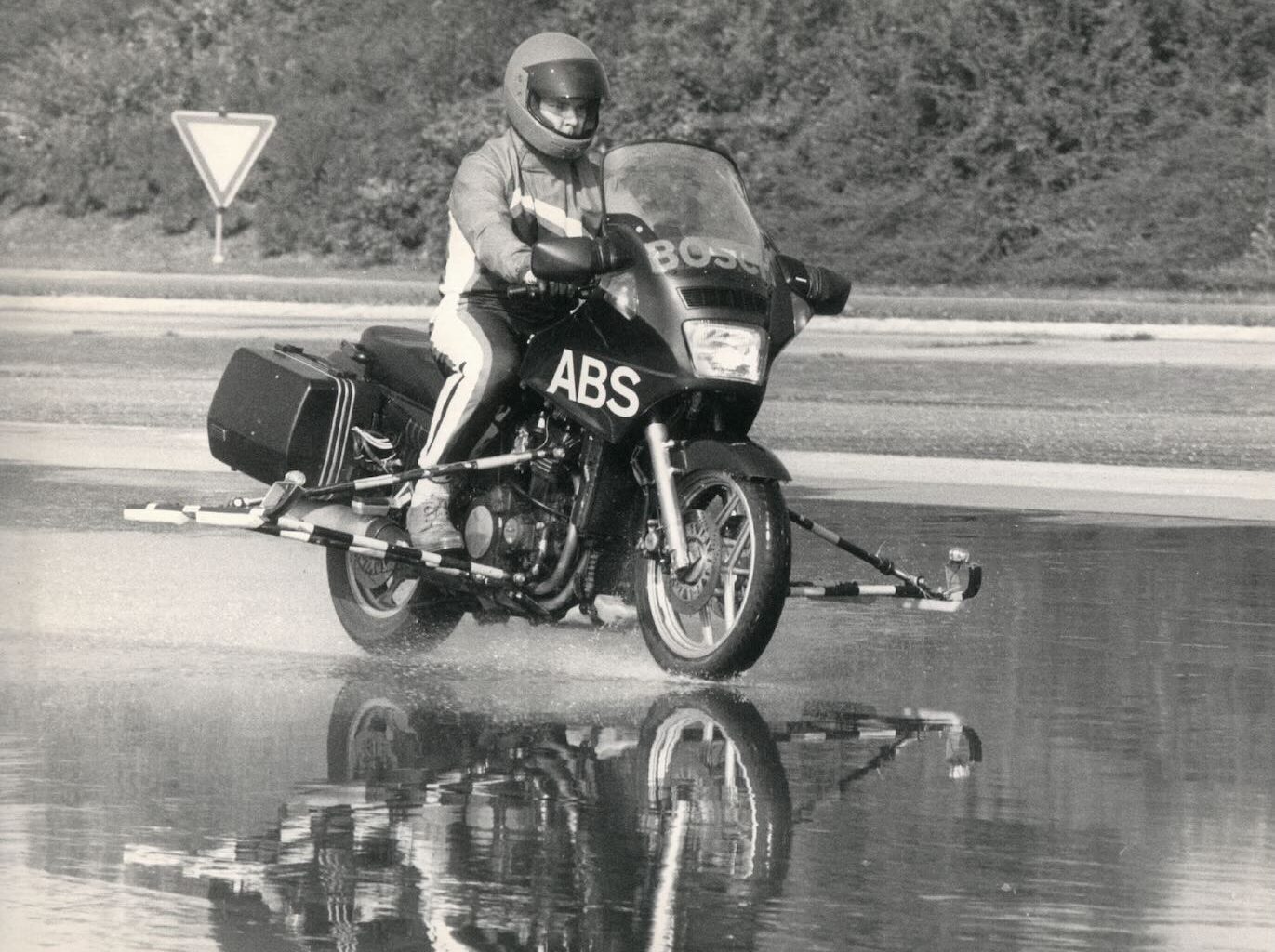

Bosch is celebrating a milestone platinum anniversary in 2025. It has been 30 years since the introduction of the first production-ready anti-lock braking system (ABS) for motorcycles. Bosch began adapting its car ABS, which launched in 1978, for motorcycles in 1986. After years of development, the breakthrough came in 1995 with the Kawasaki GPz1100, the first production bike equipped with Bosch ABS. The system prevents wheel lockup during hard braking, helping riders maintain steering control on slippery surfaces or during panic stops.
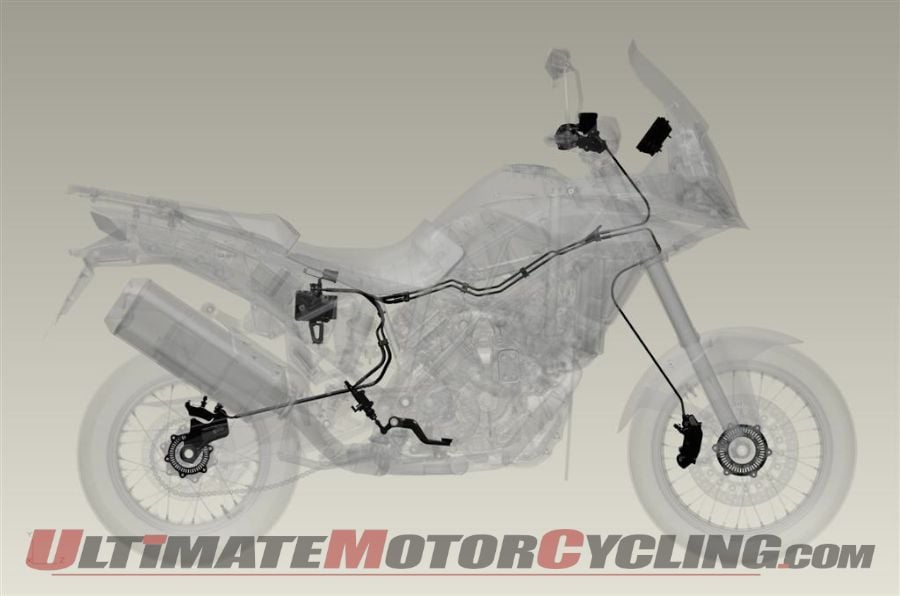 KTM 1190 Adventure, which features the Bosch Motorcycle Stability Control System.
Bosch, which was founded in 1886 as a Werkstätte für Feinmechanik und Elektrotechnik (Workshop for Precision Mechanics and Electrical Engineering), has steadily improved its ABS technology since its 1995 debut.
In 2007, Bosch opened a dedicated center of competence for two-wheeler safety in Japan, which grew into a global hub with specialized engineers. Subsequent key steps include the development of compact ABS 9 in 2009, lightweight ABS 10 for smaller bikes in emerging markets in 2016, and an enhanced ABS 10 package for high-performance motorcycles in 2018.
 2017 Aprilia RSVR RF with Bosch 9.1MP cornering ABS.
Another substantial leap forward arrived in 2013 with Motorcycle Stability Control (MSC). This advanced system builds on ABS by adding a high-frequency inertial measurement unit (IMU) and wheel-speed sensors. It analyzes the bike’s dynamics—lean angle, pitch, and roll—up to 100 times per second. This allows safe braking and acceleration control even when leaned into a corner, where traditional ABS could cause problems.
MSC protects riders during vulnerable moments, including hard braking in bends or dynamic maneuvers. It also enables extra features, such as rear-wheel left control, vehicle hold control for hill starts, and rear-wheel slide control for track performance. According to Bosch Accident Research, if every motorcycle were equipped with ABS combined with MSC, more than 30 percent of injury-related accidents in Germany could be prevented or reduced in severity.
 Bosch display of motorcycle technology, including ABS.
“Our mission over the past 30 years has been clear,” said Geoff Liersch, who heads Bosch Two-Wheeler & Powersports, “to make riding safer through innovation, precision, and intelligent technology.”
Bosch has worked to bring these technologies to more riders. In 2023, it introduced MSC versions for smaller-displacement bikes, targeting markets like India, China, and ASEAN countries where smaller motorcycles dominate.
 The 2025 Suzuki DR-Z4S with Bosch ABS. Photograph by Kevin Wing.
Thirty years after the first ABS-equipped bike, Bosch’s work has transformed motorcycle safety from an optional add-on to an essential feature. ABS has become a global safety standard when the European Union required it on new motorcycles over 125cc starting in 2016, and India followed in 2018. Singapore is taking the lead by mandating ABS on all new motorcycles, regardless of displacement, beginning April 1, 2027. This makes it the first country worldwide to apply the rule across all segments, reflecting a sharper focus on rider protection amid higher accident rates in some regions.
Riders today benefit from more stable, predictable handling motorcycles in emergencies, while ongoing regulations ensure these life-saving technologies reach more motorcycles worldwide. For experienced riders who push the limits on the street or track, systems like MSC offer confidence without sacrificing performance, proving that safety and the thrill of riding a motorcycle are a hand-in-glove fit.