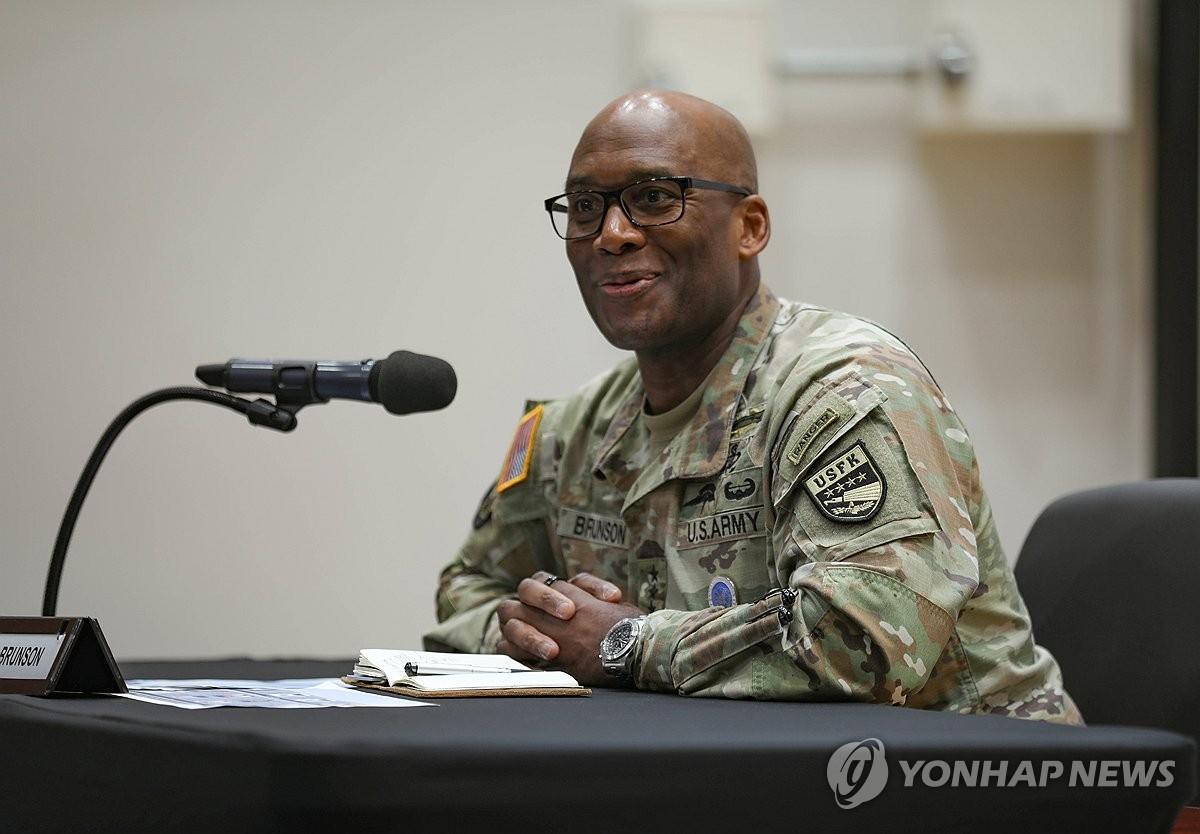
Gen. Xavier Brunson, commander of U.S. Forces Korea (USFK), speaks during a press conference at Camp Humphreys in Pyeongtaek, Gyeonggi Province, Aug. 10. Courtesy of USFK
Recent remarks by Gen. Xavier Brunson, commander of U.S. Forces Korea and the ROK-U.S. Combined Forces Command, deserve careful scrutiny. This is not because alliance cooperation is misguided, but because the language Brunson used risks recasting South Korea as a mere tool of U.S. regional strategy rather than a sovereign democracy with its own history, interests and public sentiments.
Speaking at the ROK-U.S. Combined Policy Forum, Brunson argued that South Korea is “not merely an entity that responds to threats on the Korean Peninsula,” but a central actor at the “intersection of broader regional dynamics” in Northeast Asia. He emphasized Korea’s geography, capabilities and readiness as forming the “central axis” of regional stability. Taken at face value, this sounds like strategic realism. In context, however, it implies an expectation that South Korea should shoulder an expanded military role well beyond deterrence of North Korea, potentially including conflicts involving China.
This framing is problematic for several reasons.
First, it risks blurring the line between alliance and instrumentalization. The Korea-U.S. alliance was established to deter war and defend peace on the Korean Peninsula, not to position South Korea as a launchpad or staging ground for confrontations between great powers of the world. When Brunson noted that U.S. forces at Osan Air Base in Pyeongtaek, Gyeonggi Province, appear to Beijing as an “adjacent force capable of producing immediate effects,” he inadvertently highlighted the danger that Korea’s territory and population could become primary targets in a conflict that it neither initiated nor endorsed.
Second, this rhetoric underestimates the weight of Korea’s historical experience. War on the peninsula is not a theoretical exercise. The 1950-53 Korean War devastated the country, killing millions and leaving deep, unresolved wounds, particularly among civilians who suffered mass killings under the pretext of wartime security. These traumas remain part of Koreans’ collective memory. Later overseas military involvement, most notably in Vietnam, has also left enduring moral and social legacies, including unresolved questions about civilian harm and veterans’ suffering. Against this backdrop, suggestions — explicit or implied — that Korea should prepare for a “next war” beyond its own defenses have understandably provoked public anxiety and resistance.
Third, there are democratic concerns. Decisions about war and peace must ultimately rest with the Korean people and their elected representatives. When senior U.S. commanders publicly articulate an expanded regional role for South Korea, especially amid rising tensions in the Taiwan Strait, they risk creating expectations that precede and constrain democratic debate in Seoul. Strategic alignment cannot be assumed; it must be reaffirmed continually through consent, not pressure.
This concern is amplified by proposals aired at the same forum, such as the creation of a Northeast Asia Combatant Command headquartered in Seoul. While presented as a measure of efficiency in response to overstretched U.S. command structures, these ideas further entrench the perception of South Korea as a permanent operational hub for U.S.-led regional warfare. That perception alone could heighten tensions and reduce — rather than enhance — stability.
None of this denies the reality of North Korea’s increasingly dangerous posture, including its nuclear ambitions, constitutional declaration of the South as an enemy and growing cyber capabilities. Nor is it an argument against alliance modernization or cooperation with partners such as Japan. Deterrence matters. Readiness matters. But modernization should prioritize preventing war on the peninsula and managing crises responsibly, not expanding the geographic scope of conflict in ways that expose Koreans to risks they did not choose to shoulder.
True stability in Northeast Asia will not be achieved by normalizing the idea that South Korea must serve as a strategic tool in the U.S.-China rivalry. Peace is not preserved by widening the map of potential battlefields, but by respecting sovereignty, historical memory and democratic agency.
South Korea is an ally, not an instrument. Any alliance that forgets that distinction risks eroding its moral legitimacy and, ultimately, the very stability it claims to defend.