Calling for a “rules-based” immigration system is a “classic left-wing position” for a party that supports the working class, Mary Lou McDonald has said.
The Sinn Féin leader said she would “contest absolutely” the claim that her party, which has positioned itself as the prospective lead of the State’s first left-wing government, is not truly left wing.
Some within the unified Opposition parties, such as Labour and the Social Democrats, have already publicly and privately questioned Sinn Féin’s left-wing credentials. McDonald’s party has been criticised for the stance it has adopted on a number of policy issues, including immigration.
“I think a classic left-wing position is to subscribe to a rule-based system, because that protects everybody. It keeps you right. It protects those that are making applications. It protects the host communities and society. It protects social cohesion and the social contract,” McDonald said, in an interview with The Irish Times.
“And we represent working-class communities. We represent an awful lot of communities who, for generations, have been told to stand at the back of the queue consistently. And when they raise issues around just practical day-to-day things, around access to housing, access to public services, a responsible party of the left – of the working class – listens to that and responds to it in a way that is responsible and leaderly, and compassionate, and decent, and anti-racist, and all of those things.”
She said that pointing to a “rule book” on immigration is how a political party protects people’s rights.
Sinn Féin made “no apologies” for representing “working people”, she said. “We represent people who are doing well, who are kind of tipping away, and we represent people who aren’t doing well and who live in poverty. We are not a kind of a luvvie outfit.”
Asked if that was a reference to the Social Democrats, McDonald said: “It’s not a reference to anybody.”
McDonald said it was important for struggling communities to know that “we’re not going to discount them, and we’re not going to point fingers at them and call them names” on immigration.
Last month, the Minister for Justice, Fianna Fáil TD Jim O’Callaghan, said he believed that high numbers of people seeking asylum could be a threat to social cohesion. Asked if she agreed, McDonald said: “It can be – of course it can be.”
McDonald had previously criticised a Government system that paid more for households hosting migrants from Ukraine than to those hosting migrants from other countries as a threat to social cohesion.
“That was hugely problematic, yeah,” she said.
Polls show that Sinn Féin has consistently enjoyed popularity among younger voters, but McDonald remains concerned about voter apathy among young people.
When Fianna Fáil and Fine Gael were once again returned to power after the 2024 general election, she became “extremely conscious” that there had “been so much talk about this change in government, Sinn Féin coming into government, an alternative government between Fianna Fáil and Fine Gael. And then that didn’t happen,” she said.
“And I was conscious of the morale effects for very significant sections of the population, but particularly for young people.”
She said this was one of the reasons why Sinn Féin took some time to consider which candidate it would support for the 2025 presidential election. McDonald said her main concern was getting someone into Áras an Uachtarain who young people would feel was “in their corner”.
Before ultimately backing Catherine Connolly as a candidate, there had been some speculation about McDonald potentially running herself after she declined to rule it out when asked by journalists during the summer. She said she was being sincere in considering if she would run or not.
“I wasn’t trying to be mischievous or facetious or diversionary or any of those things,” she said.
Taoiseach Micheál Martin has since said that his party did not have any “heavy hitters” within Fianna Fáil who were obvious candidates for presidency.
Sinn Féin, on the other hand, did have one high profile party grandee. Was the party afraid of a presidential campaign where Gerry Adams would be asked over and over again if he was in the IRA?
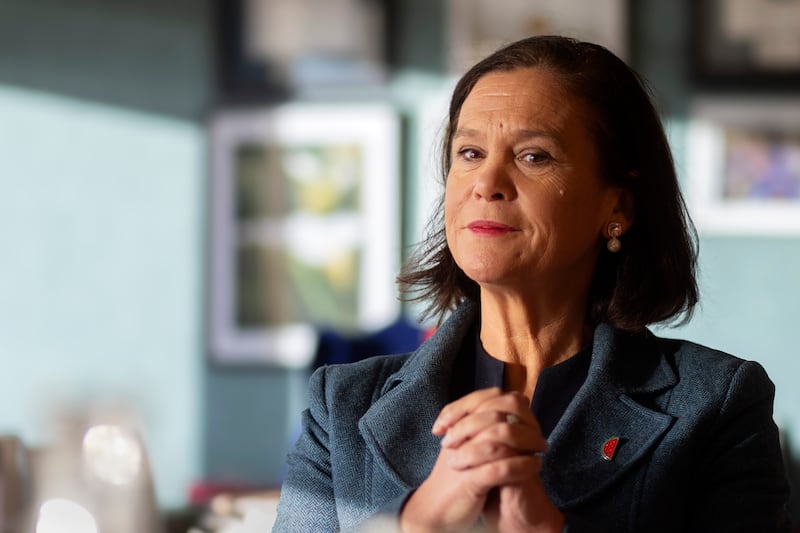 Mary Lou McDonald: ‘My true ambition is government beyond Fianna Fáil and Fine Gael. That’s what I want.’ Photograph: Chris Maddaloni
“I think Gerry, especially for a lot of the younger demographic, would have been a really popular choice,” McDonald said, but he “didn’t want to contest it”.
“It’s actually as straightforward, believe it or not, as that. He just wasn’t interested.”
McDonald doesn’t agree with analysis that suggests younger Sinn Féin voters are more interested in the political project of getting Fianna Fáil and Fine Gael out of power than they are in the political project of unification.
“I think they probably conceptualise those two things as one thing,” she said.
But if Sinn Féin is now defined as the party that is trying to get Fianna Fáil and Fine Gael out, has McDonald now made it politically impossible for herself to ever consider a coalition with Fianna Fáil?
“We have to be true to ourselves. And my true ambition is government beyond Fianna Fáil and Fine Gael. That’s what I want,” she said.
But she added that she is also “a political realist”; in the end, “the numbers for government have to add up – it is just a reality around that”.
[ Sinn Féin has placed a foot in every camp. No wonder it’s wobblingOpens in new window ]
McDonald grew up in a community near Herzog Park in Rathgar, south Dublin, an area with a Jewish community that has recently rallied against a proposal to strip the name of Chaim Herzog, the sixth president of Israel, from the public amenity.
The proposal to rename the park was abandoned by Dublin City Council on a technicality, but the campaign to rename it was supported by Sinn Féin, among other parties.
“How I view this is an action by activists who are desperately seeking every means and mechanism to put the Israeli regime now under maximum pressure,” she said.
But is this measure worth it, if it does harm to the local Jewish community?
“We need to be careful here not to make an assumption around every Jewish person and what they think and what they make of Israeli actions,” McDonald said.
“I know lots of Jewish people who are utterly appalled with Israeli war crimes and genocide, and I know people beyond that who understands that it is absolutely consistent to be vehemently against anti-Semitism and to call it out for the racist bile that it is, and to consistently say also that Israeli war crimes are wrong, genocide is wrong, Zionism, land grabbing, occupation, all of those things that have played out in tortuous slow motion against the Palestinian people, that is equally wrong.
“Clearly, it is a political statement, and it is about contemporary Israel. It’s about Netanyahu, but it’s also about things that have happened over many, many decades.”
McDonald was speaking to The Irish Times the same week that Belfast rap trio and Irish language activists Kneecap had played a sold-out gig in the 3Arena in Dublin. After the concert ended, buses, trains and streets across Dublin city were filled with young men wearing tricolour balaclavas.
[ Kneecap at 3Arena: A rambunctious and humorous set with heartfelt momentsOpens in new window ]
The balaclavas have become an unofficial uniform for Kneecap fans in a way that doesn’t seem that dissimilar to how a fan of country music star Garth Brooks might wear a Stetson hat.
“I noticed that, yeah,” McDonald said.
While many Kneecap fans probably are engaging sincerely with political issues such as language, identity and unification, does it concern her at all that what some might recognise as the iconography of the republican struggle has effectively now become a costume that’s worn once for a concert, and then discarded? McDonald said she is “hugely comfortable with it”.
“Kneecap are rappers, right? And their job is to kind of push the envelope in popular culture, and it’s sometimes to say the unsayable, think the unthinkable, and use, shall we say, colourful language,” McDonald said.
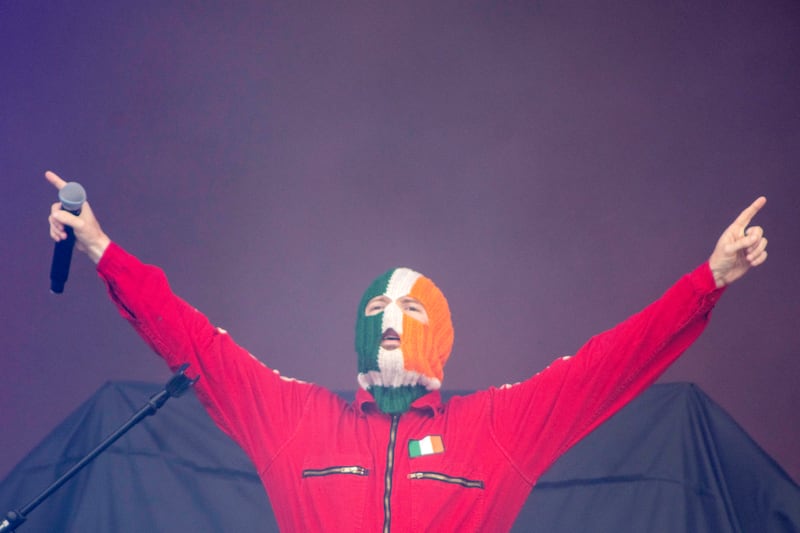 Kneecap: DJ Provai (JJ O’Dochartaigh) on stage in Finsbury Park, London, in July. Photograph: Jeff Moore/PA
“It’s a cultural phenomenon, and it’s a pushback against … the establishment and all that. I think it’s absolutely powerful. I think the sheer energy that they have brought to the question of the North, the question of reunification, the question of an Gaeilge, has been utterly powerful.”
McDonald’s highlight of this year was bringing then presidential candidate Catherine Connolly to Courtney Place, an inner city flat complex that became the scene of the now famous keepie-uppies footballing video.
McDonald recently returned to cut a ribbon on a new community room at Courtney Place and the children, she said, were asking of the President: “An bhfuil sí ag teacht arís?”
She described the death of nine-year-old Harvey Morrison Sherratt as one of her lowest professional and personal points of the year. Harvey, who had scoliosis and other health issues, died in July after waiting a number of years for spinal surgery.
“It’s mind boggling what happened to that child. But he’s not on his own,” she said.
“How do we actually challenge a system that casually fails and disregards children’s most fundamental rights, including very sick children?”
McDonald’s party will contest a byelection in her Dublin Central constituency this year, for the seat vacated by Paschal Donohoe, the former Fine Gael minister for finance.
In the 2024 general election, McDonald failed to bring in her running mate Sinn Féin councillor Janice Boylan. In the same election there was a large turnout of support for veteran criminal Gerry “The Monk” Hutch.
Did a disenfranchised community in Dublin Central vote for Hutch over McDonald’s party because they see Sinn Féin as part of the establishment?
“He came, he saw, he did not conquer,” McDonald said of Hutch.
“I’m representing the people of Dublin Central a long time now. So we are very established. We’re very strong in the constituency. I don’t think, although we are established, that for a second we would be seen as establishment,” she said.
“They think the establishment find me to be a pain in the arse, actually, and the people that I represent kind of enjoy that for the most part, and expect that, more to the point.”