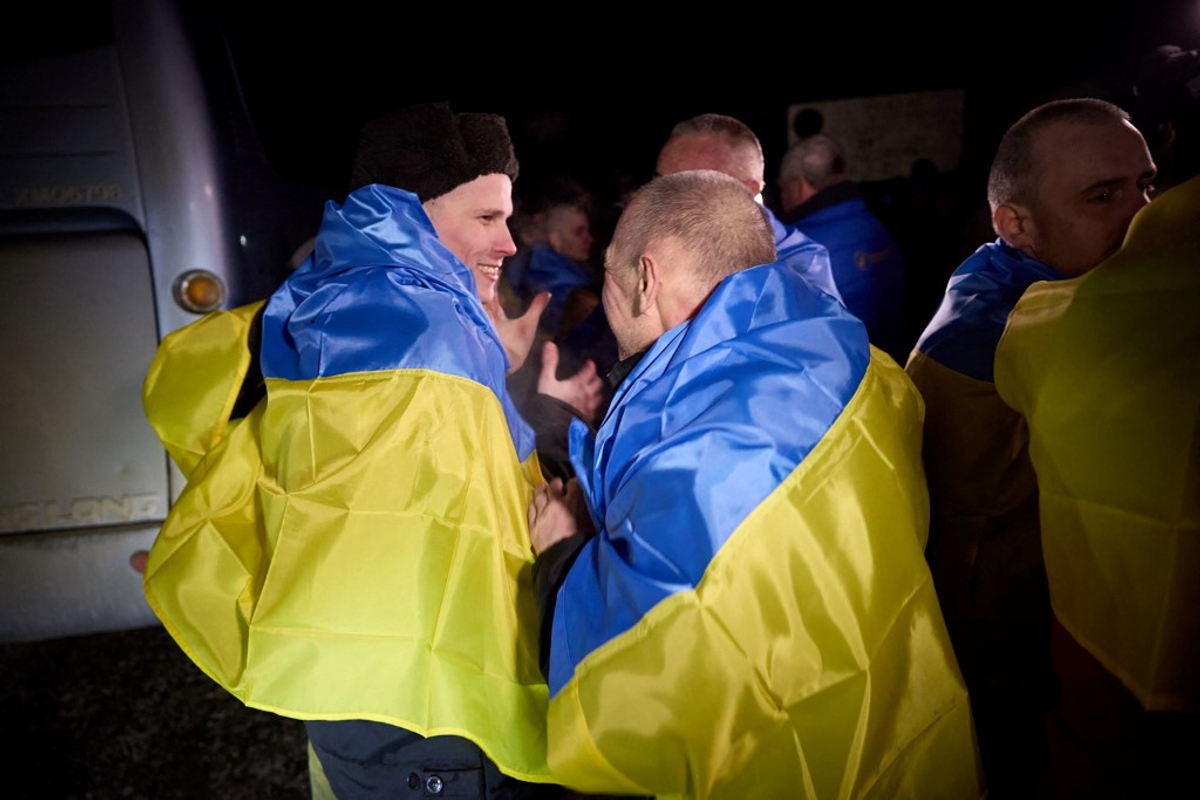
Ukraine returned more prisoners from Russian captivity in 2025 than in any previous year since the start of Russia’s full-scale invasion, following a series of exchanges enabled by political agreements and sustained coordination work, according to the country’s prisoner exchange authorities.
In total, 10 prisoner exchanges were carried out this year, alongside a major swap conducted under the first Istanbul agreements, which took place over three consecutive days and three stages, Andriy Yusov, deputy head of the Coordination Headquarters for the Treatment of Prisoners of War (POWs) told Kyiv Post.
Follow our coverage of the war on the @Kyivpost_official.
In addition, Ukraine and Russia conducted 10 separate stages of exchanges under the second set of Istanbul agreements, though the number and affiliation of those released were not disclosed.
Altogether, during the 10 confirmed exchanges and the first Istanbul swap, Ukraine secured the return of 2,310 people – 2,080 military personnel, including one woman, and 230 civilians, among them 13 women.
“This year, we managed to bring back significantly more of our people than in any previous year,” Yusov said.
While every exchange carries its own complexities, officials single out several moments that defined 2025.
Notable exchanges
One of the most noteworthy exchanges was the return of 1,000 Ukrainians in May, organized in record time under the first Istanbul agreements. The operation unfolded over three days and marked one of the largest single returns since the war began.
Other Topics of Interest
Trump Signals Russia Blocking Path to Peace as US Intel Rejects Putin’s Claim, Voters Grow Skeptical
The US president shares editorial blaming Putin for stalled talks, intelligence dismisses Kremlin claims, and the public questions whether peace is near.
Another symbolic exchange took place on Ukraine’s Independence Day on Aug. 24, while particular attention was paid throughout the year to the return of women, journalists, civilians, and captives who had spent more than three years in Russian detention.
“Each exchange is important and unique,” Yusov said.
According to the Coordination Headquarters, the record results of 2025 were driven primarily by political agreements reached through the Istanbul track – prisoner exchange protocols established with Turkish mediation in 2022 – combined with mechanisms developed and refined by Ukrainian institutions over previous years.
“More exchanges became possible thanks to political agreements,” Yusov said, adding that negotiations and coordination mechanisms continued to function in parallel.
“All of this together produced a very strong result.”
As a result, 2025 became a record year both in the number of exchanges and in the number of Ukrainians released, he said.
Despite the increased number of exchanges, Ukrainian officials say Russia’s approach to the process has not fundamentally changed.
According to Yusov, negotiations continue to be complicated by delays, unrealistic demands, and attempts at manipulation, alongside sustained information pressure – including during the repatriation of the bodies of fallen soldiers.
“The entire arsenal has remained unchanged since the start of the invasion,” he said, noting that Russia is often reluctant to retrieve its own prisoners.
Civilians remain among the most difficult categories to secure for release, despite progress made this year. Ukraine continues to document cases of unlawful detentions and fabricated sentences, imposed on Ukrainians seized in occupied territories.
“People are receiving long prison terms for crimes that were simply invented,” Yusov said. However, he added that a fake sentence is not an obstacle to return, pointing out that Ukraine has already secured releases in such cases and intends to continue doing so.
To facilitate exchanges, the Coordination Headquarters operates the “I Want to Be With My Own” project, which enables the transfer of convicted collaborators to Russia in exchange for Ukrainians held in captivity.
“There have been significant shifts with civilians this year as well,” Yusov said.
For 2026, the Coordination Headquarters’ priority remains unchanged.
“The main priority is one: the fastest possible return of each and every person,” Yusov said.
He added that, under the president’s mandate, all institutions involved in the Coordination Headquarters will continue working together so that more Ukrainians can reunite with their families.
“Our work continues so that more people can once again see the eyes of their loved ones,” he said.