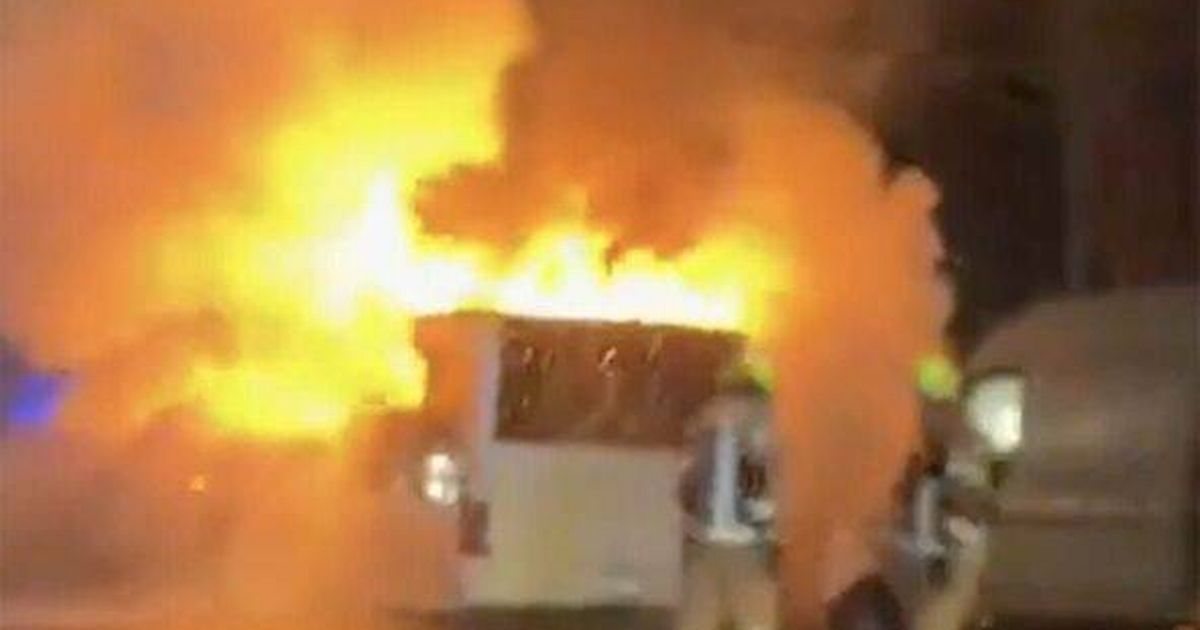
A bus on fire on the streets of Berlin on New Year’s Eve(Image: NIUS)
Germany’s New Year celebrations descended into chaos with over 400 arrests in Berlin as illegal fireworks were used as weapons, leaving dozens injured including a seven-year-old boy in emergency surgery
Germany’s capital plunged into mayhem during New Year’s Eve festivities welcoming 2026, with police confirming over 400 arrests following relentless assaults involving banned fireworks. The evening witnessed violent clashes in trouble spots including Neukölln, Kreuzberg, and Moabit, where mobs bombarded emergency services with rockets and makeshift explosives, mirroring persistent problems across the city’s neighbourhoods.
Officers mobilised 4,300 police personnel – triple the standard deployment – alongside 1,600 firefighters in a bid to contain the disorder, yet these measures couldn’t avert a sobering casualty count. Berlin’s police launched 670 criminal investigations, predominantly concerning the dangerous use of pyrotechnics, violent attacks, and deliberate fire-setting.
By the early hours of 1st January, 37 officers had been wounded, one suffering a serious leg injury from a “Kugelbombe” or spherical shell, necessitating surgical intervention. One dramatic video clip seemingly captured a bus engulfed in flames.
A firefighter was also injured whilst on duty, with numerous other officers experiencing “blast traumas” from point-blank detonations, underlining the extreme hazards confronting emergency workers.
Civilian injuries escalated sharply, placing immense pressure on local accident and emergency units. At Berlin’s Trauma Hospital (UKB), 42 individuals were treated for serious firework-inflicted wounds, including catastrophic injuries to hands, faces, and eyes, reports the Express.
Charité hospital dealt with a shocking 49 similar incidents within a 24-hour period, with medics likening the injuries to “war wounds” inflicted by illicit devices. Several people lost fingers or parts of their hands in explosions throughout the city, with UKB reporting at least eight such cases by 1 am alone.
Heartbreakingly, children were also caught up in the chaos. In Tegel, a ball bomb firework explosion injured eight individuals, including a seven year old lad who had to undergo emergency surgery for life-threatening injuries, along with two other minors who suffered minor injuries.
In Schoneberg, another powerful blast injured five civilians and caused enough damage to buildings to force residents from 36 flats to evacuate.
The chaos wasn’t confined to Berlin, with national reports highlighting the dangers of unregulated fireworks. In Brandenburg, a 21 year old bloke tragically died from injuries sustained from a device he wasn’t authorised to handle.
Across the country, five men lost their lives due to exploding fireworks.
Among the severe non-fatal incidents, a 23 year old man near Rostock lost his left hand when a “firecracker” exploded in his grasp, necessitating immediate hospitalisation.
Similar accidents occurred in other regions; a 14 year old lad near Rostock also lost his left hand to a firecracker explosion, while a 16 year old girl in Leipzig lost her little finger and parts of her ring finger after mishandling an illegal device.
In Berlin alone, police confiscated more than 220,000 illicit fireworks, but the magnitude of the chaos proved challenging to control. Authorities acknowledged that while preventative strategies such as weapon prohibitions and pyrotechnic limitations alleviated some hazards, the night represented a “low point” marked by ruined infrastructure and shaken communities.
As inquiries persist, demands for tighter fireworks regulations are escalating, accompanied by hospital warnings about the avoidable, “combat-like” impact on youngsters.