Synopsis: Pete Hegseth has floated reorganizing combatant commands—but the larger, harder reform would be reshaping the military services themselves.
-The services still dominate procurement, training, and doctrine, and bureaucratic divides can slow adaptation even as modern war changes fast.
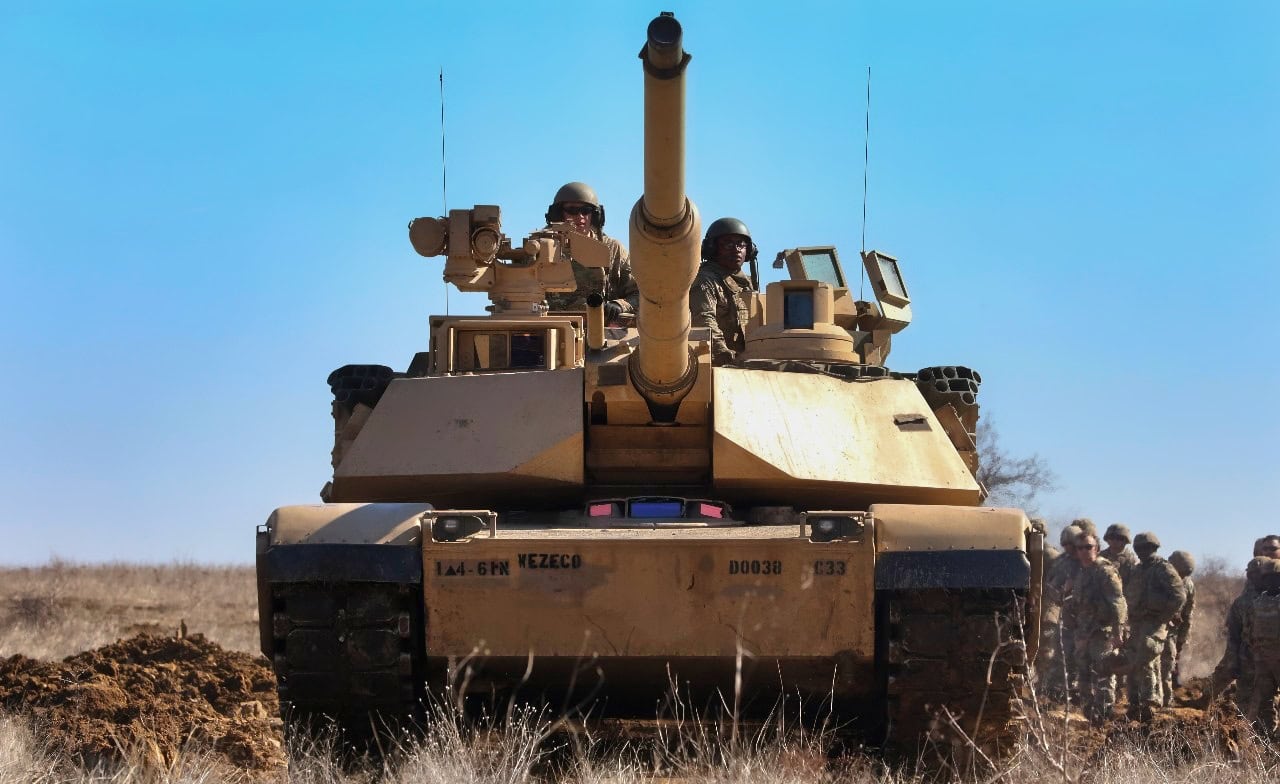
A U.S. Army M1 Abrams, assigned to 4th Battalion, 6th Infantry Regiment, 3rd Armored Brigade Combat Team, 1st Armored Division, fully emerges from the tank firing point to engage the simulated enemy at Novo Selo Training Area, Bulgaria, March 5, 2025. 1st Armored Division, a rotational force supporting V Corps, conducts training with engineers and tank operators in the European Theatre to maintain readiness and instill fundamental Soldier skills that are vital in maintaining lethality. (U.S. Army photo by Spc. Kyle Kimble)
-The creation of the Air Force and Space Force shows the U.S. can remake institutions when strategy demands it; critics now argue redundancy has grown, with “multiple air forces” and overlapping roles.
-Meanwhile, drone-centric fighting in Ukraine is driving institutional change in Russia and Ukraine.
-The op-ed argues the U.S. should at least consider whether today’s service structure is optimized for tomorrow’s warfare.
Hegseth’s Pentagon Reorg Has a Message: The Services Are the Real Target
Earlier this month, U.S. Secretary of War Pete Hegseth floated the idea of a significant reorganization of the Pentagon’s combatant command system. The overhaul would substantially revise the system established in 1986 by the Goldwater-Nichols Act, which was itself a major revision of the 1947 National Security Act.
While details remain vague, there is no indication Hegseth or President Donald Trump have abandoned these ambitions—although they have also done little to engage Congress or the rest of the national security bureaucracy.
But combatant commands are small fry. If U.S. leaders want to reorganize the combatant command system, why not take on a much bigger target?
Why not contemplate reorganizing the military services?

X-37B. Image Credit: Creative Commons.
Services Reorganization for the U.S. Military?
The services still drive procurement, and procurement is the biggest problem facing the Pentagon right now. Training and doctrine are similarly in the hands of the services, and while significant steps have been made to integrate these processes across the services, bureaucratic divides leave gaps in communication and planning.
Weighed against the costs of bureaucratic division is what the services provide: long-term continuity of culture, planning, and tradition that structures the U.S. defense enterprise and provides a foundation for the future.
The idea of a major revision of the services is not new. The story of the founding of the U.S. Air Force is well known, but the birth of the U.S. Space Force is a far lesser-known story, despite its recency. Yet the Space Force significantly modified how the Department of Defense does business.
In 2014, this author proposed abolishing the U.S. Air Force and folding its assets into the Army and Navy.
A recent op-ed by Harrison Kass suggested doing the same thing to the U.S. Marine Corps. Both arguments rested in large part on redundancy: Why does the United States need four air forces and two armies?
And why does the U.S. Space Force require its own special warfare capabilities? Such questions may have answers, but the people associated with the organizations should provide them.
Developments in modern combat suggest reform may be necessary sooner rather than later. Learning from contemporary wars can be dangerous.
But over the past two years, the character of combat has changed in dramatic ways. Drones now account for most casualties on both sides of the fight in Ukraine, and the omnipresence of drones has changed the ways in which infantry, armor, artillery, and aircraft interact.
Operational changes have already produced institutional change in both the Russian and Ukrainian militaries. Russia, for example, has begun a reorganization of its armed forces to manage drone warfare—a step Ukraine took a year earlier.

US Navy Littoral Combat Ship. Image Credit: Creative Commons.
It is premature to argue the U.S. armed forces are unprepared for the kind of warfare seen in Ukraine, and they are trying to learn lessons about the integration of tactics and technology at the front.
Further, the U.S. concept of operations largely focuses on avoiding the kind of war that Russia and Ukraine are now fighting. Still, it’s worth wondering whether the uniformed military services as constituted are up to the challenge of adapting to new realities and preserving longstanding advantages in conventional warfare.
It is never wrong to question the institutions that protect U.S. security and further U.S. interests. If it was in the interest of the United States to create new military services in 1947 and 2019, it may be in its interest to unmake one today.
Unsurprisingly, Hegseth has taken the easy path in pursuit of surface-level reform.
A deeper approach requires both a revolutionary mindset and the capacity to engage in serious negotiations with Congress, the services, and the Pentagon’s civilian bureaucracy.
About the Author: Dr. Robert Farley, University of Kentucky
Dr. Robert Farley has taught security and diplomacy courses at the Patterson School since 2005. He received his BS from the University of Oregon in 1997, and his Ph. D. from the University of Washington in 2004. Dr. Farley is the author of Grounded: The Case for Abolishing the United States Air Force (University Press of Kentucky, 2014), the Battleship Book (Wildside, 2016), Patents for Power: Intellectual Property Law and the Diffusion of Military Technology (University of Chicago, 2020), and most recently Waging War with Gold: National Security and the Finance Domain Across the Ages (Lynne Rienner, 2023). He has contributed extensively to a number of journals and magazines, including the National Interest, the Diplomat: APAC, World Politics Review, and the American Prospect. Dr. Farley is also a founder and senior editor of Lawyers, Guns and Money.