“Aaji hotey shotoborsho porey/ ke tumi porichho boshe amar kobitakhani… koutuholbhori? (Even after a hundred years, who are you, reading my poems with such curiosity?)”
When Rabindranath Tagore posed this question in verse in 1896, he could scarcely have imagined that the answer would one day come from across continents in Sweden. In 1913, the Swedish Academy stunned the West by awarding him the Nobel Prize for Literature, making him the first non-European laureate. Few could have foreseen that more than a century later, his music would find a living home in Sweden.
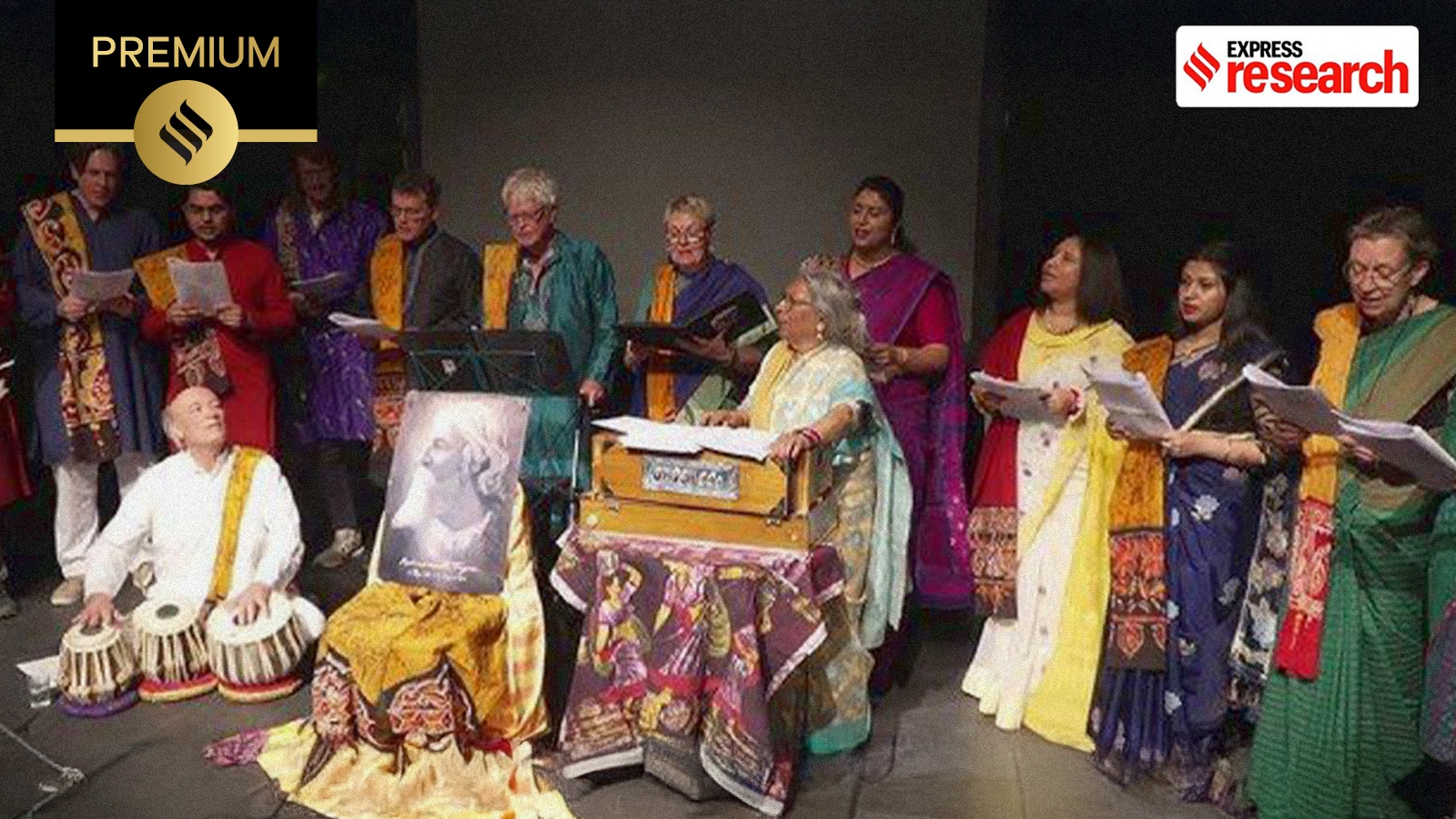
The Lund International Tagore Choir was born out of a commitment to carry Tagore’s songs and philosophy across Scandinavia and beyond. Comprised largely of Swedish singers performing in Bangla, the choir stands as a testament to how cultural memory transcends geopolitical borders, and shows that music, long after history has moved on, continues to speak in languages not its own.
A chance encounter in Calcutta
The story begins far from Scandinavia, on a humid May afternoon in India in 1982. Lars Eklund, a young Swedish journalist, arrived in Calcutta and found accommodation as a guest at the home of Annada Munshi, the pioneering artist widely regarded as the father of commercial art in India and a mentor to the famous filmmaker, Satyajit Ray. At Munshi’s residence in Tala Park, Lars met Bubu Munshi, the artist’s daughter, for the first time.
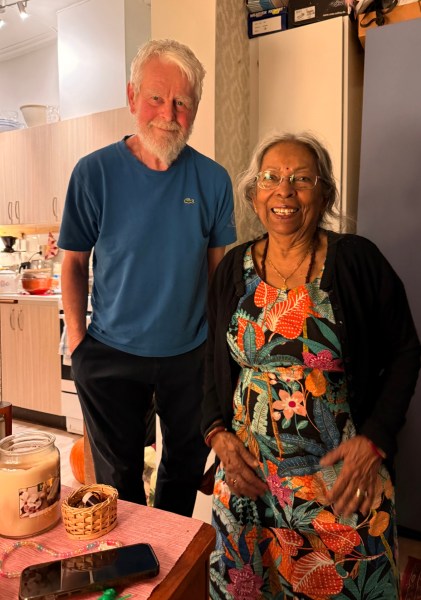 Lars Eklund and Bubu Munshi Eklund, at their residence, in Lund, Sweden. (Riyanka Roy)
Bubu was already an accomplished exponent of Rabindrasangeet, having trained under two of the most revered figures in Tagore’s musical tradition, Suchitra Mitra and Kanika Bandyopadhyay, whose guidance shaped both her artistic grounding and interpretive depth. When the two met, Bubu was performing across Bengal with her group, Santiniketan Ashramik Sangha.
Decades later, sitting in their cosy living room in Lund, Lars flipped through the pages of his old journal, recalling that first meeting. Even now, the recollection brings a quiet smile to his face, which he describes, without hesitation, as “love at first sight”.
Story continues below this ad
The connection quickly deepened. Later that year, the two got married in Calcutta. In 1983, they moved to Lund, a postcard-perfect town in southern Sweden whose rich intellectual and cultural life, anchored by one of Northern Europe’s oldest universities, would gradually turn it into an unexpected centre of Tagore’s legacy in Scandinavia.
In Sweden, Lars and Bubu pursued parallel paths shaped by a shared purpose. Lars continued his work in journalism and international engagement, eventually becoming the deputy director of the Swedish South Asian Studies Network (SASNET), strengthening academic and cultural ties between Sweden and South Asia.
Bubu, guided by an instinctive devotion to music, joined a Swedish choir, Svart på Vitt in Lund. A turning point came in 2011, when SASNET organised a week-long celebration in Lund to mark Tagore’s 150th birth anniversary. Under Bubu’s guidance, Svart på Vitt performed Tagore’s ‘Ontoro momo bikoshito koro (Let my soul blossom)’, bringing Tagore’s melodies into a Western choral space. The response was immediate and warm, revealing a deep resonance between the music and its new audience.
For Lars and Bubu, the performance became the seed of a larger vision: to build a choir devoted to Tagore’s songs and philosophy. They wanted to create a space in Sweden where Tagore’s music could be learned, sung, and lived—as a shared cultural experience.
A choir takes shape
Story continues below this ad
Later that year, in May, Bubu performed Rabindrasangeet at conferences in Gothenburg and Uppsala before audiences numbering in the hundreds. The concerts were accompanied by lectures on Tagore’s life and work, sparking conversations that travelled across Scandinavia, from Lund to Copenhagen, Stockholm and beyond.
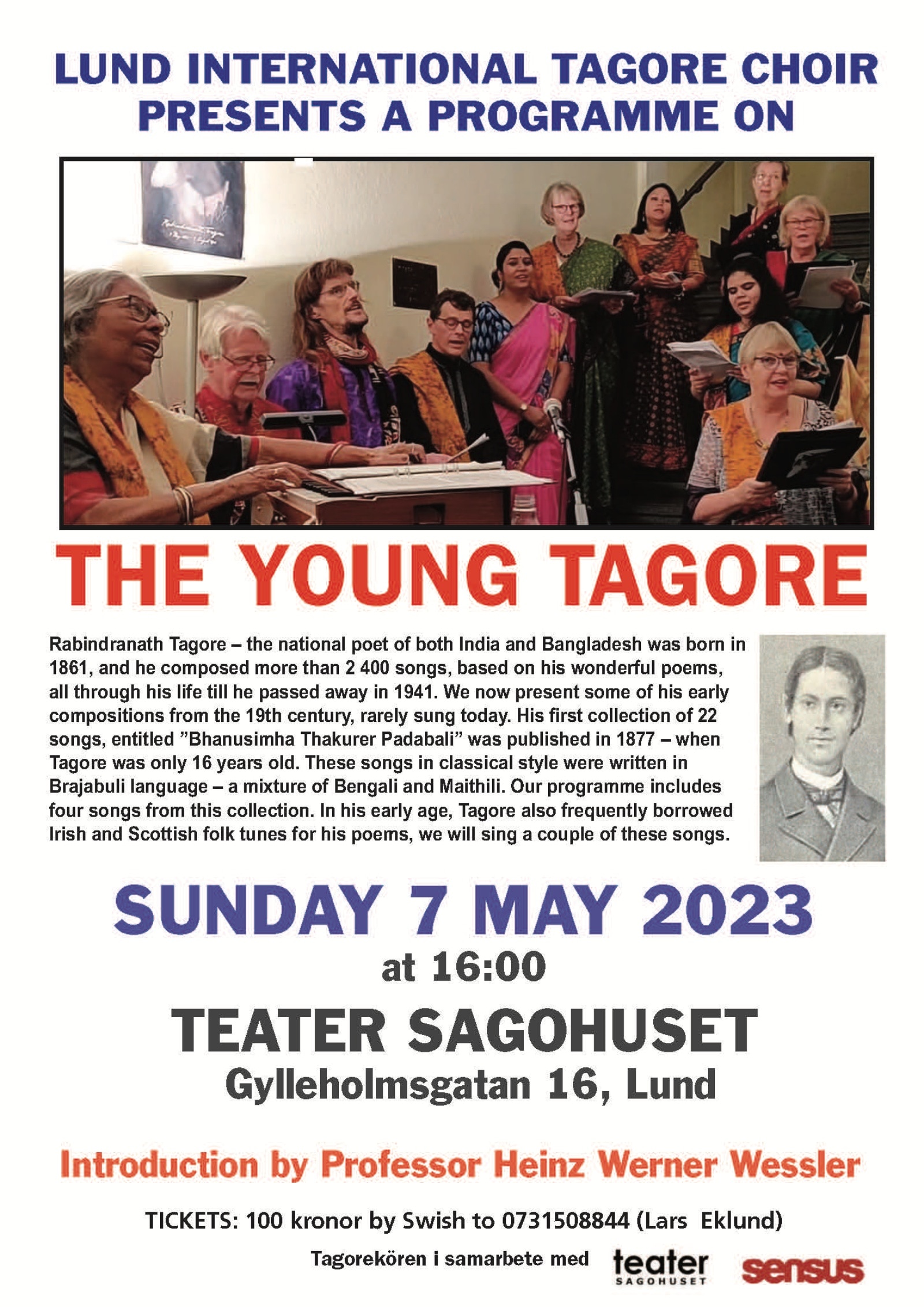 Concert poster from 2023, which was shared across social media platforms. (From the collection of Lars Eklund)
In 2012, the vision took formal shape with the founding of the Lund International Tagore Choir. Rehearsals were deliberate and intimate, full of love and respect. Sitting at her harmonium, Bubu trained Swedish singers to pronounce Bangla with remarkable accuracy, guiding them patiently through unfamiliar sounds while holding the melody steady. The choir became a medium of forging cultural kinship. Their rehearsal sessions particularly demonstrated how emotional understanding often precedes linguistic fluency.
On a snowy evening in November this year, watching Lars sing ‘Phule phule dhole dhole (flowers swaying gently in the breeze)’, alongside Pia and Lena, two fellow members of the choir, both Swedish by nationality, was a deeply moving experience. As Bubu accompanied them on the piano that day, it was hard not to feel the invisible presence of Tagore, somewhere in the room, listening to the pauses, the melody, and the precision with which each note was held.
From Stockholm to Santiniketan
In 2013, to mark the centenary of Tagore’s Nobel Prize, the choir performed at Stockholm’s Public Library. The programme brought together scholars and musicians, along with people from various other fields.
Story continues below this ad
Writer and Tagore scholar Per Olov Henricson spoke on the poet’s role in connecting the East and the West, reciting his poems in Swedish translation, while Bubu sang Tagore’s compositions in Bangla. The same year, the choir performed in Lund at Sagohuset, presenting songs such as ‘Aji Boshonto Jagroto Dare’, ‘Mor Beena’, ‘Pagla Hawar Badol Dine’, and ‘Hey Nuton’.
By then, Bubu had become the first artist to sing Rabindrasangeet in Bangla on Swedish television and radio, quietly marking a cultural milestone.
And soon, the choir’s journey brought Tagore’s music back to the land from which it first emerged. In 2013, they undertook a widely appreciated concert tour of India, performing in Balasore and Baripada in Odisha, and then, in Kolkata alongside the Mamata Shankar Ballet Troupe at the historic Star Theatre.
They also performed in Santiniketan, where the choir was invited to sing at the prestigious Sangeet Bhavan, established by Tagore himself, as a part of his larger vision for Visva-Bharati University.
Story continues below this ad
Looking back on the choir’s journey, Lars and Bubu recall the friends who played a quiet but significant role in its growth. One of them was Professor Subrata Chattopadhyay, who invited the ensemble to perform at IIT Kharagpur during its India tour. Chattopadhyay had been a guest professor at Lund University in 2001, a period during which he became closely acquainted with the couple. Aware of their efforts to carry Tagore’s music beyond borders, he extended a warm invitation for the choir to visit IIT Kharagpur in 2013, adding another meaningful chapter to its travels.
In 2019, the choir travelled to Bangladesh, with performances in Dhaka, Jessore, Kushtia, and Sylhet. “During our trip to Bangladesh, we also visited Tagore’s Kuthibari at Shilaidaha and the shrine of Baul king Fakir Lalon,” Lars recalled, reflecting on how Tagore’s music, carried by voices from across continents, had finally found its way home.
As a man who has mastered the art of documentation, Lars has preserved photographs, programme schedules, and handwritten notes from nearly every performance the choir has given. Speaking of their tour of Bangladesh, he recalled, “There was no funding for the trip, yet the members were so committed that they travelled on their own, spending their hard-earned money.” For Lars, this willingness spoke volumes. It reflected how deeply each member of the choir feels connected to Tagore and to the quiet power of his music.
Where Tagore still lives
When news of Tagore’s Nobel Prize reached Santiniketan in 1913, the world stood on the brink of upheaval. The First World War broke out the following year, making travel across Europe impossible, and it was only in 1921 that Tagore was finally able to visit Sweden, returning once more in 1926. In the years that followed, his works were translated into Swedish, and for decades he remained a widely read and much-discussed figure in the country.
Story continues below this ad
Today, there is renewed interest in his writing, fuelled by fresh translations in English and Swedish and a growing engagement with his humanist philosophy.
For Bengalis, Tagore’s songs are woven into childhood and memory, learned in school classrooms and sung at home. For Lars, who affectionately calls Kolkata his “second home”, embracing Tagore’s music has been an act of commitment and care. “None of this would have been possible without him,” Bubu says affectionately, recalling how Lars translated lyrics, organised rehearsals, and held the choir together. “He took charge of everything.”
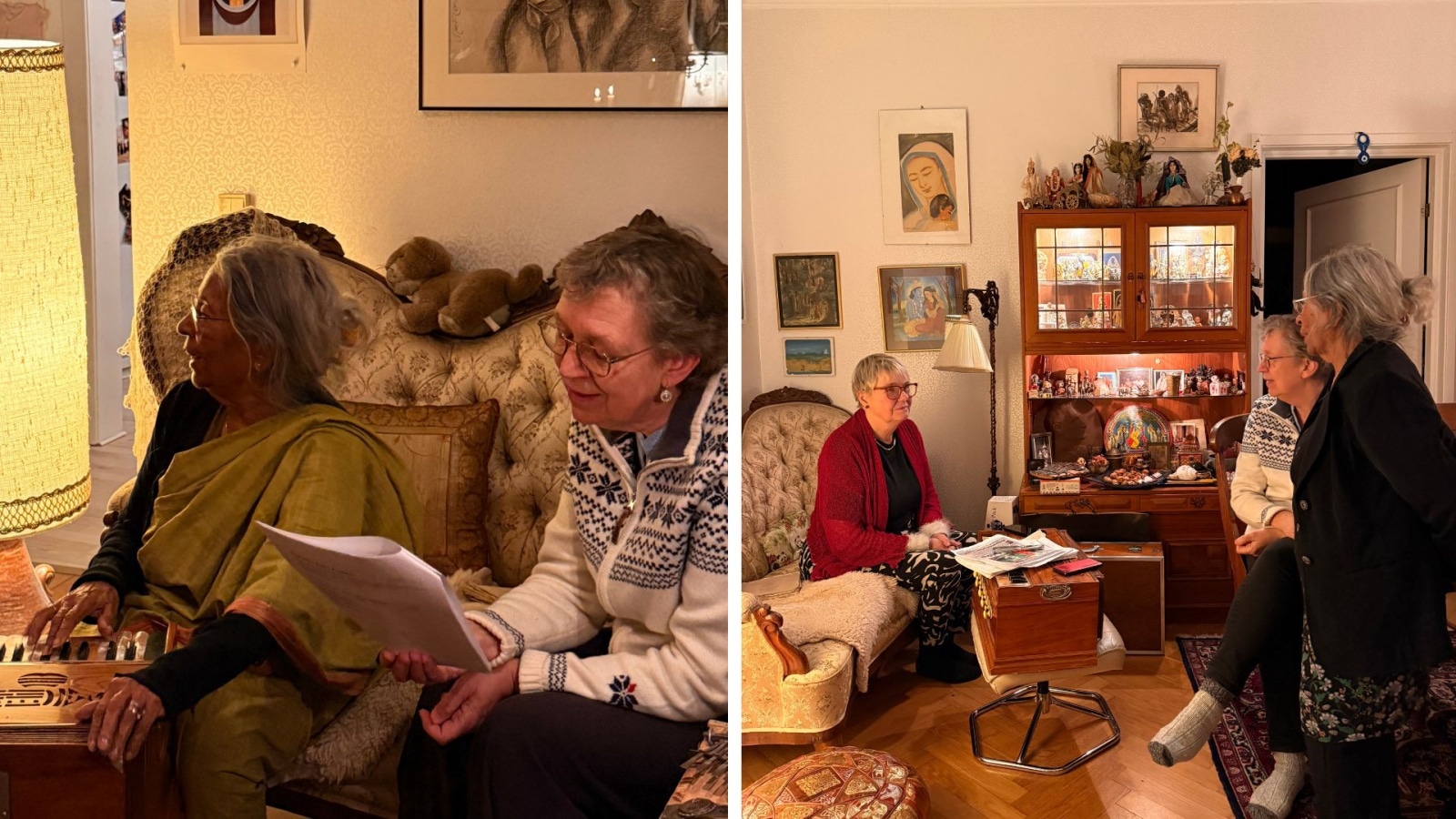 Left: Bubu Munshi Eklund and Pia Holmberg, singing Tagore’s song ‘Maati Toder Daak Diyeche’. Right: Lena, Pia and Bubu discussing about their rehearsal at the Eklund Residence. (Riyanka Roy)
And when the conversation turns to the translation of Tagore’s work, Lars speaks with particular affection about Professor William Radice of SOAS University of London, widely regarded as one of Europe’s leading scholars of Bengali studies. “Being a poet himself, Radice could make translations more similar to the Bengali originals,” Lars recalled, speaking of his close friend, who passed away in November 2024.
The Lund International Tagore Choir continues to meet at the Eklund residence in Lund. Its members now include Swedes alongside singers from India and Bangladesh. Every alternate Wednesday, they gather, and as evening falls, the room fills with Tagore’s melodies.
Story continues below this ad
“Next May, for Tagore’s birth anniversary, we will be performing Chandalika,” Pia said. Moments later, the room filled with the opening lines of “Maati toder daak diyeche, aye re chute aye aye aye (The soil has called out to you, come running, come).”
The call felt personal—an invitation to witness something quietly extraordinary: the beauty that Bubu and Lars have patiently woven, year after year, through the Lund International Tagore Choir.
And more than a century after Tagore asked who would read his poems, the answer arrives not in words, but in songs, carried across continents, sustained by devotion, and alive in a place far beyond his horizons.