Breadcrumb Trail Links
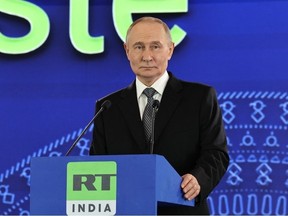 In this pool photograph distributed by the Russian state agency Sputnik, Russia’s President Vladimir Putin attends a ceremony launching the RT India TV channel, in New Delhi on December 5, 2025. Photo by ALEXANDER KAZAKOV /POOL/AFP via Getty Images
Article content
During Vladimir Putin’s annual year-end press conference, the mendacious Russian dictator denied launching the unprovoked full-scale of invasion of Ukraine in February 2022.
Advertisement 2

Article content
“We do not consider ourselves responsible for the deaths of people, because we did not start this war,” a Dec. 19, 2025, story in The Kyiv Independent quotes Putin as saying. And he repeated Moscow’s demand that Kyiv surrender the Donbas even though Russian forces have been unable to capture the Ukrainian region.
Article content
Recommended Videos
Article content
Even as the Putin regime pretends to engage in peace negotiations with the pro-Kremlin Trump administration, Russia continues to commit war crimes, using missiles and drones to deliberately strike Ukrainian civilian targets, including apartment buildings, hospitals, parks and energy infrastructure.
Hybrid war
Meanwhile, Russia is waging so-called hybrid warfare against the democracies of Europe, carrying out acts of terrorism. For example, Donald Tusk, Prime Minister of Poland, alleges that Russia was behind an attack on the Polish transportation system in late 2025.
Advertisement 3
Article content
“As a result of the investigation, we now know it was the Russian Secret Services that commissioned the blast of the Polish railway and recruited two Ukrainians to do it. We also know the identities of the perpetrators who immediately fled Poland for Belarus,” Tusk said in a Nov. 18, 2025 social media post.
“Blowing up the rail track on the Warsaw-Lublin route is an unprecedented act of sabotage targeting directly the security of the Polish state and its civilians,” Tusk stated in another post. “This route is also crucially important for delivering aid to Ukraine.”
Despite the Trump administration’s cozy relationship with the Putin regime, the American intelligence community understands that Russia is not interested in a U.S. brokered peace deal with Ukraine, or peaceful coexistence with Europe. “U.S. intelligence reports continue to warn that Russian President Vladimir Putin intends to capture all of Ukraine and reclaim parts of Europe that belonged to the former Soviet empire, six sources familiar with U.S. intelligence said,” reads a Dec. 19 exclusive published by Reuters.
Article content
Advertisement 4
Article content
In addition, Russia has deliberately severed undersea cables, including power and communications cables that serve Europe, whilst repeatedly violating NATO airspace with swarms of drones.
European financing
On Dec. 18, the European Council, composed of the leaders of the European Union, gathered in Brussels to discuss proposals to provide a financial lifeline to Ukraine. At issue was whether or not to use Russian assets, infinitely immobilized by the EU, to support Ukraine in its fight to survive Russian aggression.
As he prepared for the European Council deliberations, Tusk made a powerful case for supporting Ukraine against Russian aggression. “Now we have a simple choice: either money today, or blood tomorrow,” the Polish leader said in a Dec. 18 social media post. “I’m not talking about Ukraine only, I’m talking about Europe. This is our decision to make. And only ours. All European leaders must finally rise to the challenge.”
Advertisement 5
Article content
“We have a deal. Decision to provide 90 billion euros of support to Ukraine for 2026-27 approved,” António Costa, president of the European Council, announced in a post in the early morning hours of Dec. 19.
“The European Council reaffirms its continued and unwavering support for Ukraine’s independence, sovereignty and territorial integrity within its internationally recognized borders,” reads an official statement issued by the European Council after the agreement was reached. “The European Union will continue to provide, in coordination with like-minded partners and allies, comprehensive political, financial, economic, humanitarian, military and diplomatic support to Ukraine and its people.”
Advertisement 6
Article content
“We gathered today with a clear objective: to address Ukraine’s pressing financing needs,” Ursula von der Leyen, president of the European Commission, said in a Dec. 19 post. “We delivered.”
Due to internal disagreement, the European Council could not come up with a deal that would have allowed the EU to use frozen Russian assets to rebuild and defend Ukraine.
“The European Council agrees to provide a loan to Ukraine of EUR 90 billion for the years 2026-2027 based on EU borrowing on the capital markets backed by the EU budget headroom,” the council’s statement reads. However, it noted that “any mobilization of resources of the Union’s budget as a guarantee for this loan will not have an impact on the financial obligations of the Czech Republic, Hungary and Slovakia.” In other words, those three dissenting EU countries opted out of the loan arrangement.
Advertisement 7
Article content
In separate posts, the European Commission president said that the European Union reserves the right “to use the cash balances from Russian assets immobilised in the EU to finance the loan.” And von der Leyen also said that “financing Ukraine beyond 2027 will be part of the next long-term EU budget discussion.”
“The allocation of €90 billion by Europe, which in any case is linked to Russian assets, is an unprecedented decision, and it will also have an impact on the peace negotiations. Ukraine will be in a stronger position,” Volodymyr Zelenskyy, president of Ukraine, declared in a Dec. 20 social media post. “We understand that the interest-free loans — 90 billion — will only be repaid by Ukraine if Russia pays reparations to Ukraine. Therefore, this is a major, tangible, and important victory, and not only financially.”
Advertisement 8
Article content
“Geopolitically and politically, European leaders have shown their strength, and they had enough integrity to make such a decision,” Zelenskyy said in praise of the European Union.
Yulia Svyrydenko, prime minister of Ukraine, described the loan as “a decisive step for economic resilience and fiscal stability under wartime conditions.” And she explained in a Dec. 19 post that economic stability is “a prerequisite for security, for Ukraine and for Europe.”
In a social media post, Denys Shmyhal, minister of defence of Ukraine, described the European Council’s financing deal as “a strategic investment in Europe’s security.” By helping to strengthen Ukraine, said Shmyhal, Europe is reinforcing “deterrence, stability and its long-term security architecture.”
Advertisement 9
Article content
However, Kira Rudik, a member of parliament and leader of Ukraine’s Golo Party, complained that the European Union should have authorized the use of frozen Russian assets to support Ukraine. “The fact that the solution for usage of russian assets was not found at the Counsil is showing russia that there’s not enough unity in EU states,” she posted on Dec. 19. “We need to continue the work — so that it is not a burden on EU to pay for the war that russia started.”
“After long night-time negotiations, the leaders reached an agreement. It involves a loan of 90 billion euros to Ukraine, financed through joint EU borrowing,” Jessica Rosencrantz, Minister for EU Affairs of Sweden, said in a Dec. 19 social media post. “It is no secret. Sweden’s first-hand option was to use the frozen Russian assets as collateral for a so-called reparations loan to Ukraine. But too many held back. It became the second-best option,” reads the translation of her statement.
Advertisement 10
Article content
“Ukraine does not have to repay the loan until Russia has paid for the damage it has caused. Until then, the Russian assets remain frozen,” the Swedish cabinet minister explained, echoing Zelenskyy. In addition, Rosencrantz stressed that the security of Europe depends on the European Union maintaining pressure on Russia while strengthening Ukraine.
“The EU must be radically reorganised, or it risks falling apart,” an angry Viktor Orbán, prime minister of Hungary and Putin ally, said in a Dec. 19 social media post after the loan was announced. Orbán opposed extending a financial lifeline to Ukraine. “Without change, the EU will continue to weaken from within. It’s time for a Union that serves its nations, values sovereignty, and puts its citizens first.”
Advertisement 11
Article content
Despite the Putin-Orbán alliance, Hungary remains a nominal member of the European Union — for now.
“Maybe time for you to propose an exit?” Michal McFaul, former U.S. ambassador to Russia 2012-2014, posted in response to Orbán’s attack on the European Union.
Conclusion
In light of the Trump administration’s affinity for the Kremlin, disdain for NATO and lack of support for democratic Ukraine, it will be imperative for the European Union to continue to invest in European security by financially supporting Ukraine against Russian aggression.
Follow Geoffrey P. Johnston on BlueSky @geoffypjohnston.bsky.social
Article content
Share this article in your social network