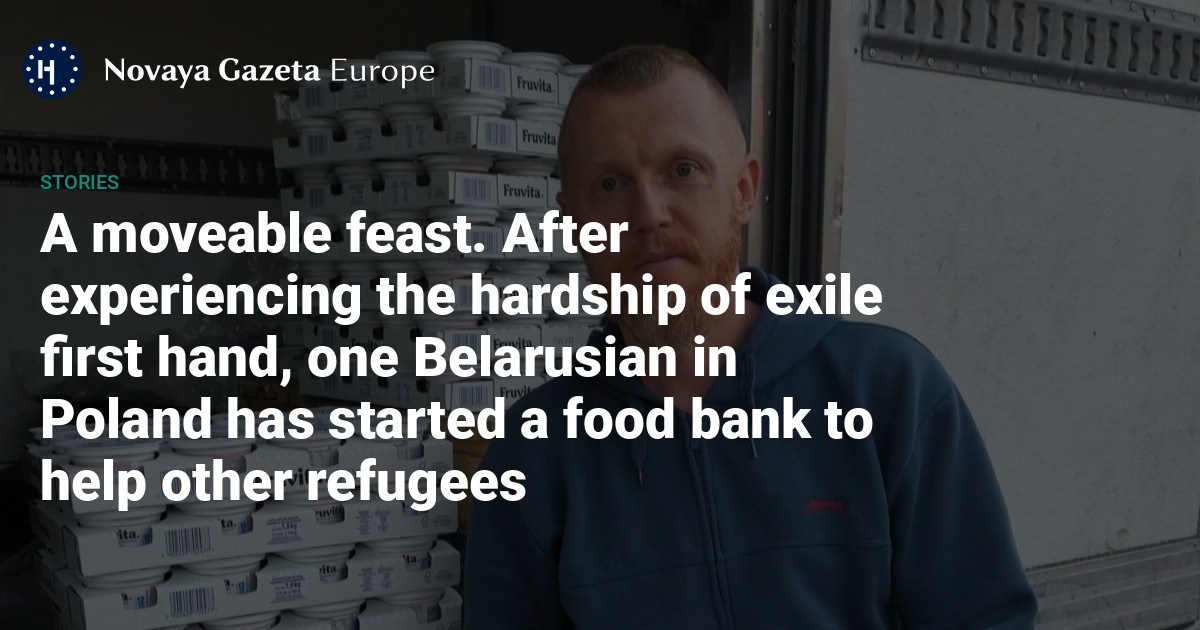
In the Warsaw suburbs, you’ll find a small railway station optimistically named Radość, Polish for joy, where Belarusian migrants are gathering in a small nearby car park one cold and wet afternoon at twilight. Some greet each other and share their news, while others, lost in thought, keep themselves to themselves.
When a van enters the car park, the small crowd instinctively gravitates towards it, even before it has come to a stop. The van’s energetic driver, Siarhei Melianets, is also from Belarus, and hasn’t always had an easy time as an immigrant himself, with seven children to feed. He now devotes much of his time to collecting and distributing food to Belarusians living in Warsaw.
A well-known Christian preacher, musician and poet in Belarus, Melianets found himself in legal trouble in 2020 for supporting the nationwide protests against dictator Alexander Lukashenko’s stolen election that year. After being detained in central Minsk in August 2020 while on his way to church, Melianets was so brutally beaten and tasered by law enforcement officers that he had to be rushed to hospital in a critical condition.
After his release came the harassment: social workers were instructed to investigate whether his children were living in “socially precarious circumstances” — a precursor to placing them in social care — and he was even fined for having red and white blinds on his windows, as these are the colours of the post-independence Belarusian flag, which dictator Alexander Lukashenko abolished and replaced with a variation on the country’s Soviet-era flag in 1995.

A Belarusian refugee collects toys for his daughter in Radość, Poland. Photo: Iryna Khalip
As the trials of those who dared call for the overthrow of the Lukashenko regime began, an undeterred Melianets attempted to enter the courts to lead prayer for a new generation of Belarusian prisoners of conscience.
As he was leaving court after the trial of journalist Ihar Karnei in March 2024, Melianets was detained by ununiformed law enforcement officers. After being interrogated, he was sent to Minsk’s notorious Akrestsina prison for almost a month.
A KGB officer who was sent to interrogate Melianets showed him pictures of his wife standing in a line of people with their arms linked in solidarity, a bible in her hands, and warned him that he faced anything from 10 years in prison to the firing squad for passing on information about the protests to independent media outlets and human rights activists. He also told Melianets that his wife would be in the next cell that same day, while his children would be placed in an orphanage in less than a fortnight.
In the meantime, his family had begun preparing to flee the country, and so when Melianets was unexpectedly released after 25 days behind bars, they took their chance and left Belarus immediately. They took their leave in secret, without saying goodbye to any of their friends or family, and without any idea of what would await them abroad.
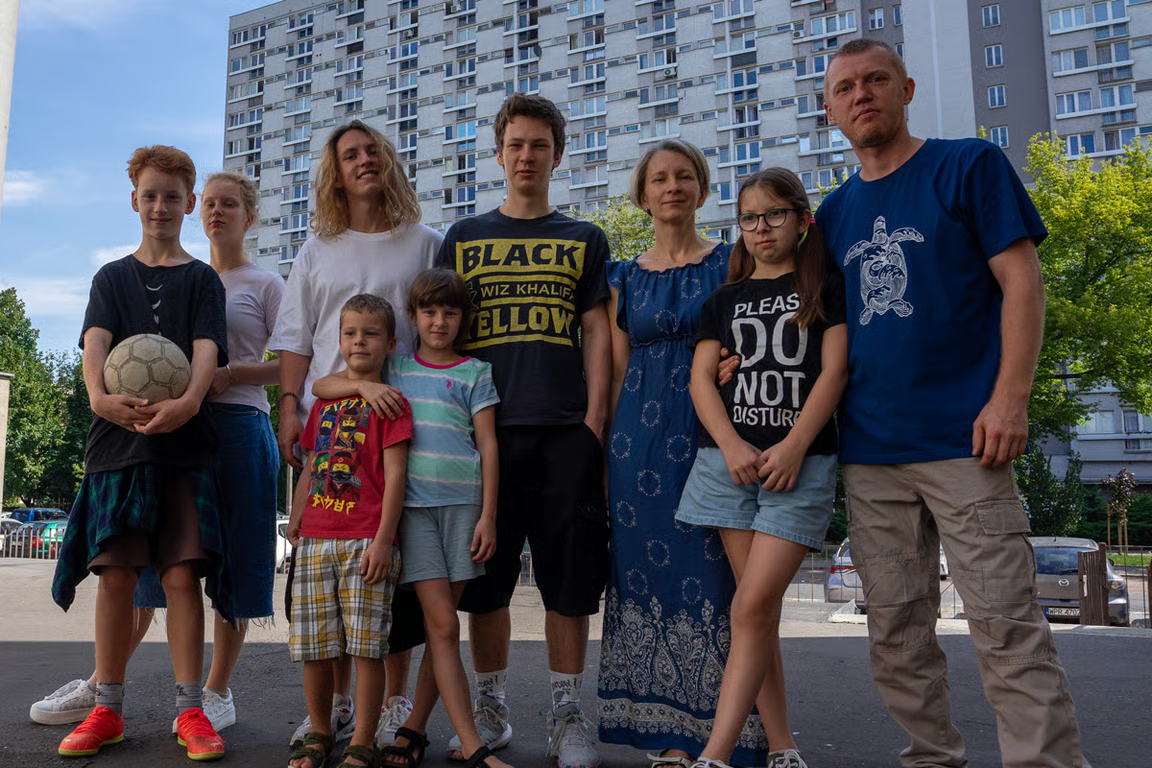
Siarhei Melianets (R), his wife and their seven children. Photo: Siarhei Melianets
At first, the family lived at a church in Warsaw, where the children were given bunk beds to sleep in while their parents slept on mattresses on the floor. Though they started looking for their own place immediately, finding an apartment for such a large family was difficult.
But then, in a stroke of luck, they heard from friends about an apartment that had been so seriously flooded by a broken washing machine that the owners wanted to completely renovate it. Having taken a shine to the large family of migrants from Belarus, the owners of the apartment agreed to allow the Melianetses to live there, while renovating the property around themselves and paying discounted rent. They live there to this day.
Despite not speaking any Polish and lacking residence permits, both parents, as well as the older Melianets children, began to scour Warsaw for work. They mostly ended up taking on cleaning jobs, and were always grateful for the opportunity.
At church, Melianets met Brother Henryk, who ran the Radość Christian Foundation, which provides food to people in crisis. The foundation helped the family several times. And then Melianets realised this was a chance for the foundation to provide food to other refugees from Belarus, and got down to work.
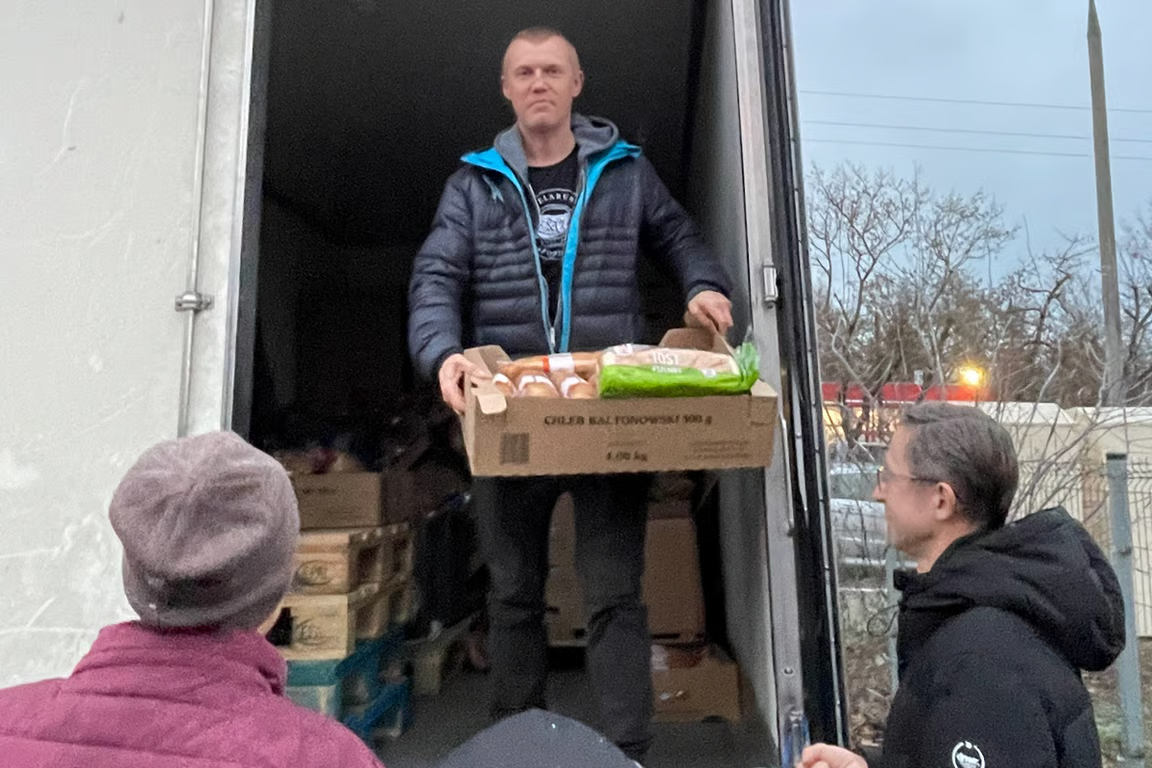
Siarhei Melianets at work with the Radość Christian Foundation. Photo: Iryna Khalip
“I have good news and bad news!” Melianets tells the crowd gathered in the car park outside the station as he opens the door of the van. “The only food I have today is bread. But I do at least have enough for everyone. And I also have toys and clothes!”
Helping Belarusians in need isn’t just volunteer work for Melianets now, it’s become a personal vocation. Though he now has two jobs — making fresh pomegranate juice in a shopping mall and cleaning at a car dealership with his son Ivan — he still finds time to collect food that can then be redistributed to those in need.
“Siarhei helps out our compatriots in need, but also helps the environment, as otherwise retailers would throw the food away.”
Food banks, organisations that collect food items that are about to reach their sell-by date from supermarkets and then distribute them to those in need, are “very important from an ecological point of view,” according to Uladzimir, a Belarusian environmentalist refugee in Poland who is a regular user and volunteer at the food bank. “Siarhei helps out our compatriots in need, but also helps the environment, as otherwise retailers would throw the food away.”
Volunteers at the project work according to a simple philosophy: I am in a difficult situation, but I will both seek and provide help.
One young man picks up a toy rabbit. “My daughter will be very happy. She’s autistic. We have three children, and I’m the only one working. …You know, sometimes these groceries mean we don’t go hungry. A lot of people find themselves in the same very difficult situation as our family. What Siarhei provides is a god-send to us and to many others.”
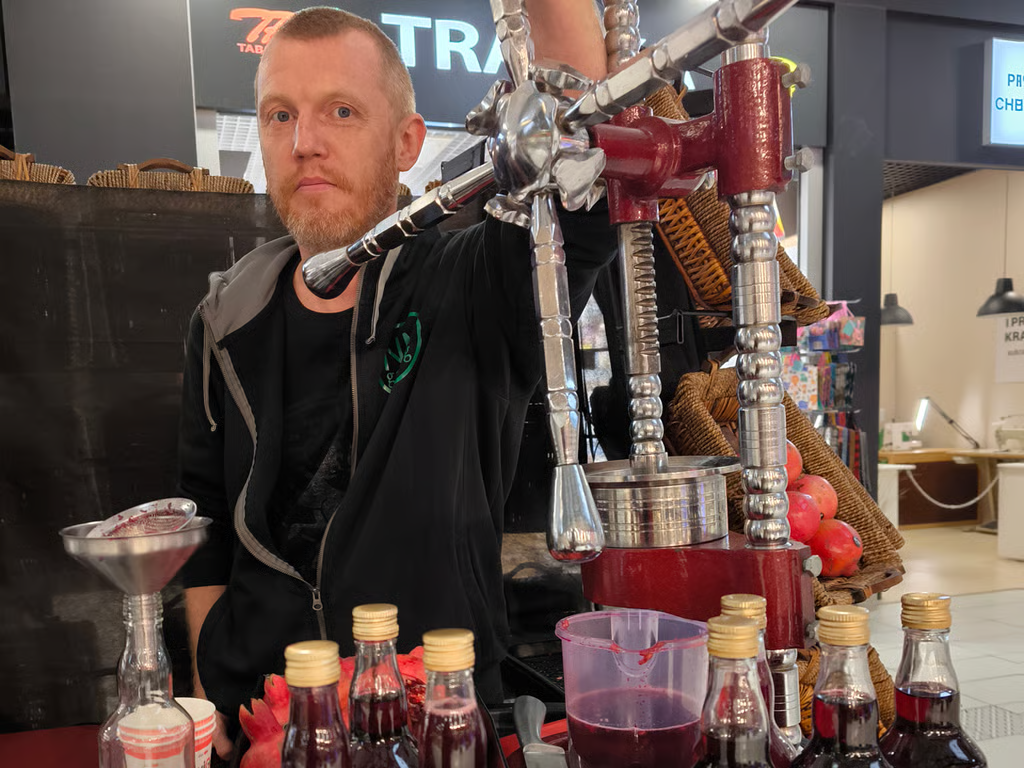
Siarhei Melianets at work pressing pomegranate juice in Warsaw, Poland. Photo: Siarhei Melianets
We drive the empty van, which belongs to the foundation, to the car park to meet Brother Henryk. “You should set up your own foundation!” he tells Melianets, who dismisses the idea. “I’m not made for paperwork and bureaucracy.”
The Radość Foundation has been helping those in need for 20 years. First it helped Poles, then Ukrainians, and now, thanks to Melianets, Belarusians too. The chat he set up on Telegram now has over 400 families on it, most of whom are Belarusians, as well as a Facebook group. Though the initiative is called#food4bel, it doesn’t just help Belarusians, and some 160 Ukrainian families also regularly accept food from the programme.
Melianets finds time every week to go to different locations to collect donated foodstuffs, which he loads into his van, unloads elsewhere and then distributes. He also manages to work two jobs, take care of his children, coordinate the work of volunteers, go to church and help out at Christian children’s camps. He never switches off. Even when he was in prison, Melianets says that it was his faith that inspired him and gave him the strength to continue. Since then, Melianets says he has intuitively wanted to offer his support to those who are struggling, those who are exhausted, those who are on the brink of giving up, and make them feel a little better in any way he can.
Perhaps it’s a form of self-help, helping others out so as to not give up on yourself when you lack papers, an obvious future, stability, and any hope of being able to return home any time soon.