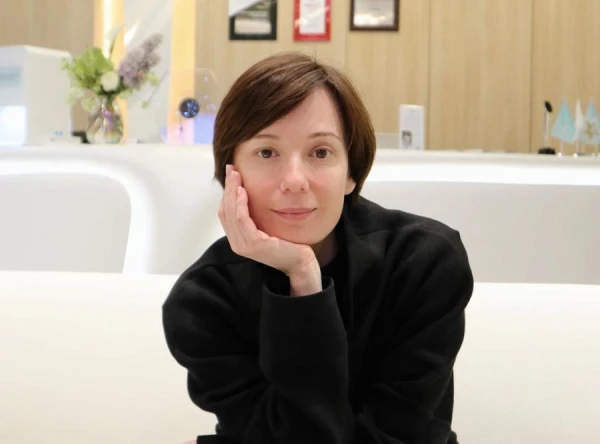

Chulpan Khamatova spoke candidly about life in Latvia and learning the language
## – Next week, on January 5, you will arrive in Tallinn with the performance “The Only Tallest Trees on Earth.” When reading the annotation, there is so much talk about the form and rhythm of the word, but almost nothing is revealed about the plot. How would you present the performance to the audience?
– Considering that this performance does not have a conventional plot, there is not much to tell… Two friends, who have lost hope that good will triumph over evil, discuss this world. They try to convince themselves that there is no hope left in this world because people have so spoiled everything around and their own souls that there is absolutely nothing to hope for.
Until a third character appears, played by Vasya Zorky, a character named Bonch. He childishly and simply explains that all the light and all hope are within themselves. They can blame the world as much as they want, but if they themselves do not cultivate hope, there is no one to blame. The world is as it is, and hope is in our hands.
## – You mentioned how important interaction with the audience is. And after the curtain falls, what feelings do you have left?
– It all depends on the audience. This performance requires mutual work with the public because the text is very dense and quite difficult to understand. If the audience is ready to work with us, to connect emotionally and mentally, a very good feeling remains. If not, it’s not as pleasant. But the three of us really love this performance.
The form of the performance is unusual and complex. It is not like the usual productions, the theatrical school that the audience is accustomed to. They need to solve a crossword puzzle together with us.
## – I would like to know about your life in Latvia, where you moved in 2022. How has this country revealed itself to you?
– To my shame, I did not know Latvia at all. Fifteen years ago, we bought land here. Gradually, I built a house, and we came here in the summer for vacations, at best it was a month a year. When there was not much work. Sometimes we came and celebrated the New Year holidays. That’s basically it. I knew nothing about this beautiful country or its people.
But, of course, when I started living here and getting to know the locals; when I learned the language and began to hear and understand what people were saying on the streets; when I went to work in the theater in Latvian; when I saw wonderful colleagues, an amazing level of the team…
And now I am already at the point… Just recently I worked for a long time in America, and there I missed home. And suddenly I caught myself thinking that I was not thinking about Moscow at all, but only about Riga.
## – You already mentioned that after moving you started learning the Latvian language. I’m curious: how difficult was it for you?
– It is difficult because it is very unfamiliar. Latvian is unlike any of the languages I already know: neither English nor German. It has some ancient Russian words that vaguely resemble Russian.
The hardest part for me, as an actress, is the phonetics, specifically the pronunciation. And I am still lagging behind in this. Even now I try to pay attention to it because at first I just needed to learn the words.
And the fact that I started learning the language without thinking about phonetics was my mistake. I advise everyone who will learn it to start with phonetics if you want to be understood by Latvians (laughs).
## – Do you have a favorite word or expression in Latvian?
– The word strādāt in Latvian means “to work.” It is related to the Russian word страдать, because “страда́” was the time of the hardest work when it was necessary to harvest and work almost around the clock. And, in fact, the meaning has been preserved in Latvian, while in Russian it has taken on a completely different meaning.
When I started living in Latvia and learning the language, I was most struck by the fact that during the Soviet years we knew almost nothing about the republics that were part of it. Not to mention that when Latvia gained independence and became a separate country, we also knew nothing about it.
I thought that perhaps there would be fewer wars and conflicts if children understood what countries their neighbors were from since school. I think this is very, very important.
## – It is now fashionable to make vision boards, to write down wishes and goals for the upcoming year. Do you do anything like that?
– No, I do not believe in this connection. Absolutely not. Everything good that has come to me in life has been spontaneous and completely unexpected. I have only one wish: for my loved ones to be healthy. Everything else can be endured!
Because happiness is a volitional concept. If you want, you are happy; if you do not want, you are unhappy. If there is no war, if bombs are not falling, if loved ones are not dying or suffering from some serious illness, everything else can be endured.