January 2, 2026
BERLIN – Mr Tien Nguyen is a man on a mission. The second-generation Vietnamese-German wants to reduce the likelihood of young Vietnamese being fleeced while migrating to work in Europe’s largest economy.
In 2024, 7,100 Vietnamese citizens signed new vocational contracts in Germany, forming the largest foreign source of apprentices, according to Germany’s Federal Statistical Office. This is a 61 per cent jump from 4,400 in 2023, part of a post-Covid-19 surge after Berlin first approved its Skilled Immigration Act in June 2019.
These numbers are only set to grow, with further modifications to this law in 2023 making it even easier for non-European Union vocational workers to migrate, and a 2024 Berlin-Hanoi deal formalising a partnership to plug German labour gaps with Vietnamese workers.
But the risk of young people being exploited is also magnified, with unscrupulous brokers in Vietnam charging inflated prices – sometimes as much as €20,000 (S$30,200) – to facilitate a move to Germany for vocational training, said Mr Nguyen and other labour and migrant advocates, who are sounding the alarm.
“The more we researched, the more we dived into the ecosystem, the more we realised the student training placement industry has been built in a way where there’s a lot of false advertising, empty promises and financial exploitation,” said Mr Nguyen, co-founder and chief executive of Alma Recruiting.
Through his company, Mr Nguyen hopes to bypass the unscrupulous middlemen and direct young Vietnamese towards the legal pathways for migration.
He said Vietnamese social media influencers and other self-professed “experts” and recruiters paint such a rosy picture of living in Germany that young people are willing to pay the hefty prices asked for.
However, the glossy videos often obscure the practical difficulties of integration and securing affordable housing in major German cities, while perpetuating unrealistic salary expectations.
Vietnamese in their late teens and 20s are the demographic groups most vulnerable to such enticements.
Typically fresh out of high school, many of them will not have travelled much or have any professional skills or training, but are eager for some experience of living and working abroad while they learn vocational skills.
Advocates say Vietnamese migrants generally think paying off loans over one to two years is acceptable. But, coming from a country whose annual gross domestic product (GDP) per capita stood at just above US$4,000 (S$5,142) in 2024, many migrant workers take months, if not years, to repay broker fees extending into the thousands.
This is made worse if brokers refer their Vietnamese clients to underground lenders with sky-high compounded interest rates. Starting salaries in Germany for vocational trainees also do not tend to exceed €1,200 a month.
“The recruitment process is just very poorly regulated in recipient and source countries. The agencies basically have the free access to do whatever they want, charge whatever they want,” said Ms Mimi Vu, co-founder of the Vietnam International Safe Labour Alliance (VISLA) that advocates migrant rights and ethical recruitment practices.
“There are legal pathways for Vietnamese people to migrate to Germany for work, but it’s just that they don’t think they can do it on their own, and they think they have to pay these exorbitant fees – that’s the problem.”
Other than its vocational track, Germany also has migration tracks specifically aimed at recruiting trained nurses and skilled hospitality and service professionals.
Under the terms of the 2024 Berlin-Hanoi labour deal, both governments agreed to engage in regular roundtables on migration issues. At the Vietnam-Germany Labour Cooperation Forum held in the eastern German city of Leipzig in early December 2025, both governments appeared aware and committed to combat the risks of exploitation.
While Germany needs to plug urgent labour shortages due to its low birth rates, Vietnam considers labour exports as an important tool for job creation, poverty reduction and sustainable economic development, VISLA said in an online note on Vietnam’s state-driven development strategy on Nov 23, 2025.
According to the World Bank, Vietnam was the 12th largest recipient of remittances among low- and middle-income countries in 2024 – at US$14.7 billion, this represents more than 3 per cent of its 2024 GDP.
Despite recording strong economic growth in the last few years, Vietnam’s development model has relied heavily on low labour costs to attract foreign investment, with factory workers earning less than half of Chinese wages, said VISLA.
More than half of Vietnam’s 101 million people are now of working age, a window of demographic opportunity that is forecast to end sometime in the late 2030s.
But at the same time, like other middle-income countries in Asia such as China and India, Vietnam suffers from a mismatch of skills required by the job market.
Sluggish higher education enrolment and a skilling curriculum that does not adequately prepare graduates to take on more advanced industrial jobs are issues that will impede Vietnam’s productivity growth and industrial upgrading in its economy.
The result is a chronic state of underemployment for young Vietnamese, a key reason so many of them are drawn to going abroad.
According to the General Statistics Office of Vietnam, the country’s youth unemployment increased from 8.2 per cent in the second quarter of 2025 to 9 per cent in the third quarter. This is more than three times the overall unemployment rate, which held broadly steady at 2.2 per cent over the two time periods.
More worryingly, more than 10 per cent of Vietnam’s youth aged 15 to 24 were not in employment, education or training.
Thus, South-east Asia’s fourth-largest economy stands to benefit when its workers move abroad to earn higher wages and acquire advanced skills that could help the country – when or if they return.
The appeal of Germany, with its multiple tracks and the possibility of long-term residence, among Vietnam’s young is understandable. But while their move to Germany may be initially legal, young Vietnamese have been known to drop out of their intended industrial placements and resort to work in fields that fall outside of their authorisation.
In October, German public broadcaster Deutsche Welle reported that more than 200 Vietnamese trainees at a leading hospitality-focused vocational training college in Berlin had dropped out and disappeared, sparking fears they had taken jobs in the black economy – in beauty salons and even prostitution – in their desperation to earn more money more quickly.
Confronted with this reality, Mr Nguyen, along with his childhood friend Son Le Duc and two others, Mr Anh Nguyen and Mr Maddin Truong, came together to start Alma Recruiting at the end of 2024. They hope to scale up the company by tapping the market for funds later in 2026.
“Our value proposition very much starts from the beginning, with what is reality and what is real,” Mr Nguyen said. “We realised that students haven’t been properly guided, so they end up in Germany under false expectations, with wrong or unfit career choices and then are left to fend for themselves.”
He added: “Students then risk falling through the cracks and joining the shadow economy. Our job is to avoid that by any means and re-educate students to pave the way for the right path.”
Using their bicultural affinity and multilingual abilities, Mr Nguyen and his Vietnamese-German crew straddle Berlin and Ho Chi Minh City, working with reputable German-language schools in Vietnam to place their young clients with German companies and vocational training.
Their aim ultimately is to eliminate costly middlemen through the use of technology, and offer comprehensive pre-arrival and post-arrival integration support. Alma also helps in the conversion of professional accreditation for skilled Vietnamese professionals moving to Germany.
“They helped me find an apartment to share with not too many people, and with others who are trustworthy,” said Ms Nguyen Minh Khue, one of Alma’s young clients who recently finished the first of three years of vocational training to be a dental assistant in the Stuttgart area in south-west Germany.
Originally from Hanoi, she recounts Alma recruiters interviewing her in both Vietnamese and German to gauge the validity of her German language qualification. B1 is usually the minimum required by German authorities, though some sectors require the higher B2 level of competence.
“It’s important for me to be on my own and be independent,” said Ms Nguyen, who is about 20, and left for Germany shortly after finishing high school. “It gets lonely sometimes, but I speak German and English and have international friends in school from Ukraine, Turkey and also local Germans.”
A big part of what Alma does is to create community by engaging senior clients to buddy new arrivals as they settle into life in Germany. Ms Nguyen said she will be doing the same for incoming students as her seniors did for her.
For Mr Nguyen and his business partners, the children of first-generation migrants, the issue of safe and ethical migration for Vietnamese people is personal.
The northern Vietnamese were among the first group of migrant labour invited to the former East Germany starting in the 1950s. Boat people escaping the Vietnam War started arriving in the former West Germany in the late 1970s.
In 1980, the East Germans signed an industrial training pact with a unified Vietnam to increase the labour supply for their local industries and to aid in the economic development of a fellow socialist country.
According to the Federal Statistical Office of Germany, there were 226,000 people of Vietnamese descent living in Germany in 2024, with 141,000 of those first-generation migrants – making them among the larger Asian minorities.
“There is a kind of ‘positive racism’ (towards) the Vietnamese and people from East Asia in general,” said Professor Frank Bosch, a historian and director of the Centre for Contemporary History at the University of Potsdam.
“They have the reputation of working hard, avoiding political trouble and are respected very much for their support in public services (like restaurants, beauty and flower shops),” he added.
In the half century or so since the first Vietnamese people arrived in Germany, many have naturalised or had children in the country. Many have done well academically and work in desirable professions in medicine, technology and engineering.
But Vietnamese immigrants tend to live very much in segregated communities and most Germans do not have much contact with them, according to Prof Bosch. The isolation is partly why young first-generation Vietnamese migrants do not know how or where to find help in the wider German society, when faced with woes like mounting debt.
They are also taken advantage of.
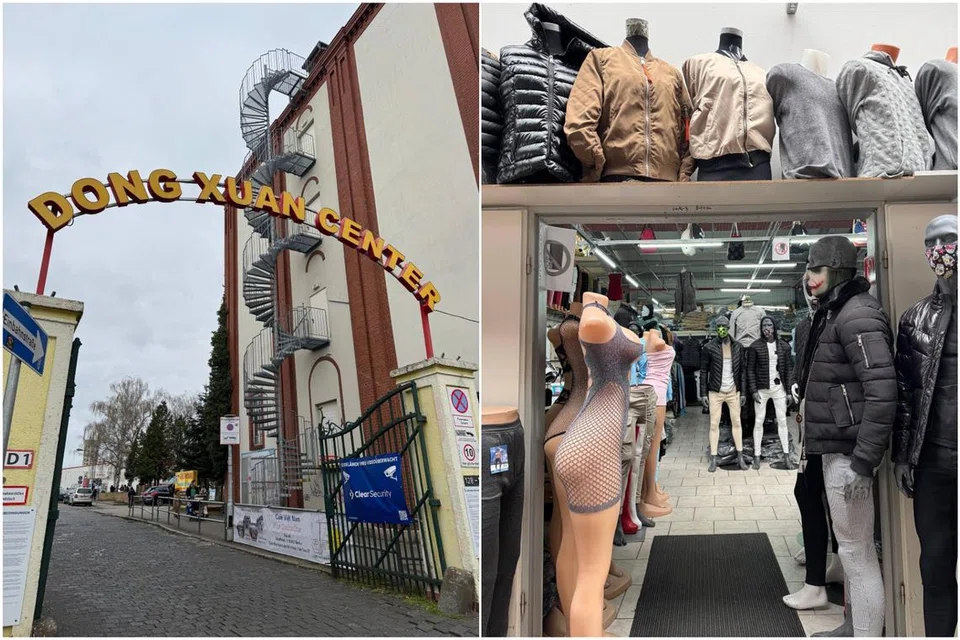
At community hubs like Dong Xuan Centre, known as Berlin’s “Little Hanoi” and the heart of the Vietnamese diaspora in the German capital, the scores of supermarkets, restaurants, beauty salons, clothing and hardware stores point to a thriving and entrenched community. But some opportunistic merchants are known to charge new migrants inflated fees for basic services such as a new cellphone line.
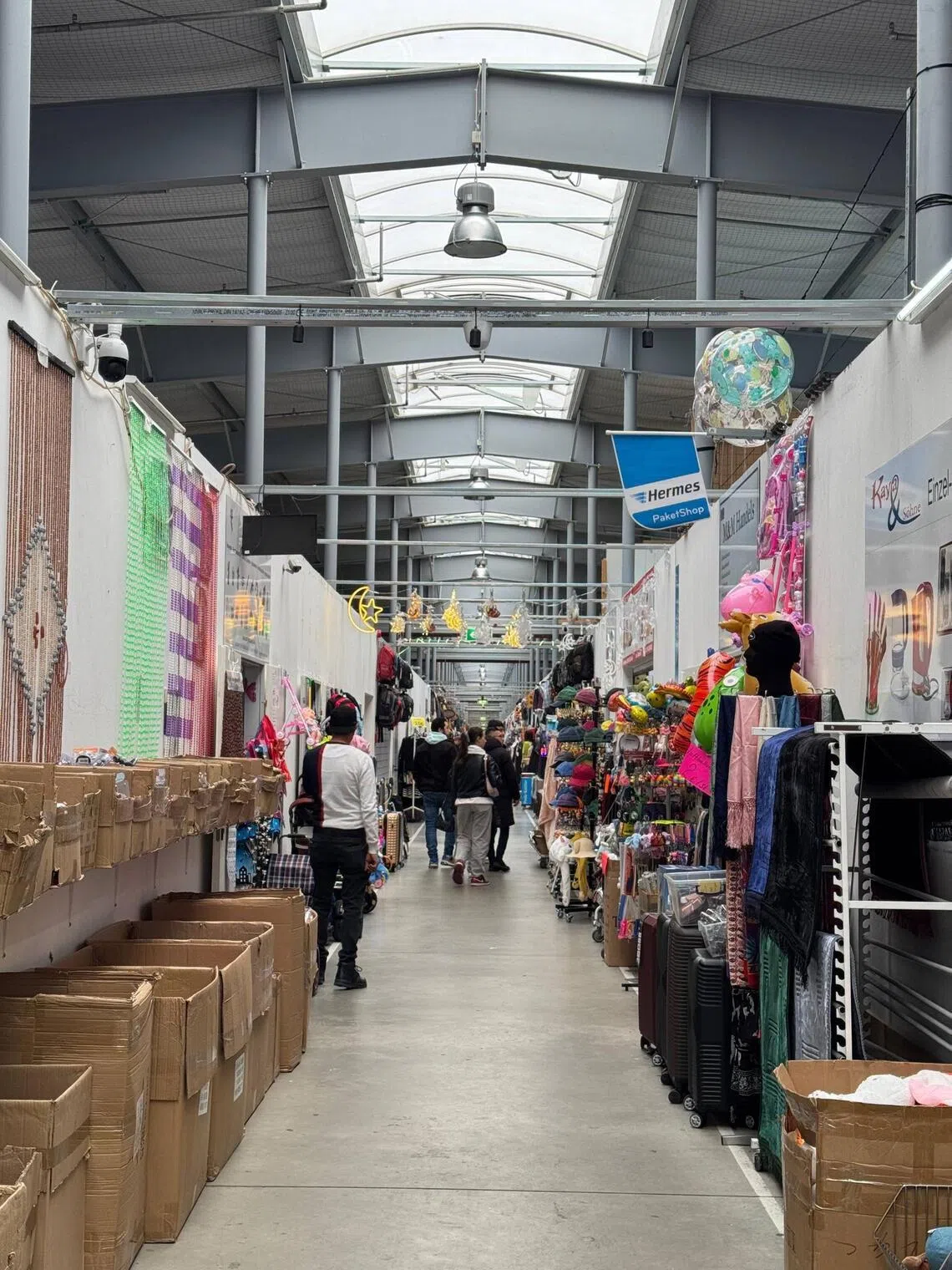
The long corridor in one of the warehouses that constitute Dong Xuan Centre in Berlin’s eastern Lichtenberg district on March 31, 2025. PHOTO: THE STRAITS TIMES
Nestled among mid-rise Plattenbau, or pre-fabricated blocks of public housing, built by the Communists in Berlin’s eastern Lichtenberg neighbourhood, Dong Xuan Centre has also been the target of a handful of police raids for human trafficking in the last decade.
Mr Nguyen and his co-founders hope to minimise these issues by arming young migrants with information and resources.
“While labour migration in the 1970s and 80s for our parents wasn’t straightforward or easy, our parents had the sole focus on providing a brighter future for us, their children,” said Mr Nguyen. “So we strongly believe we can do well – our parents have proven that and so have we.”
He added: “The next generation can prove it too, unless they are being set up for failure as we’ve seen it done in the past. The only way we can change the industry is by making sure others follow the standards that we have set.”