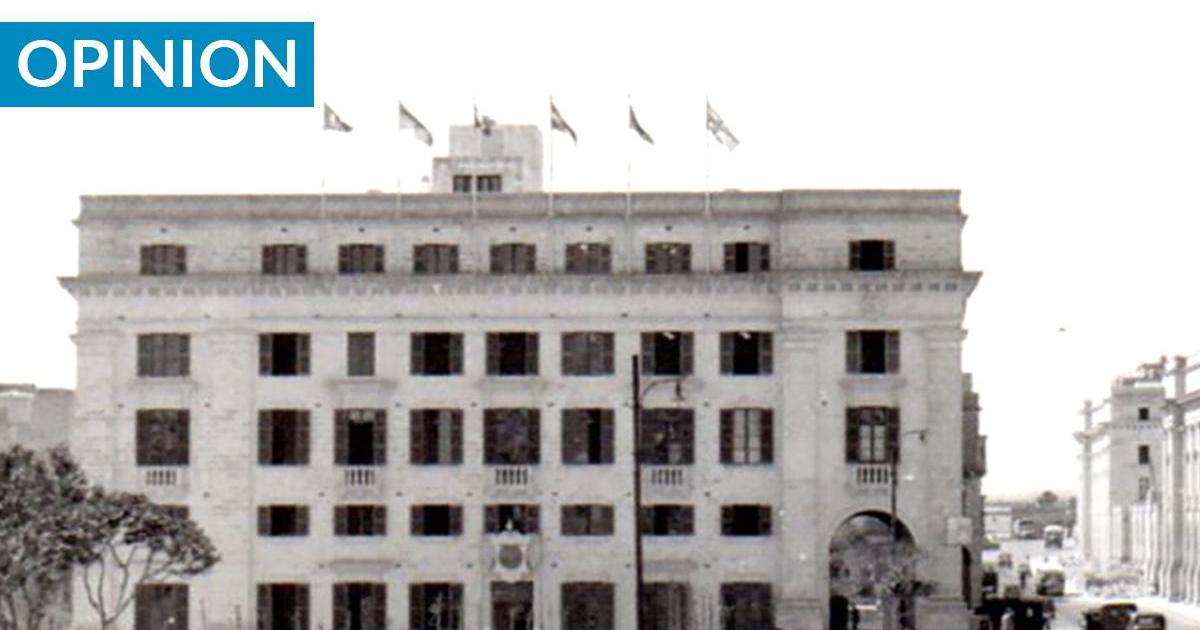
On Christmas Eve, 1953, the head of the Maltese Imperial Government, governor Sir Robert Laycock called at the residence of the Maltese prime minister George Borg Olivier. Not finding him at home, he left a short note informing him that, on the following morning, he would broadcast a message of Christmas greetings to the people of Malta.
The message, while conveying Christmas greetings to the people of Malta, would “incidentally” inform them that Malta was going to become NATO headquarters for the Mediterranean. NATO (North Atlantic Treaty Organisation) is a military alliance founded on April 4, 1949, by North American and European nations against the Soviet Union.
The Maltese prime minister read governor Laycock’s note when he returned home. Very upset, he asked the governor to restrict his message to Christmas greetings until the decision of placing a NATO headquarters in Malta had been fully discussed with the Maltese government. Governor Laycock refused, telling the prime minister that the Maltese government had no say on the establishment of NATO headquarters. This was a defence matter and, thus, fell within those powers specified as “reserved” by the 1947 constitution.
The Maltese parliament could pass domestic laws but could not deal with matters specified in the constitution as “reserved”, that is, defence and foreign affairs were in the hands of the Imperial government.
Writing for the US Naval Institute in October 1958 Alvin J. Cottrell, in ‘Malta: The Future of a Naval Base’ concluded: “Since the colony’s economy is built around the naval dockyards, there is literally no issue which does not in some way impinge upon matters reserved to the Crown.”
During the Suez Crisis of 1956 when Britain, France and Israel invaded Egypt after Egypt’s president, Gamul Abdel Nasser nationalised the Suez Canal, Cottrell writes: “Britain sought to evacuate some of its nationals from Egypt on flying boats. The governor of Malta, without consulting the prime minister, issued over the British owned rediffusion radio system the order to clear the bays of Malta of all fishing boats so that the flying boats carrying the refugees might land safely.
“The prime minister’s reaction was violent. He charged in effect that fishing was a domestic matter and that the governor had exceeded his reserved powers by giving the order without consulting him. He demanded that the order be rescinded. When the governor refused to accept this position, prime minister Dom Mintoff ordered squads of Maltese to cut down all radio poles and cables in retaliation.”
Island of peace
Cottrell writes also about the controversy over the naval air installations of the US Sixth Fleet which were established in Malta in 1952: “Maltese leaders of all parties charge that they were deceived by the British as to the true nature of the original agreement. According to Dr V. E. Ragonesi, secretary of the Nationalist Party, writing for Malta Tagħna, the stated purpose for the stationing of American air men in Malta was to ‘familiarise them with flying conditions in the central Mediterranean’. It was understood that a tactical ‘base’ as such was not contemplated… only a very small number of aircraft would be based there, and they would utilise an RAF aerodrome.”
Cottrell writes that the Maltese political leaders were angry that “the agreement was negotiated by the British authorities without drawing the Maltese leaders into their confidence as to the real purpose of the base. They were irritated further when the base was enlarged at the expense of Maltese arable land, which already is woefully scarce”. The US government paid Britain $12 million for the base and Malta did not receive anything from this subsidy.
The Mediterranean had become an arena of geopolitical rivalry between the US and the Soviet Union.- Evarist Bartolo
The Nationalist Party had proposed the leasing of Malta to NATO or directly to the US. The Labour Party was ready to negotiate Malta’s strategic assets with the “highest bidder”. Cottrell recounts how “On April 6, 1958, at an open-air meeting in Valletta, Mr Mintoff told an audience of 16,000 that if Britain closes down the dockyards in Malta without guaranteeing employment for the workers laid off, he will eject NATO and throw his weight behind a movement to obtain independence. He argued that Britain and the US are paying large sums of money to Libya for the right to station troops and maintain airbases in that country. Pointing to the NATO headquarters, he stated: ‘NATO does not pay anything. It will not remain here long if the British don’t pay up’.”
The Mediterranean had become an arena of geopolitical rivalry between the US and the Soviet Union. In 1954, the Soviet Union proposed joining NATO to turn it into a cooperative security alliance but the West rejected the offer, leading the Soviet Union to set up its own alliance, the Warsaw Pact. The Mediterranean alongside Europe was divided into two blocs in a Cold War against each other.
One nuclear bomb could obliterate Malta
Cottrell suggested to the US government that it should pay and keep NATO in Malta even though the changes in weapons technology might indeed raise the value of such small territories as Gibraltar, Malta, Cyprus, Ceuta and the Balearic and Canary Islands, to mention only a few. “The West’s deterrent strategy must depend increasingly upon a dispersal of its air-missile nuclear power.” He was convinced that Malta could be easily adapted as a missile launching site and as a service station for aircraft carriers and nuclear submarines.
He acknowledged the risk that this posed for Malta, “one nuclear bomb could obliterate Malta”, but stressed the benefit a Malta base offered NATO: “the dispersal of Western bases reduces the mathematical possibility of a single successful knockout blow by the Soviets.”
A year later, Mintoff declared in The New Statesman in ‘A New Plan for Malta’: “We would pledge never to make any military or other warlike alliance with any bloc or state.” Malta would seek prosperity and peace through its economy and stop serving as a threatening naval and military base as it had done for centuries.
Evarist Bartolo is a former Labour foreign and education minister.