The UK’s New Towns Taskforce has recommended locations for the next generation of 12 new towns. The plan is to build at least 300,000 homes. However, as much as the quantity, we need to focus on quality – creating spaces that are community and nature-focused and well connected to the rest of the UK. Luckily, we do not have to look far for good examples of such urban planning.
When I first arrived in the UK from Poland 15 years ago, central London felt like a revelation. As a young adult, I was genuinely amazed by how effortlessly the city allowed me to live without a car. Everything I needed was within reach, either on foot or by a short tube ride. Back home, the idea of an adult choosing not to own a car was borderline absurd. But in London, it suddenly felt obvious. Whenever my family visited, they finally understood: life can function perfectly well without cars. At least in central London, anyway.
Step outside the M25 and the feeling changes fast. In much of the country, a car isn’t optional; it’s the only thing standing between you and isolation. Buses don’t show up when they’re meant to; trains cost a fortune; and everyday amenities are too distanced for walking.
My view shifted even more when I visited my sister in Amsterdam. I noticed how the city prioritised people over cars. Whenever there were roadworks, locals looked happy about it, because it usually meant wider pavements, cycle paths, more greenery, more amenities, and less parking. Amsterdam, I assumed, must be the Dutch equivalent of London – special, the capital, the exception. Then my sister moved out to a tiny suburban town. And that’s when everything clicked.
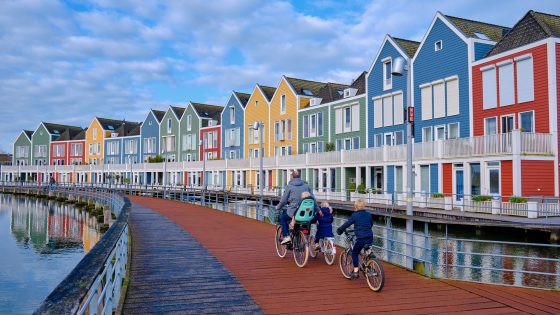
In The Netherlands, the ‘15-minute city’ isn’t a buzzword, it’s the default. The Dutch have built entire towns, villages and suburbs on the same principle as Amsterdam. You can bike from one neighbourhood to the next without feeling you’re risking your life. Even the smallest towns have train stations. And the trains? Genuinely affordable. Sometimes I’d pay triple the amount in the UK for a similar journey. Residential areas are surrounded by greenery, waterways, playgrounds and parks. Access to nature doesn’t depend on income or postcode; it’s built-in.
This would be admirable on its own, but it’s even more staggering, given that The Netherlands is more densely populated than England. Nevertheless, they’ve managed to create neighbourhoods that feel communal, safe and child-friendly. Parks between residential buildings act as natural meeting places, the closest thing to a communal front porch. Children play freely without constant supervision; neighbours know each other; and impromptu street festivals are normal. It feels almost nostalgic, like the social fabric many of us remember from the 1980s.
And then there’s the Dutch mastery of water management. As much of the country sits below sea level, canals double as ecological corridors, recreational routes and cultural landmarks. Cycling beside them is so standard that Dutch schoolchildren are required to know how to swim by age eight, just to participate in school trips.
What becomes obvious is this: when a country deals with extreme density, limited land and environmental risk, it cannot afford to waste space on endless roads and car infrastructure. The Netherlands made a choice – to design for people, rather than vehicles, not just in the city centre but everywhere. They’ve put into practice the urbanist ideas many of us only read about in Jeff Speck’s Walkable City. I believe Dutch urban design plays a huge role in their overall lifestyle. So maybe it’s no surprise The Netherlands ranks fifth in global happiness surveys, while the UK sits at 23rd.
The Netherlands, like the UK, is planning to build 10 new towns that follow their urban design principles on land reclaimed from the sea.
If Britain genuinely wants healthier, friendlier, more sustainable communities, it doesn’t need to dream up a revolutionary new model. It just needs to glance across the Channel and take notes.
Aga Szedzianis is a senior associate at DSDHA