On December 29, Israeli Prime Minister (PM) Benjamin Netanyahu visited the US to brief President Donald Trump on Iran’s rebuilding of its missile capabilities after June 2025. Given that Trump has repeatedly declared the Iranian nuclear issue a “closed case”, Netanyahu is seeking US support for an offensive against Iran’s ballistic missile capabilities. This comes at a time when the sharp depreciation of the Iranian rial sparked protests among merchants, which quickly turned into broader protests reflecting widespread frustration with the economic crisis after the snapback of the previously lifted UN sanctions in August 2025.
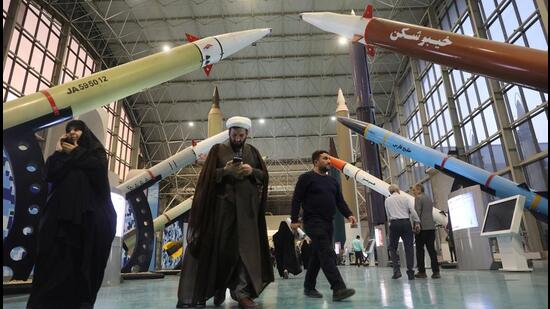 Iran, the only country to develop a 2,000-km missile without first having nuclear weapons capability, maintains that its missile programme, led by the IRGC, is “aimed at deterring aggressors from any idea of attacking Iran”. (West Asia news Agency via REUTERS)
From a defensive posture aimed at containing threats, Israel has used the politics of insecurity, its superior military and intelligence capabilities, and US backing to maintain a sustained offensive initiative to eliminate the threat posed by Iran and its network of allies. Having demonstrated near-complete freedom to operate militarily over Iran, Israel seeks to realise its long-term objective of structurally dismantling Iran’s military capabilities through military operations. Israeli leaders are keen to use the unrest in Iran to bring about internal collapse or regime change. At a time when popular perceptions of Israel in the West are deeply polarised, a sympathetic administration in the White House is seen by the Israeli leadership as offering a limited window of opportunity to realise long-term objectives on Iran.
Iran, the only country to develop a 2,000-km missile without first having nuclear weapons capability, maintains that its missile programme, led by the Islamic Revolutionary Guard Corps (IRGC), is “aimed at deterring aggressors from any idea of attacking Iran”. Given Israel has decimated Iran’s “axis of resistance” and the US-Israeli attacks on Iranian nuclear facilities have denied it the deterrence of a nuclear threshold State, ballistic missiles are at the very core of Iran’s deterrence and defence. Tehran believes that the performance of its domestically produced ballistic missiles validated Iran’s doctrine of deterrence by punishment.
During the June war, Iran’s defensive strategy relied on launching sustained salvos of over 500 missiles and drones, saturating Israeli air defences, and forcing them to exhaust their interceptors, which are not only more expensive but also have longer production timelines. The asymmetry in battlefield economics and vulnerabilities arising from Israel’s relatively small size limit its ability to sustain an offensive against Iran. Iran also relies on its much larger cruise missile arsenal to pose a credible threat of escalation against US interests in the region in the event of US aggression against Iran.
Facing renewed pressure to limit the range of its missiles, Tehran has maintained that it will not negotiate on its defensive capabilities. Washington’s coercive diplomacy and Israel’s maximalist approach to security have made Iran even more determined to preserve and strengthen its deterrence capabilities. Amid external threats, Iranian President Massoud Pezeshkian has signalled a conciliatory approach to the protests by instructing his interior minister to address their “legitimate demands” and by appointing a new Central Bank governor. However, the appointment of Ahmad Vahidi, who was the interior minister during the Mahsa Amini protests, as deputy commander-in-chief of the IRGC also signals the resolve of the security apparatus. Israel’s overreliance on militaristic solutions will only deepen regional States’ view of Israel as a destabilising actor.
Deepika Saraswat is an associate fellow at Manohar Parrikar Institute for Defence Studies and Analyses.The views expressed are personal