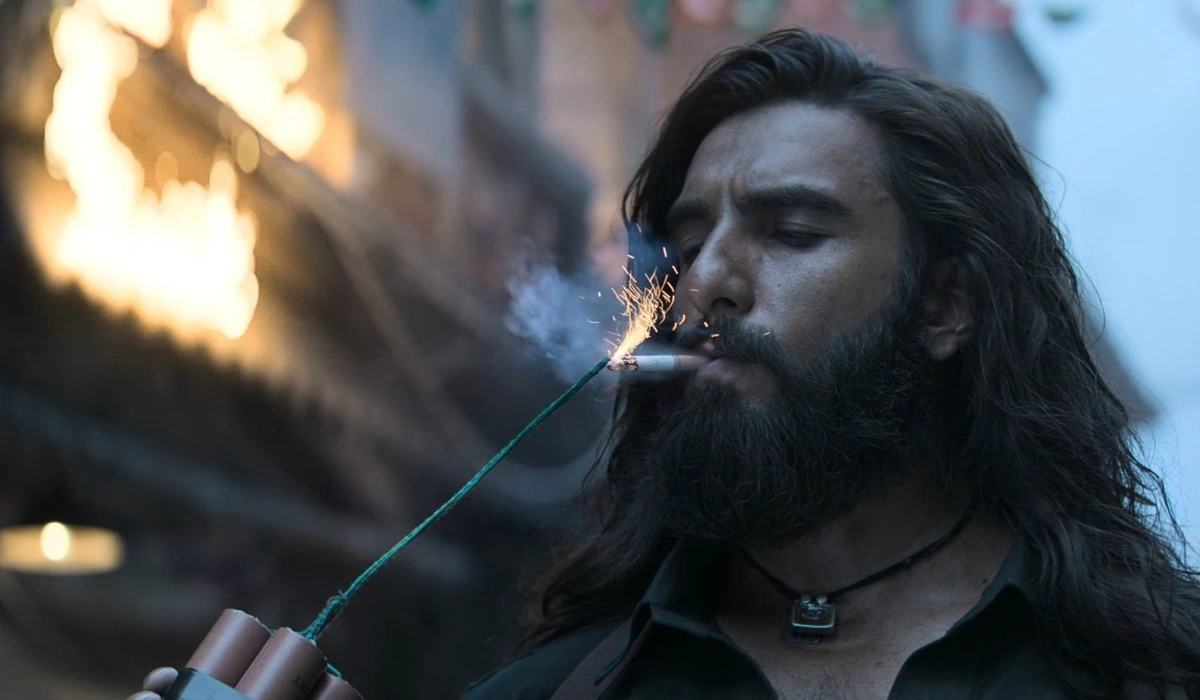
Soon after the release of the Bollywood film ‘Dhurandar’, which follows the trajectory of an Indian spy operating in the curated landscape of Karachi’s Lyari locality, Instagram reels were filled with the trend ‘Day one as a Spy in Pakistan’. There has rightfully been conversation about the Islamophobic undertone of the film, along with its characterisation of Pakistan through a narrow and stereotypical lens, one that fixes the country into frameworks of being nothing but a geography of terrorism and Islamic fundamentalism. Elements of this reductive portrayal have seeped into pop culture. While there is some variation across the reels under this tag of ‘Day One as a Spy in Pakistan’, a large number of them work on a similar premise. A person is seen jumping over walls, walking through shady alleys or hiding behind trees with a stern and stealth expression on their face. They are then examined through the question: ‘India se ho?’, ‘are you from India?’ to which a common response is: ‘nahi India humara dushman mulk hai’, ‘no India is our enemy nation’.
Women protagonists are usually in a burkha or hijab and carry a ‘Muslim sounding’ name ( Muskaan Sheikh Hamza, Zoya Ali Khan, Fatima Siddiqui…Take your pick). The characters played by men, on the other hand, often have kohl under their eyes and a Tabeez (amulet) around their neck. They adopt the name ‘Hamza’, borrowed from Ranveer Singh’s character, who is undercover in the film ‘Dhurandar’ itself. The visual identity markers are a portrayal of a ‘Muslim Other’ and depict the epitome of ‘what a Muslim should look like’, leaving no room for fissures of variance in life and practice. This depiction is well critiqued in an Instagram post by @floorcollapsing captioned ‘And don’t forget the eyeliner’. Further, comments from Pakistani viewers: ‘aisa get up dekh kar hi pakra jata’ ‘the get up itself will expose you’, circumvent religious identity and instead focus on hyperbolic presentations of Muslims and Pakistanis as a monolith to reveal the fault in the gaze.
However, what is noteworthy and the climactic point of these reels, is when the ‘Indian spy’ is busted and their cover is blown. This moment is crucial and marks each reel’s diversion from the uniform template, providing the viewer with innovative reasons for the revelation of ‘Indianness’. While the implied causes for the incompetence of this spy are multiple, they create a particular kind of ‘Indian self’ that is exposed. This disclosure carries what moralities, practices of clothing, food, faith, reverence and greetings are considered ‘Indian enough’. For instance, a ‘spy’ who, when asked about food in a reel, replies with ‘mein Tuesday ko chicken nahi khata’, ‘I don’t eat chicken on Tuesday’. Another such ‘spy’ is questioned about whether he would be scared to operate in the dark, to which he says: ‘janab, mujhe puri Hanuman Chalisa aati hai’, ‘Sir, I know the Hanuman Chalisa well’. The illustrations are countless, with the points of leakage ranging from Sindoor (vermilion) on a woman’s forehead, the ‘accidental’ slippage of the words ‘Jai Mata Di’ and ‘Ram Krishna Hari’ or an act of reverence towards a cow mid ‘interrogation’.
The problem is multifold. First, is the Indian imagination of Pakistan that ignores the existence of non-Muslims in the nation, along with the different ways of being lived by Pakistani Muslims. Take the example of an Indian influencer, who made a reel following this trend. In her depiction, she is ‘caught’ as an Indian when Kebabs are offered and she refuses by stating she is a vegetarian. The reel is captioned:
‘Killed by Enemies ⨯, Killed by Food Choices ✓’ furthering the cultivation of an effect that creates an automatic link between being a vegetarian and an Indian. A relevant response to this is by a Pakistani Hindu content creator, Deepna Rajput, who wrote saying ‘ Pakistan mein bhi vegetarians hote hai’ (there are vegetarians in Pakistan as well).
Moreover, it is essential to engage with the optics used to create an ‘Indian Spy’. Positioned in an oppositional binary with the caricaturized portrayals of ‘Muslimness’, the ‘Indian’ in this spy is conflated with being Hindu, often habitual of some Savarna practices of cow worship and vegetarianism. In other words, in many of these reels, the secret of being Indian hides in the signs of belonging to the Hindu faith, and the solution for the same is to adorn oneself with Surma (kohl) and a Rumaal (scarf) along with a conversation in Urdu. The exaggerated adoption of these tangible symbols is ignored, and so is the fact that Urdu is a language shared by communities on either side of the border or that Kebabs are a delicacy with no one nationality attached to them.
The exclusionary nature of this categorisation is revealed in a reel I came across. Distinct from the scripted videos before, this has the controversial clip of the Bihar Chief Minister Nitish Kumar forcefully pulling down the niqab of a Muslim doctor. The reel in question uses this footage with ‘Day 1 as a spy in Pakistan’ written over it. The meaning is evident, the presence of the doctor implies the sight to be that of Pakistan, and by extension deems her ‘un-Indian’. Furthermore, both the film and these reels cannot be divorced from the reality of the ongoing persecution and marginalisation of minorities in India, particularly Muslims. There have been countless incidents of targeting businesses and shops owned by Muslims, mob lynchings on the suspicion of cow slaughter and policing of food sale and consumption, especially during the festival of Navratri by right-wing Hindutva groups. Viewed in this context, Indian journalist Arfa Khanum Shervani correctly situated the film ‘as a part of the BJP -RSS Cultural Project’.
The same can be extended to explain the quality of these reels. They cultivate Indian belonging by marking some experiences as legible and defining various others as an antithesis. While passed on as humour all over Instagram, the trend is telling of the construction of a hegemonic vocabulary, and within it, its synonyms.
Meher Kaur is an independent researcher based in Delhi. She is interested in studying the intersection between media and social identity.