Executives today express anxiety over model accuracy, governance, regulation, vendor noise, and cost escalation. Yet beneath all of these concerns sits a more fundamental issue that rarely receives the attention it deserves: the absence of talent at every level of the enterprise.
Not just technical talent, but the operators who will supervise AI systems, the managers whose roles are shifting under their feet, and the executives who must re-architect the very structure of the organization.
This is the quiet truth emerging inside boardrooms. AI is not failing.
Organizations are failing to prepare for a world where intelligence is abundant, inexpensive, and continuously evolving. Companies built around human judgment, human buffers, and human improvisation are now attempting to integrate systems that require precision, clarity, and well-designed workflows.
The disconnect is structural, not technological.
For decades, enterprises succeeded despite ambiguity because people absorbed the friction. They fixed broken processes informally, handled exceptions instinctively, and made the system work despite itself.
AI does not offer that luxury. It executes exactly what exists, not what people wish existed. And when the underlying structure is unclear, AI exposes it immediately.
This is why so many organizations begin with optimism, generate impressive pilots, and then stall. The pilots did not fail; the enterprise revealed its unreadiness. If you examine these struggles closely, the constraint is rarely the model. It is the organization’s inability to implement, sustain and scale artificial intelligence systems.
Four systemic forces explain this pattern with uncomfortable precision.

The Four Forces Limiting Enterprise AI
Below is the framework that the Boards and CEOs must understand because these forces quietly shape the boundary of what AI can achieve inside any enterprise:
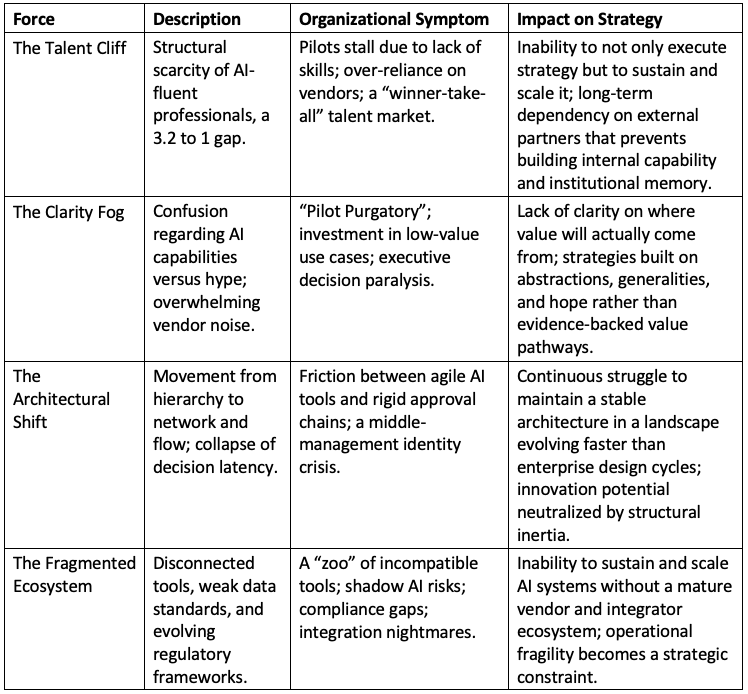
These four forces shape the ceiling of AI performance long before any model is deployed. Companies treat them as operational irritants, yet they define the boundary of what AI can achieve inside a real enterprise.
Taken together, they point toward an even deeper issue: the absence of a leadership model capable of addressing them.
The Leadership Vacuum
AI changes the physics of work. It alters how information moves, how decisions are made, where authority sits, and what role humans play in production systems.
Yet no existing executive role was designed for this shift.
CIOs protect stability and manage complexity, but AI requires redesign, not preservation.
COOs safeguard throughput and operational continuity, but AI reshapes the operating model itself.
CHROs understand talent, yet AI redefines work rather than workforce composition.
CAIOs, where they exist, often run pilots without the enterprise authority required to transform the organization.
Strategy teams interpret markets, not internal system dynamics.
The result is predictable. AI sits everywhere and nowhere, important enough to generate pressure but not owned deeply enough to generate coherence. The organization attempts to modernize using a leadership architecture built for a different era.
Every successful AI transformation I have seen includes a particular type of leader, even if that leader does not have a formal title.
This person:
Understands systems rather than functions.
Sees workflows as interdependencies rather than steps.
Recognizes that psychological safety influences adoption as much as technical accuracy.
Knows that AI changes the relationship between humans and work long before it changes the work itself.
This is the Organizational Architect for the AI Era. Not an evangelist, not a technologist, but a structural thinker who can realign the enterprise around intelligence.
Their responsibility is to translate AI from a set of tools into a coherent operating model. They design how AI enters the workflow, how people supervise it, how decision rights shift, how roles evolve, and how the organization maintains coherence as systems become more autonomous. They sit beside the CEO because their mandate touches every part of the enterprise. Without them, AI remains fragmented, episodic, and low-yield.
This is the leadership capability most companies lack.
Where CIOs Fit in This Story
For CIOs, this moment represents a turning point.
The role can expand into enterprise architecture in the truest sense, becoming the strategic partner who helps redesign how the organization functions in an era of intelligence. Or it can remain tethered to technology stewardship, infrastructure optimization, and delivery accountability, all important, but increasingly peripheral.
CIOs who step into this architectural void become indispensable because they can see the entire system, the technology, the workflows, the decision flows, and the psychology around them. CIOs who cling to traditional boundaries risk becoming observers rather than shaping the organization’s future.
Boards should be asking a simple question: Who is responsible for designing the organization that our AI strategy requires?
If the answer is unclear, then so is the strategy.
The Closing Insight for Boards and CEOs
The companies that succeed in the AI era will not be the ones with the most sophisticated AI technology. They will be the ones with the clearest processes, the most adaptable roles, the strongest internal architecture, and the leaders capable of orchestrating all three.
The fundamental constraint in AI is not the technology. The fundamental constraint is the organization, and the leaders who must redesign it.
This is the inflection point.
The enterprises that understand it now will define the next decade.