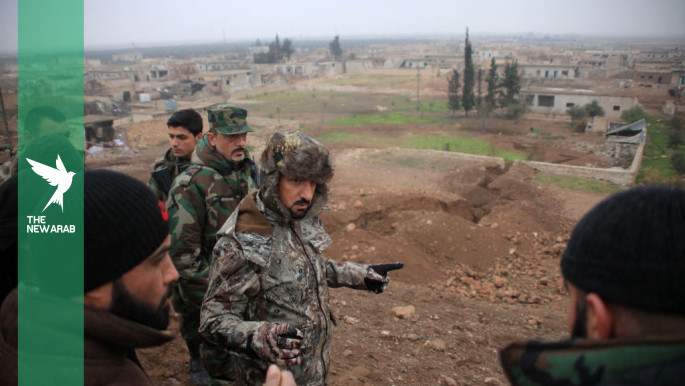
Suheil Al-Hassan (centre, pointing) is featured prominently in the recordings [Getty]
An investigation by Al-Jazeera has revealed plans by senior military officers from the regime of deposed dictator Bashar al-Assad to destabilise Syria, possibly in coordination with Israel.
Al-Jazeera has obtained more than 74 hours of leaked audio recordings and hundreds of pages of documents showing this.
The recordings prominently feature Suheil Al-Hassan, an Assad regime brigadier-general who led the notorious Nimr (Tiger) Forces, who are accused of numerous atrocities and war crimes during the Syrian conflict.
The investigation found that Assad regime officers are trying to reorganise and obtain funding and weapons in order to create renewed conflict and instability in Syria.
The recordings appear to have been obtained by a hacker posing as an Israeli military officer. Suheil al-Hassan asked for Israeli support in the recordings.
“The State of Israel, with all its capabilities, will stand with you,” the hacker told al-Hassan.
“There is a level higher than me, Mr Rami is the one who coordinates,” al-Hassan is heard saying. “And I have dangerous intelligence information.”
This appeared to be a reference to Rami Makhlouf, Bashar al-Assad’s estranged cousin, who controlled key sectors of the Syrian economy and amassed billions of dollars in corrupt wealth before falling out with Assad in 2020.
A new uprising?
Makhlouf previously claimed to be building an army comprising 15 divisions to take back control of Syria from the current government of President Ahmed Al-Sharaa.
Another leaked document shows that Al-Hassan claims to have around 168,000 fighters under his command.
In the recordings, al-Hassan also explicitly praises Israel’s genocidal war in Gaza, in what seems to be an attempt to gain favour with the hacker he thinks is an Israeli intelligence officer.
The voice of Ghaith Dalla, another brigadier-general in Assad’s forces also appears in the recordings.
“My Master, Suheil the Tiger, spoke the feeling of the whole mountain and the whole coast,” he is heard saying.
This is a reference to Syria’s mountainous coastal area, where most of the country’s Alawite minority live.
Assad and key members of his former regime are Alawites and the community, who form around 12 percent of the population, were seen to dominate Syria during his rule.
However, after the December 2024 rebel offensive which ousted Assad, Alawites have felt increasingly disenfranchised and targeted, with Syria’s Sunni majority now perceived to be in control of the country.
In recent days, Alawite demonstrators took to the streets of Latakia and other coastal cities after a bomb at an Alawite mosque in Homs killed eight people. The protests turned violent and around three people were killed.
Last year, Assad regime remnants also launched an uprising against the current government on the coastal area. Hundreds of members of the government’s security forces were killed and the government responded with violence, with security forces killing hundreds of Alawite civilians.
Israel has launched hundreds of strikes and incursions into Syrian territory since the Assad regime’s fall, taking advantage of the country’s weakness and divisions. It has openly stated its intention to divide Syria on ethnic and sectarian lines.
Lebanese reaction
Following the fall of the Assad regime, many regime officers and officials fled to Lebanon. Lebanese Deputy Prime Minister Tarek Mitri expressed concern about the content of the leaks.
Mitri said that Lebanese security agencies must verify the accuracy of the leaks and take appropriate measures.
“Actions that harm Syria and its security in Lebanon, or from Lebanon, must be prevented,” he said.
He said that these developments require strengthening cooperation with the Syrian authorities based on trust and mutual respect for the sovereignty of both countries, in a way that serves the common interests and preserves the security of both sides.