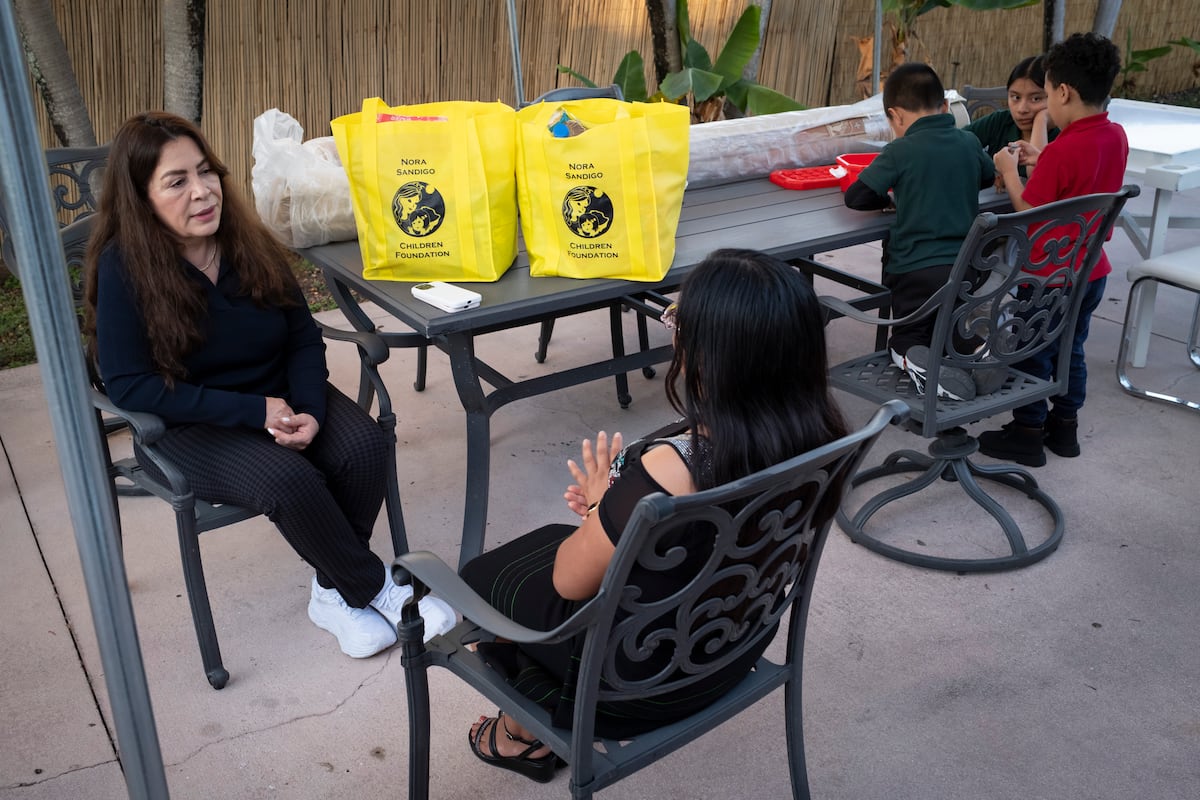
An hour’s drive from Miami Beach, on the way to the suburb of Homestead, is the headquarters of the Nora Sandigo Children Foundation, founded by Nora Sandigo. Known as “La Gran Madre” — “the great mother” — Sandigo is a local legend. Since opening her foundation in 2006, she’s been the legal guardian to 2,373 children, whose parents have been deported or are at risk of being detained by immigration authorities. This number is constantly changing as the children reach adulthood.
Sandigo doesn’t adopt the kids — their mothers and fathers retain parental rights — but she takes responsibility for decisions regarding their education, health, and upbringing, accepting guardianship of them. She cares for these youths in the absence of their parents, preventing them from being left at the mercy of the state.
With the intensification of Immigration and Customs Enforcement (ICE) operations following Donald Trump’s return to office, as well as the fear among many undocumented immigrants about being detained, the number of applications that Sandigo receives has increased considerably. The vast majority come from mothers who fear for their children’s future. In the last 18 months alone, Sandigo has become the legal guardian of 472 minors, bringing the total number of children currently under her care to around 700.
The organization’s headquarters is a nine-room house that also serves as a senior care center (also run by Sandigo), with profits going to fund the Nora Sandigo Children Foundation. On a Wednesday in early December, after 2:00 p.m., Sandigo arrives at the house. She’s dressed entirely in black, wearing comfortable clothes and white sneakers, which match her nails. Her long, dark hair is loose. She hasn’t eaten yet, despite having gotten up at 6:00 a.m. “I live on coffee,” she jokes.
The voice of this 60-year-old woman of Nicaraguan origin is warm and gentle. She recounts spending the morning working from home, where migrants also show up, seeking her assistance. She says that her doors are always open, without any set hours. “I have a home and I also don’t, you understand? I’m not like those people who closely guard their privacy, who only find peace when they’re alone,” she emphasizes. “My life is one of service.”
Sandigo, the divorced mother of two daughters, now 27 and 28 years old, has also raised several other children in her home. She took care of some of them from young ages until they went to college, during the years that their parents were unable to care for them due to their precarious immigration status. At one point, she cared for six children under the same roof.
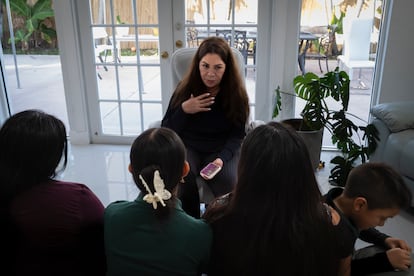 Nora Sandigo talks with immigrant women and their children in Miami, on December 3.Marco BelloHelping those in need 24/7
“I’m not going out to make deliveries today. Three families have told me they’re coming to see me,” Sandigo says. Fear is causing more and more migrants to avoid leaving their homes. The foundation’s work revolves around this dual approach: welcoming families who come to their center, while visiting the homes of those who don’t dare to leave. However, Sandigo’s way of working doesn’t follow any structure or methodology. Rather, it flows organically, according to the needs of the moment. “Every day is different,” she sighs.
Sometimes, she distributes bags of food with basic necessities (for Thanksgiving, she included turkeys), or she organizes events where in addition to food she gives away school supplies. She dedicates the rest of her time to answering emails and returning phone calls, while managing the open cases of the migrants who come to her for help. She has years of experience stopping deportations, filing writs of habeas corpus and tracking down lawyers.
Her phone never stops ringing. She has two cell phones, which she leaves on the table next to her computer. She moves back and forth between conversations and text messages; sometimes, she answers a phone to apologize, promising to call back later.
A member of one of the families calls her four times. Despite having visited the foundation several times, she got lost while driving there. It’s Marisol, a 31-year-old Guatemalan woman (she asks that her real name not be used, as she’s undocumented). She arrives with her two children, aged four and 11, who are dressed in their school uniforms. They slowly settle down on the sofa; the children, shy, remain still. Their father was arrested two months ago and sent to a migrant detention center in Texas. The younger boy thinks that his dad is visiting his grandmother.
“He calls me every day to tell me that he’s okay, not to worry about him and to focus on the children,” the woman shrugs. She came to visit Sandigo to see if she’s heard from her husband’s lawyer. He has a court date next Monday and, by then, his lawyer must present a document certifying that Sandigo is the detainee’s U.S. sponsor… an essential requirement for his release.
Marisol’s husband has no criminal record. He’s also a Dreamer, protected under the DACA program, which was created in 2012 for those who arrived in the country as minors. However, while the program authorizes them to live and work in the U.S., it doesn’t grant them legal status. The Department of Homeland Security (DHS) maintains that Dreamers “are not automatically protected from deportation.” Even so, Sandigo believes that the situation is resolvable: she thinks that, with sponsorship and the payment of bail (which ranges from $1,000 to $20,000, depending on the case), Marisol’s husband will be able to get out of jail.
But Marisol remains worried. “How are we going to get the money that the lawyer is asking for? I think [he’s] taking advantage of our desperation. At first, he asked for $1,500… [but] when he found out Nora was going to help me, he raised it to $8,000,” she laments. Marisol works in a plant nursery and barely earns enough to pay the rent.
Sandigo reassures the woman. She has the tenacity and confidence of someone who has handled worse situations. In 2022, she helped a family that arrived in the U.S. with two children. The mother stayed with the baby in Florida, the father was deported to Guatemala, while the nine-year-old daughter was sent to a center in Texas and disappeared. Sandigo “moved heaven and earth” to find her. After reporting the girl’s disappearance, someone called anonymously to report where she was being held, which allowed Sandigo’s lawyers to get her returned to Florida, to be with her mother and brother.
Sandigo — who cannot bear the separation of families — was warned that it would be impossible to bring the father back from Guatemala. But she didn’t give up: she argued that he had been deported without being afforded the right to a fair defense and that he should be returned to the same place where the process began. On December 24 of that same year, the authorities accepted the appeal and returned the father to Florida.
For the Nicaraguan-American woman, who is deeply religious, the fact that the family was reunited on such a significant day in the Christian calendar is a divine sign. “This [work] has to continue. It’s perfect because it’s spiritual, not material,” she affirms.
Separated families and unaccompanied children
The other woman who comes to the center needs food. Ingrid, who also prefers to keep her real name private, arrives unhurriedly and sits down on the sofa, as if she were at home. She has known Sandigo since 2017, when her husband was deported and she was left alone with their children, who, at the time, were aged two, 11 and 15. The Guatemalan family arrived in the U.S. with political asylum, but when they moved, they missed a notification that required them to appear in court. Since then, they’ve had an arrest warrant out for them.
“I consulted with four lawyers about the case and they all told me there’s nothing that can be done,” Ingrid explains. When asked if she’s considering going somewhere else to avoid being arrested and having to leave her children alone, she replies, “Where would I go? If [they’re going to take me, that’s the way it is],” she shrugs, prepared to take the risk. She believes that, if she’s arrested, they’ll let her youngest daughter (now 10) go with her.
“If they separate us, she’ll die. And I’ll die, too,” she affirms, not considering the possibility of being arrested any day on her way to work, which is what happened to her husband. Her case exemplifies how easily an American child can end up all alone in a matter of hours… even if their parents are still alive.
For now, the families Sandigo is in contact with have only had one parent arrested or deported, meaning that the remaining parent can still care for the children (most of whom were born in the United States). “It’s just pure chance that only one parent was arrested. If they found both of them at the same time, do you think ICE would have any compassion for the children?” Sandigo points out. “What’s happening is diabolical, cruel, callous, inhumane.”
If both parents are taken, the children will remain in her custody. But it’s not just about how many children Sandigo can take in. Rather, it’s about how many minors the U.S. immigration system can separate from their parents.
As of the end of November, more than 65,700 people were in ICE custody at migrant detention centers across the country. And, despite Trump’s claim that, in his crusade against migrants, he’s targeting “the worst of the worst,” 73% of the detainees had no criminal records.
Sandigo points out that the government’s narrative is influencing ordinary people, who are becoming less compassionate and more reluctant to help. “Last year, we received more support from the community. We just had to post on Facebook and we received donations. But now, the dynamic has changed,” she explains. She adds that, sometimes, when families at risk call her to ask if she has food, she has nothing to give them. The foundation is sustained by donations from churches, volunteers and local businesses, as well as by Sandigo’s own resources. “My intention in speaking to the media is to contribute to a greater sense of humanity in the face of what’s happening, to reach people’s hearts.”
Marisol’s husband is already in the process of being deported. The lawyer handling his case refused to accept payment in installments and demanded an $8,000 deposit on Monday, just hours before the court hearing. The Guatemalan woman didn’t have the money, so the lawyer abandoned the case.
“This is an example of the monstrosity we’re experiencing,” Sandigo says, with frustration in her voice. “The lawyer only had to submit my sponsorship paperwork to free that man. It was an easy case, but people have no compassion.”
For those who wish to contribute to the cause, donations can be made
Sign up for our weekly newsletter to get more English-language news coverage from EL PAÍS USA Edition