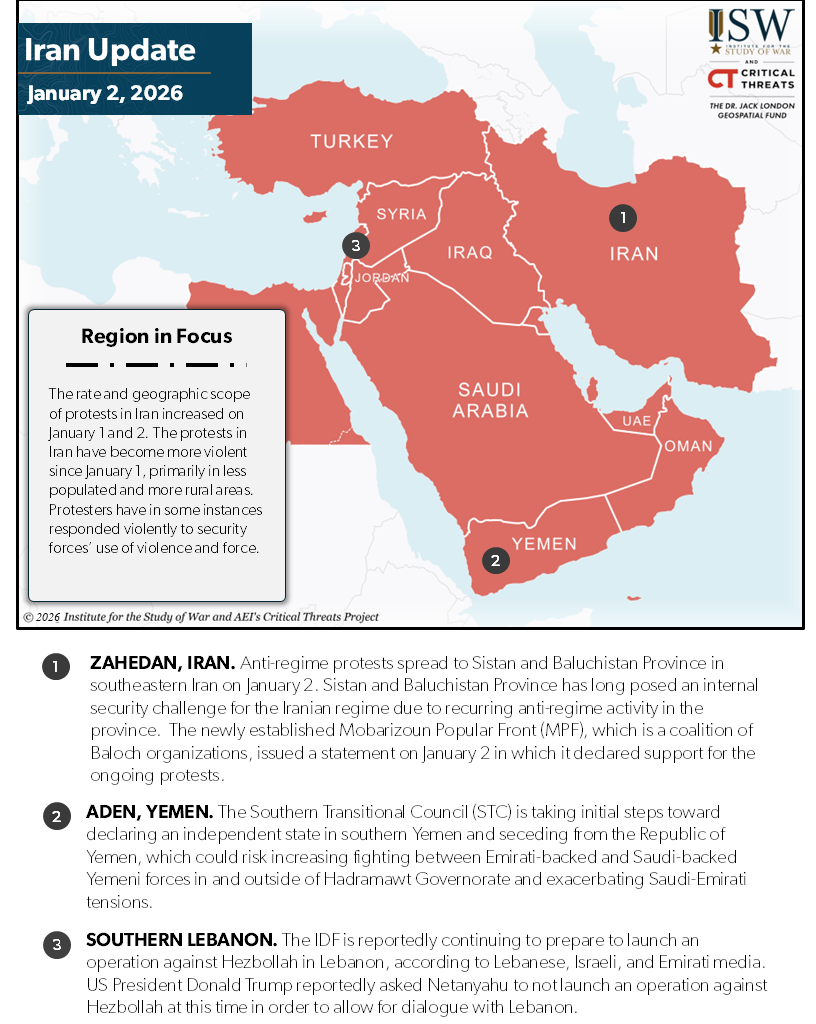
Data Cutoff: 2:00 PM ET
The Critical Threats Project (CTP) at the American Enterprise Institute and the Institute for the Study of War (ISW) publish the Iran Update, which provides insights into Iranian and Iranian-sponsored activities that undermine regional stability and threaten US forces and interests. CTP-ISW publishes the Iran Update daily.
Click here to see CTP and ISW’s interactive map of assessed control of terrain in Syria, and here to see CTP and ISW’s interactive map of Israeli ground operations. The Syria map is updated daily alongside the static Syria maps in this report. CTP-ISW ended daily maps of Israeli ground operations in February 2025.
Click here to see ISW-CTP’s new interactive map showing the locations of daily protests in Iran since December 28, 2025. ISW-CTP will continue to publish daily static maps depicting the Iranian protests in forthcoming Iran Updates. Click here to see ISW-CTP’s interactive map showing the total strikes in Iran during the Israel-Iran War, as well as an interactive timelapse showing the strikes day-by-day.
Note: This update covers information for the 48-hour period between 2:00 PM ET on December 31, 2025, and 2:00 PM ET on January 2, 2026. CTP-ISW did not publish an Iran Update on January 1 in observance of New Year’s Day.
The rate and geographic scope of protests in Iran increased on January 1 and 2. CTP-ISW recorded 56 protests on January 1 and 70 protests on January 2, compared to 31 protests on December 31.[i] Protests took place in 17 out of Iran’s 31 provinces between December 28 and 31 and have since spread to five additional provinces, including Ghazvin, Kohgiluyeh and Boyerahmad, Mazandaran, North Khorasan, and Sistan and Baluchistan provinces.[ii] Protests have also spread to a greater number of cities within individual provinces. CTP-ISW recorded one protest in Chaharmahal and Bakhtiari Province on December 31 and three protests in three cities in Chaharmahal and Bakhtiari Province on January 1, for example.[iii] Protests have primarily taken place in medium-sized and small towns instead of in major cities. CTP-ISW has not observed significant protest activity in provinces with large Kurdish populations, such as Kurdistan and West Azerbaijan Province. The lack of protest activity in these provinces thus far is notable given that a significant portion of protests during the Mahsa Amini movement took place in Kurdistan and West Azerbaijan provinces.[iv]
The protests in Iran have become more violent since January 1, primarily in less populated and more rural areas. Iranian security forces have killed protesters in at least the following locations: Kuhdasht, Lorestan Province, Fuladshahr, Esfahan Province, Marvdasht, Fars Province, Azna, Lorestan Province, and Lordegan, Chaharmahal and Bakhtiari Province.[v] Security forces previously fired live ammunition at crowds of protesters in Fasa, Fars Province, and Kuhdasht, Lorestan Province, on December 31.[vi] The concentration of the use of lethal force in more rural areas reflects Iranian security forces’ reduced capacity to suppress unrest and impose control in these areas.
The Iranian regime claimed that a protester whom security forces killed during protests in Kuhdasht was a member of the Basij, likely in an effort to obfuscate the regime’s use of violence and lethal force against protesters.[vii] The Basij is a paramilitary organization that largely focuses on producing and disseminating propaganda, suppressing domestic dissent, and conducting civil defense activities.[viii] A Kurdish human rights organization reported that the regime refused to hand over the protester’s body to his family or allow his family to hold a funeral until they publicly stated that their family member was a member of the regime.[ix] The protester’s father confirmed that his son was not a member of the Basij, however.[x]
Several funerals for killed protesters transformed into anti-regime protests on January 2. Funerals for killed protesters transformed into anti-regime protests in Kuhdasht, Lorestan Province, and Marvdasht, Fars Province, with protesters chanting slogans such as “I will kill, I will kill whoever killed my brother.”[xi] Attendees at the funeral in Kuhdasht threw stones at and pushed back security forces.[xii] The Iranian regime has historically sought to prevent Iranians from holding funeral and commemoration ceremonies for killed protesters given that these ceremonies can often turn into protests against the regime.[xiii]
Protesters have in some instances responded violently to security forces’ use of violence and force. Social media users circulated a video of protesters throwing a Molotov cocktail at security forces in Arak, Markazi Province on December 31.[xiv] Protesters have also reportedly set fire to regime property in multiple cities, including a security vehicle in Lorestan Province, a Basij building in Hamedan Province, and a seminary building in Chaharmahal and Bakhtiari Province.[xv] Iranian media claimed that 13 Law Enforcement Command (LEC) and Basij members were injured by stones thrown by protesters in Kuhdasht.[xvi] The regime previously claimed that three security forces members were injured in Fasa, Fars Province, on December 31.[xvii] The Lorestan LEC Deputy for Cultural and Social Affairs claimed that LEC officers arrested a protester who had a “pistol” on January 1, although there is no evidence that the protester used or intended to use the weapon against security forces.[xviii]

Iranian officials have threatened that Iran could attack US interests in the Middle East if the United States intervenes in the ongoing protests. US President Donald Trump stated on January 2 that “If Iran [shoots] and violently kills peaceful protesters…the United States of America will come to [protesters’] rescue.”[xix] Iranian Parliament Speaker Mohammad Bagher Ghalibaf responded to Trump’s statement, warning that US “adventurism” would make US bases and forces in the Middle East “legitimate target[s].”[xx] Former IRGC Commander Mohsen Rezaei separately stated that any “hostile action” would “destroy” Israel, US bases, and regional stability.[xxi] Supreme National Security Council Secretary Ali Larijani similarly warned that US interference in the protests would destabilize the Middle East and destroy US interests, adding that the United States should “be mindful of [its] soldiers’ safety.”[xxii]
Anti-regime protests spread to Sistan and Baluchistan Province in southeastern Iran on January 2.[xxiii] Protesters gathered after Friday prayers in Zahedan, which is the largest city in Sistan and Baluchistan Province. Prominent Sunni cleric Moulana Abdol Hamid addressed the ongoing anti-regime protests in his sermon on January 2, stating that peaceful protests constitute a legal and legitimate right.[xxiv] Abdol Hamid criticized how Iranian officials handle the economy and stated that “Iranians’ lives have reached a dead end.”[xxv] Abdol Hamid urged protesters to keep protests peaceful and urged security forces not to use violence against protesters. Zahedan residents began holding weekly protests after Friday prayers in late September 2022, after security forces violently suppressed protesters in an event that became known as “Bloody Friday.” Zahedan residents continued to hold weekly Friday protests even after the Mahsa Amini protest movement culminated in other parts of the country.[xxvi]
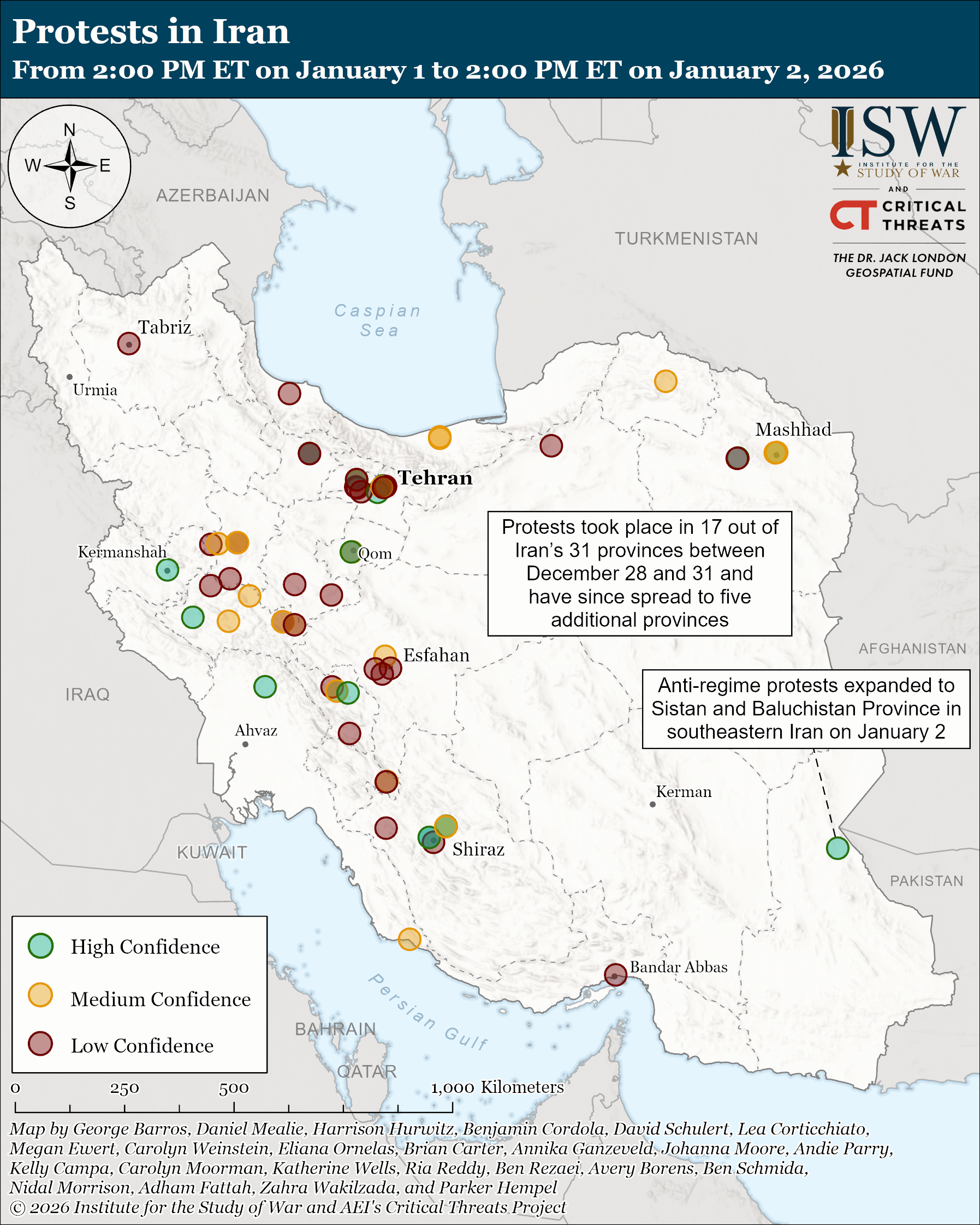
The newly established Mobarizoun Popular Front (MPF), which is a coalition of Baloch organizations, issued a statement on January 2 in which it declared support for the ongoing protests as a legitimate response to severe “livelihood pressures and structural discrimination.”[xxvii] The MPF stated that it will not directly intervene in the protests “so as not to provide an excuse for abuse, distortion of facts, and organized repression” by the regime.[xxviii] Sistan and Baluchistan Province has long posed an internal security challenge for the Iranian regime due to recurring anti-regime activity in the province. Jaish al Adl, which is part of the MPF, and other Baloch groups frequently conduct attacks targeting Iranian regime security forces and institutions in Sistan and Baluchistan Province.[xxix]
A senior Shia cleric acknowledged public grievances and the regime’s shortcomings and mismanagement on January 1. Prominent Shia cleric Grand Ayatollah Hossein Nouri Hamedani blamed government mismanagement for the current protests during a meeting with Islamic Republic of Iran Broadcasting (IRIB) head Peyman Jebelli on January 1.[xxx] Nouri Hamedani stated that Iranians are “fed up with high prices” and livelihood hardships and that the declining value of the national currency has left people “confused” and feeling economic pressure.[xxxi] Nouri Hamedani also stated that the “lack of leadership and proper management are the cause of these [economic] problems” and that the problems must be solved to satisfy the people.[xxxii] Nouri Hamedani previously called on Iranian officials during the Mahsa Amini movement in 2022 to listen to protesters’ demands and resolve their grievances.[xxxiii]
The Southern Transitional Council (STC) is taking initial steps toward declaring an independent “State of South Arabia” and seceding from the Republic of Yemen, which could risk increasing fighting between Emirati-backed and Saudi-backed Yemeni forces in and outside of Hadramawt Governorate and exacerbating tensions between Saudi Arabia and the United Arab Emirates (UAE). The STC is a UAE-backed political organization that controls some military forces in southern Yemen and has long had secessionist aims. STC President and Presidential Leadership Council (PLC) Vice President Aidarous al Zubaidi declared the beginning of a two-year transitional period for a future independent state on January 2.[xxxiv] The STC also released a constitutional declaration for the independent and sovereign “State of South Arabia,” the borders of which will correspond with those of the former People’s Democratic Republic of Yemen, which controlled southern Yemen prior to Yemen’s unification in 1990.[xxxv] The STC has indicated that it seeks to establish an independent state in southern Yemen since it launched an offensive in early December 2025 and seized key areas of Hadramawt and Mahra governorates.[xxxvi] The 30-article constitutional declaration outlines the structure of the “State of South Arabia” following the two-year transition period and will, according to Zubaidi, go into effect on January 2, 2028.[xxxvii] The declaration states that the STC will use the two-year transition period to hold a popular referendum and build state institutions, including a democratic political system with separation of powers and a free-market economy.[xxxviii] Zubaidi called for the Central Bank in Aden to organize a mechanism to collect revenue.[xxxix] The publication of a constitutional declaration and Zubaidi’s comments mark the most tangible steps that the STC has taken since its offensive toward the establishment of an independent southern Yemeni state.
Zubaidi said that the STC seeks to establish dialogue with “all concerned parties in the South and North,” presumably referring to the Republic of Yemen Government (ROYG).[xl] Saudi-backed PLC leaders and non-UAE-backed actors, including PLC President Rashid al Alimi, maintain that they are the rightful leaders of the ROYG and have continued to call for the withdrawal of STC forces from Mahra and Hadramawt governorates as the “only option for restoring normalcy” in the region.[xli] Zubaidi said that the STC’s declaration will achieve southern Yemen’s aspirations in a “gradual and safe manner” and provide the ROYG with a “stable and responsible” partner during the transition.[xlii] Zubaidi called on the international community to promote dialogue between the STC and ROYG.[xliii] Zubaidi also emphasized the STC’s commitment to participating in the anti-Houthi coalition during the transition.[xliv]
Saudi-backed Yemeni forces’ new operation to recapture areas of Hadramawt Governorate risks increasing fighting between UAE- and Saudi-backed Yemeni group amid the STC’s initial steps toward establishing an independent southern state. Alimi appointed Hadramawt Governor Salem al Khanbashi on January 2 to command the Saudi-backed National Shield Forces (NSF) in Hadramawt Governorate.[xlv] Khanbashi immediately announced a new military operation to retake military positions from the STC in Hadramawt Governorate.[xlvi] Khanbashi’s announcement follows reports that around 20,000 NSF fighters had gathered in al Wadiah and al Abr districts in Hadramawt Governorate near the Saudi-Yemeni border on December 17.[xlvii] The NSF seized the 37th Strategic Brigade military base in Khashaa, which is located along a key route that connects Wadi Hadramawt to other parts of southern Yemen. Pro-ROYG Hadrami tribal forces also seized the 1st Military Region Command Headquarters in Seiyun, according to Khanbashi.[xlviii] Local Yemeni media reported on January 2 that Saudi-backed forces advanced east toward al Qatn and Seiyun.[xlix] The Saudi Air Force struck at least seven STC positions in Hadramawt, including Khashaa and Seiyun.[l]
The STC is reportedly redeploying forces from its fronts with the Houthis in western Yemen to reinforce STC positions in Hadramawt Governorate in response to the NSF’s operation. Military sources told Yemeni media on January 1 that six brigades from the STC’s Southern Giant Forces redeployed from positions along the western frontlines with the Houthis to reinforce STC positions in Hadramawt Governorate.[li] The sources said that UAE-backed National Resistance Forces backfilled the Southern Giant Forces’s positions.[lii] The Southern Giant Forces, which is commanded by STC Vice President and PLC Vice President Abu Zaraa al Muharrami, is primarily based in southwestern Yemen and has played a significant role in fighting the Houthis in Shabwa and Marib governorates in central Yemen.[liii] The STC may not be able to continue to backfill positions along Houthi frontlines if the fighting between Saudi-backed forces and the STC increases in eastern Yemen and requires further STC reinforcements to protect the territory that would comprise the State of South Arabia. The Houthis could exploit the conflict between UAE- and Saudi-backed forces for their own territorial gains if the STC continues to redeploy forces from the front lines in western Yemen to Hadramawt and other eastern Yemeni Governorates.

Israel conducted at least 17 airstrikes targeting Hezbollah military infrastructure across Lebanon, including a training facility and weapons depots, on January 2.[liv] These strikes marked Israel’s most extensive wave of airstrikes in Lebanon in recent months. The Israel Defense Forces (IDF) reportedly struck Hezbollah targets in several areas of Jezzine, Nabatieh, Sidon, Bint Jbeil, and Western Bekaa districts in southwestern Lebanon.[lv] The IDF stated on January 2 that it struck a Hezbollah Radwan Force training compound and several other Hezbollah buildings that Hezbollah used to store combat equipment.[lvi] The Radwan Force is Hezbollah’s elite special operations unit that conducts cross-border infiltrations and attacks on Israeli positions.[lvii] The IDF has regularly conducted airstrikes targeting Hezbollah fighters, weapons, and infrastructure since the November 2024 Israel-Hezbollah ceasefire agreement in order to prevent Hezbollah’s reconstitution and remove any threat to northern Israeli towns.[lviii] Israel conducted at least 14 airstrikes targeting several Hezbollah sites across Lebanon, including a training facility and weapons depots, on December 18, for example.[lix]
The IDF is reportedly continuing to prepare to launch an operation against Hezbollah in Lebanon, according to Lebanese, Israeli, and Emirati media. Unspecified Western sources told Emirati media on January 1 that recent intelligence reports that circulated among Western diplomats showed that Israel is mobilizing special rapid intervention units along the Israel-Lebanon border in order to “preemptively intervene” in the event of any development on Israel’s northern front.[lx] Western sources told the Emirati outlet that the deployment indicates Israel’s readiness to conduct a “preemptive” operation in Lebanese territory.[lxi] The Israeli defense establishment is also reportedly working to raise the IDF’s readiness to launch an operation against Hezbollah in Lebanon “to the extent necessary.”[lxii] Lebanese and Israeli media reported on January 2 that the IDF is preparing options for action against Hezbollah and will present these options to Israeli Prime Minister Benjamin Netanyahu in “the near future.”[lxiii] Netanyahu will reportedly hold a security cabinet meeting to make “exceptional” decisions about Lebanon soon.[lxiv] CTP-ISW is unable to verify the Emirati media report that Israel has deployed units along the Israel-Lebanon border.
US President Donald Trump reportedly asked Netanyahu to not launch an operation against Hezbollah at this time in order to allow for dialogue with Lebanon during their December 29 meeting.[lxv] Netanyahu warned Trump about Hezbollah’s reconstitution during their meeting.[lxvi] US sources told Lebanese media on December 31 that Israel’s military plan to “deter” Hezbollah “exists and is ready.”[lxvii] Two unspecified sources familiar with the matter told Israeli media on January 2 that the Trump administration does not rule out the possibility of an Israeli operation in Lebanon.[lxviii] Israeli and Lebanese officials will reportedly hold their third direct talks on January 7, 2026.[lxix]
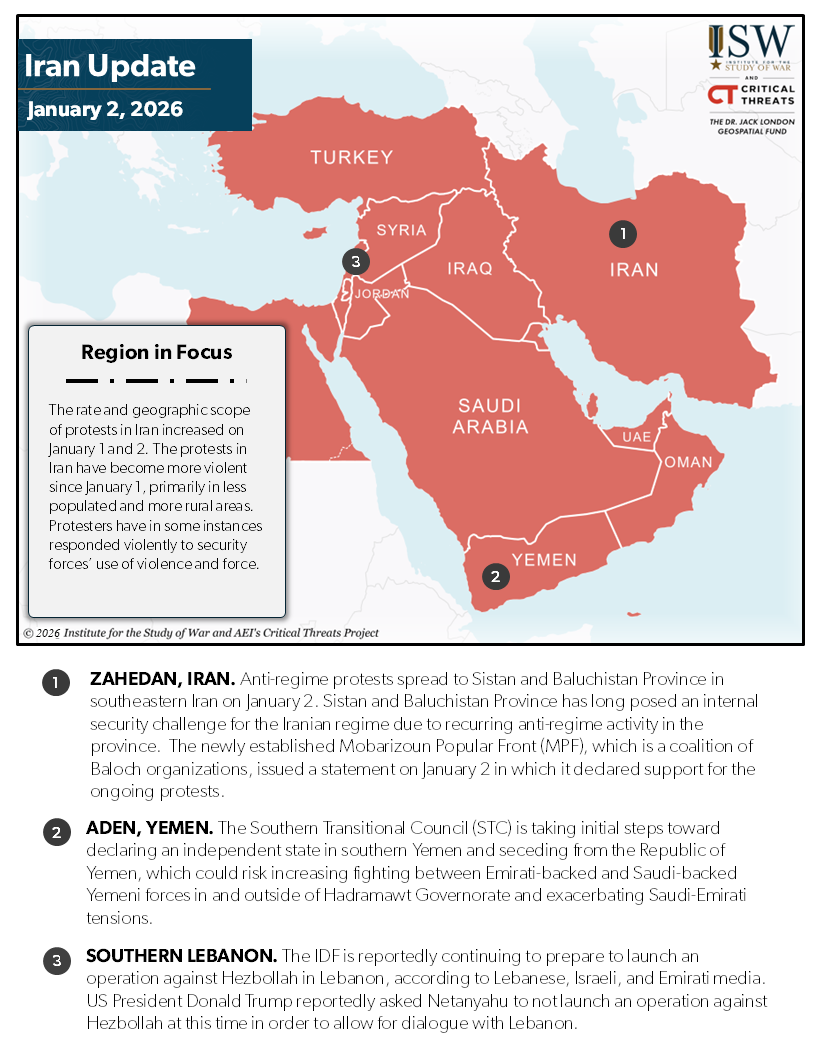
Key Takeaways
Iranian Protests: The rate and geographic scope of protests in Iran increased on January 1 and 2. The protests in Iran have become more violent since January 1, primarily in less populated and more rural areas. Protesters have in some instances responded violently to security forces’ use of violence and force.
Iranian Protests: Anti-regime protests spread to Sistan and Baluchistan Province in southeastern Iran on January 2. Sistan and Baluchistan Province has long posed an internal security challenge for the Iranian regime due to recurring anti-regime activity in the province. The newly established Mobarizoun Popular Front (MPF), which is a coalition of Baloch organizations, issued a statement on January 2 in which it declared support for the ongoing protests.
STC Efforts to Establish an Independent Southern Yemeni State: The Southern Transitional Council (STC) is taking initial steps toward declaring an independent state in southern Yemen and seceding from the Republic of Yemen, which could risk increasing fighting between Emirati-backed and Saudi-backed Yemeni forces in and outside of Hadramawt Governorate and exacerbating Saudi-Emirati tensions. STC President and Presidential Leadership Council (PLC) Vice President Aidarous al Zubaidi declared the beginning of a two-year transitional period for a future independent state and a new constitutional declaration for the “State of South Arabia.” Saudi-backed Yemeni forces’ new operation to recapture areas of Hadramawt Governorate risks increasing fighting between UAE- and Saudi-backed Yemeni groups.
Israeli Efforts to Prevent Hezbollah’s Reconstitution: The IDF is reportedly continuing to prepare to launch an operation against Hezbollah in Lebanon, according to Lebanese, Israeli, and Emirati media. US President Donald Trump reportedly asked Netanyahu to not launch an operation against Hezbollah at this time in order to allow for dialogue with Lebanon. Israel conducted its most extensive wave of airstrikes in Lebanon in recent months targeting Hezbollah infrastructure.
Iran
The Iranian regime has reportedly offered to sell advanced weaponry to foreign governments for cryptocurrency within the past year in an attempt to circumvent Western sanctions, according to a Financial Times investigation. The Financial Times reported on January 1 that Iran’s Defense Ministry Export Center offered to sell ballistic missiles, drones, and warships to foreign governments for cryptocurrency at an unspecified time in the past year.[lxx] The Defense Ministry Export Center advertises Emad ballistic missiles, Shahed drones, Shahid Soleimani-class warships, and short-range air defense systems. The Financial Times analyzed Defense Ministry promotional documents and payment terms and found that the ministry was willing to receive cryptocurrency payments in addition to rial payments and “barter arrangements.”[lxxi] It is unclear if Iran would be willing to sell ballistic missiles to foreign countries in the aftermath of the Israel-Iran War given the degradation of its ballistic missile program during the war and Iran’s recent prioritization of the reconstitution of its ballistic missile capabilities over other defense priorities.[lxxii] Iran fired Emad ballistic missiles at Israel during the Israel-Iran War.[lxxiii] The Financial Times report did not specify which countries Iran tried to sell weapons to. Iran’s Defense Ministry claims that it has 35 foreign countries as sales clients. Iran has sold weapons, such as Shahed and Mohajer-series drones, to key US adversaries like Russia and Venezuela, respectively, in the past.[lxxiv]
The Iranian regime continues to face internal security challenges in southeastern Iran. Islamic Revolutionary Guards Corps (IRGC) intelligence agents arrested several individuals in Saravan, Sistan and Baluchistan Province on December 31 whom the IRGC claimed are affiliated with “terrorist and hostile groups.”[lxxv] The IRGC arrested the individuals as part of a counterterrorism exercise in southeastern Iran.[lxxvi] The Iranian regime has been particularly concerned about internal security threats since the end of the Israel-Iran War, and these concerns have been heightened after the formation of the Mobarizoun Popular Front in early December 2025. The Mobarizoun Popular Front is a coalition of multiple anti-regime groups that includes Baloch Salafi-jihadi group Jaish al Adl.[lxxvii]
The Iranian regime likely views its illicit sanctions evasion networks with Russia and the People’s Republic of China (PRC) as crucial to keeping the Iranian economy afloat as it faces immense economic challenges. Iranian state media outlet Mehr News assessed on December 31 that the Iran-Russia-PRC sanctions evasion mechanism of using “shadow fleets” is an indication of an “emerging economic-political bloc” between Iran, Russia, and the PRC.[lxxviii] Mehr News argued that Russia, the PRC, and Iran have developed a “deep strategic synergy” in the use of shadow fleets to evade sanctions.[lxxix] Iran has historically relied on Russia and the PRC as key sanctions evasion partners. Iran heavily relies on the PRC to purchase sanctioned Iranian oil, for example.[lxxx] The PRC purchases Iranian oil and promotes the use of alternatives to the US dollar and SWIFT banking system, which increases the network’s resistance to US sanctions.[lxxxi] Mehr News’s reference to Iran’s deep economic partnerships with Russia and the PRC comes at a moment when Iran continues to face extremely challenging economic circumstances. Iranian oil revenue–its main source of government revenue–has dropped significantly, only meeting about 16 percent of the expected annual revenue in 2025, according to the Parliamentary Budget and Planning Commission Deputy Chairman.[lxxxii] This article also follows the US seizure of an oil tanker off the coast of Venezuela on December 10 that has illicitly transported Iranian oil.[lxxxiii]
Iraq
Nothing significant to report.
Syria
Syrian security forces prevented a likely Islamic State in Iraq and al Sham (ISIS)-affiliated or -inspired suicide vest (SVEST) attack that sought to target New Year’s celebrations and possibly a church in Aleppo City on December 31.[lxxxiv] Local Syrian sources reported that a Syrian General Security Service (GSS) foot patrol identified and attempted to arrest an unspecified attacker near Bab al Faraj Square, Aleppo City.[lxxxv] The attacker fired on the patrol and detonated his SVEST, which killed one GSS officer and wounded two other officers.[lxxxvi] Ministry of Interior (MoI) Spokesperson Noureddine al Baba told Syrian state media on December 31 that the attacker likely intended to target the nearby Armenian Church of Forty Martyrs.[lxxxvii] The MoI announced on January 1 that Syrian intelligence indicated that ISIS sought to attack churches and civilian gatherings during New Year’s celebrations, particularly in Aleppo City, and that the Syrian government deployed increased personnel to the area and near churches.[lxxxviii] Baba added that preliminary information indicated that the attacker may have adhered to ISIS ideology or belonged to an ISIS cell and that the MoI has launched an investigation to determine the attacker’s possible affiliation with ISIS.[lxxxix] ISIS has not claimed the thwarted attack at the time of this writing. The December 31 thwarted attack would be the latest Salafi-jihadi attempt to conduct attacks on Syrian minorities since the fall of the regime.[xc] Saraya Ansar al Sunnah, an ISIS-aligned Salafi-jihadi group primarily based in western Syria, previously conducted an improvised explosive device (IED) attack on an Alawite Mosque in Homs City on December 26.[xci] Saraya Ansar al Sunnah also claimed responsibility for a suicide bombing on a church in Rif Dimashq Province in June 2025.[xcii]

Jordanian airstrikes that targeted Captagon production sites, arms caches, and smuggler positions in Suwayda Province on December 24 and 25 indicate that drug traffickers continue to utilize Assad-era smuggling infrastructure in Suwayda along the Syria-Jordan border. Local Syrian sources reported that the Jordanian military struck at least eight Captagon production sites, arms caches, and smuggler positions across Suwayda Province on December 24 and 25.[xciii] Jordanstruck targets in al Shaab village, which Bedouin drug smugglers belonging to the al Rathman tribe reportedly controlled outside of the authority of the Syrian government and Suwayda National Guard.[xciv] Jordanian airstrikes previously killed an al Rathman tribe Captagon “kingpin” in Suwayda Province in 2023.[xcv] Syrian government Badia (Desert) Security Directorate forces took control of al Shaab on January 1 following the strikes.[xcvi] Local residents requested that government forces remove local drug smugglers and armed gangs who controlled the village.[xcvii]
The Jordanian military also struck seven sites under the Suwayda National Guard’s control.[xcviii] One of the Jordanian strikes targeted a reported arms depot in al Kafr, Suwayda Province, that reportedly belonged to the Suwayda Military Council (SMC).[xcix] The SMC was a Druze militia that is now part of the National Guard.[c] The Suwayda National Guard is a coalition of over 40 Druze militias that support the Supreme Legal Committee, an autonomous government formed in early August 2025 to oppose the Syrian government’s rule over Suwayda Province.[ci] The Suwayda National Guard denied that Jordanian airstrikes hit its facilities and accused Bedouins in al Shaab village of conducting cross-border Captagon smuggling.[cii] The Jordanian Army has thwarted at least 12 cross-border Captagon smuggling attempts, likely from Suwayda Province, since August 2025.[ciii]

The Jordanian airstrikes and cross-border drug seizures follow previous analysis and claims that Assad-era smuggling infrastructure in Suwayda continues to exist. An unspecified former Israeli official and a Druze commander in Syria accused Druze Sheikh Hikmat al Hijri and his sons of involvement in drug dealing and kidnapping in Suwayda Province in December 2025.[civ] A Captagon expert also reported in October 2025 that the ousted Assad regime pitted Druze and Bedouin actors against one another in competition for the Captagon trade in Suwayda Province.[cv] These actors include militias loyal to Hikmat al Hijri, such as the Men of Dignity militia and SMC, both of which are now part of the National Guard.[cvi] The expert also implicated Bedouin tribal units, including the al Balaas group, and prominent Suwaydawi families, such as the Mazhar and al Ramthan families, in conducting Captagon smuggling.[cvii]
Arabian Peninsula
See topline section.
Palestinian Territories and Lebanon
See topline section.

View Citations