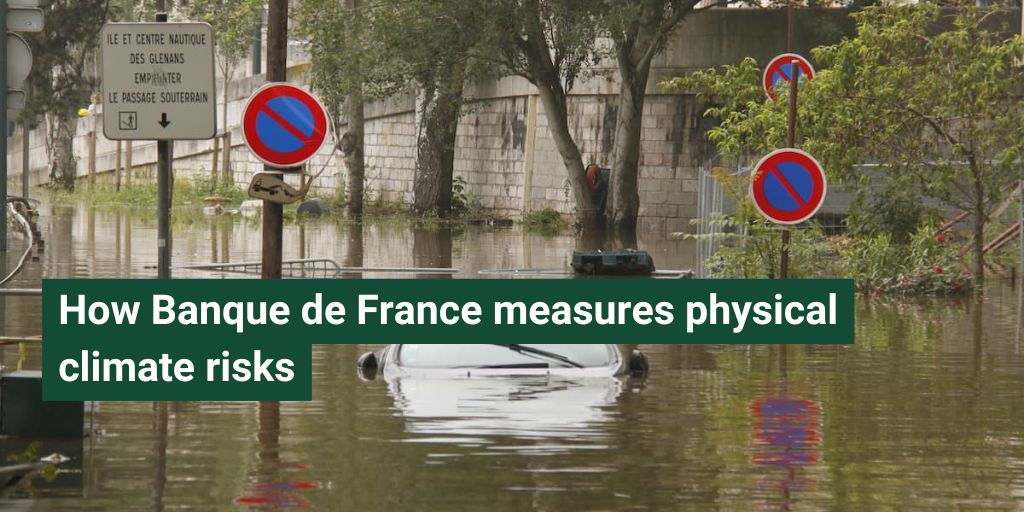
As the financial risks from climate change become clearer, Banque de France (BdF) is developing a toolkit to understand and quantify potential physical risks.
“Awareness of the damages associated with climate change is becoming increasingly entrenched not only among insurers, but also among business leaders and local government officials,” Agnès Bénassy-Quéré, second deputy governor of BdF, wrote in a blog post.
France is prone to flooding and droughts. Météo-France, the official French meteorological administration, estimates that heatwaves will increase in frequency and intensity in the coming decades, with temperatures exceeding 40°C by 2100 and rainfall intensity increasing by 15%.
Climate change is not only changing weather patterns, but is also “having a chronic negative effect on our economies and is becoming increasingly pronounced”, wrote Bénassy-Quéré.
Crop yields in Europe, for example, have stagnated, which can be partly attributed to global warming, according to one study. Businesses have been impacted by increased insurance costs from weather events, while one study shows that climate change could increase the cost of food globally.
BdF response to increased climate risks
The increased physical risks from climate change are one reason why the BdF is developing various macroeconomic methodologies and risk mapping to try and pinpoint the areas of the French economy that are the most vulnerable.
There has been a lot of research by central banks on transition risks in recent years because the modelling is generally easier, but the methodology behind physical risks tends to be more complex.
“The methodological challenge is significant, and so is the data challenge. We have to address them in parallel,” Léopold Gosset, sustainable finance specialist at the BdF’s climate and nature centre, told Green Central Banking.
In a blog post written by Gosset and his colleagues at BdF, the team highlighted the various approaches to quantifying physical risks, as well as the challenges. For example, the European Central Bank’s Eurosystem indicators assume that if 30% of a building is destroyed by a flood then the credit risk exposure would fall by 30%, which is a very necessarilysimplified approach, said Gosset.
“There is no one-size-fits-all solution for physical risk analysis, because things are way too complex, and every single approach [in] isolation is bound to miss some angles of risk. So that’s why, when you are especially interested in really understanding the transmission channels, you have to model them very specifically,” he said.
At the moment, the most advanced modelling is for floods. BdF has worked with De Nederlandsche Bank and the Hong Kong Monetary Authority on a digital twin project that quantifies the impact of flooding on firms and bank loans. Using detailed information on flood risks, buildings, and loans, the central banks can assess the exposure banks have to physical climate risks through physical assets.
BdF also models for windstorms, heatwaves and perils, as well as events that are unpredictable and harder to understand and estimate, such as wildfires. The central bank also works with the Network for Greening the Financial System (NGFS) – whose secretariat is hosted by BdF – on macroeconomic approaches and climate scenarios.
And while BdF has done a lot of research to understand these physical risks, it’s still continuing to build its methodologies.
“We’re still at the phase of building the methodological toolbox. To that end, international coordination is key, as illustrated by NGFS work or international digital twin projects. The idea is to make methodologies and tools as robust as possible to then, in the future, be able to base decisions on them,” said Gosset.
Still, he says these tools can already be useful in monitoring risk to financial stability, as it gives an idea of the scale of the impact. In stress testing, for example, not only are supervisors doing the work to anticipate risks, but the tests also require banks and insurance firms to also develop their own methodologies.
“Once you have quantified the order of magnitude of the risks, and you have built up the methodologies so nobody can have the excuse that methodologies do not exist, then … it makes it possible to really take the matter seriously, because it’s shown as a material risk that [banks] have there”.
Hiding behind data and measurements
BdF has always been at the forefront of identifying climate risks. France has received the best Green Central Banking Scorecard rating several times in a row thanks to the work of the central bank.
But now that BdF has a lot of data, the question becomes: what to do with it?
Just thinking about exposures and not transition risks at the same time could just exacerbate the problems, as it could lead to banks lending less in areas prone to disasters, said Clarisse Murphy, central banks expert at Reclaim Finance.
“If we don’t actually think about who is responsible for this problem, then we are just going to increase the physical risk of the entire system, and miss the entire point,” she said.
While it’s great that central banks have this data, they shouldn’t get stuck on getting all the data right while not acting on it or just warning market players, Murphy added.
“The market has been very bad at tackling climate change. We should stop waiting [for the market to solve it] and instead have central banks and some of us actually step up to this challenge, and play their role as guarantors of the stability of the system and the financial system, because this is actually their job,” she said.
Romain Svartzman, research fellow at Bocconi University’s Institute for European Policymaking and former BdF senior economist, says that central banks as a whole have been perhaps “hiding a little bit behind ‘let me measure, let me measure’”.
At the same time, while there is a push for central banks to be greener, they can very quickly reach the limits of their available tools.
Central banks themselves won’t be able to solve climate change and coordination is needed with fiscal policy makers, governments and the private sector, a point that Svartzman explored with his former BdF colleagues in The Green Swan several years ago.
“I think that unfortunately, six years later, it seems to confirm a little bit this risk that we’re seeing … of hiding a little bit behind these measurements so that you don’t have to ask an uncomfortable question about ‘how do I coordinate with [other] institutions?’, when you see yourself as an independent institution.”
Macroeconomic impacts
Some of the ways BdF assesses physical risk is very granular and can jump to the impact on financial firms directly rather than considering the broader economic risks, said Pierre Monnin, senior fellow at the Council on Economic Policies.
“What is important, if you want to have a good view of the risks, is to also look at the economic risk. For example, what would the loss of GDP in this region be? How much will wages and unemployment be affected? And then look at how this large economic picture is going to affect the financial sector?”
Banks are also only one part of the financial sector. Losses from catastrophic events like flooding won’t just impact banks, but also insurance firms, as well as public finance consequences. It could also have an impact on supply chains and have a cost to other regions, Monnin added.
One thing Monnin would like to see is for central banks like BdF to use the research on climate risks to encourage banks to help with the transition to a green economy.
“If we have a transition, then we will have a lot less physical risks for banks. So it is in the interest of financial supervisors to move towards the transition, because in this scenario we will have much less losses for the banking sector and thus stronger financial stability,” he said.
One macroprudential tool available to address these risks is to lower capital buffers for banks that invest in the transition, Monnin said.
“Supervisors, especially in Europe, have already asked each bank to do a better job. The next step for them is to implement macroprudential capital buffers to increase loss absorption capacities of the banking sector and to integrate capital incentives to work for the transition in these buffers,” he said.
Updated on 10 December, 2025 to add clarification on the ECB’s eurosystem indicators and to add the Hong Kong Monetary Authority as being part of the Digital Twins project.
This page was last updated December 10, 2025